If you go to any market in Northern Nigeria today, you will notice something strange. You will not see long lines at the Pharmacy. Instead, you will see crowds gathering around a man with a big loudspeaker, selling bottles of brown, dirty water.
He screams: “Maganin Musulunci! (Islamic Medicine). This cures Typhoid, Malaria, and Spiritual Attack!”
In my community, these herbal sellers are now more powerful than doctors. And the sad truth is: My people trust the man with the loudspeaker more than the doctor in the hospital.
The “Sunnah” Trap
These sellers are very smart. They know our people love religion. So, they don’t talk about science or dosage. They just label the mixture as “Sunnah Medicine” or “Prophetic Medicine.”
Once they add the name of religion, people stop asking questions. To a villager, going to a Chemist to buy Panadol feels like a “Western” thing. But buying a bottle of Maganin Gargajiya from a man reciting verses feels like an act of worship (Ibada).
They tell the sick people: “The white man’s medicine has chemicals. But this? This is natural. It is what our grandfathers used.
From Fasting to Kidney Failure
But they don’t tell you that “Natural” does not mean “Safe.” Snake poison is natural too.
Right now, our hospitals are full of young people with Kidney Failure. Why? Because during Ramadan, after a long day of fasting without water, the first thing many people will drink is this harsh herbal mixture to get “strength.” It hits the kidneys hard.
A doctor will tell you: Take 500mg every 8 hours.
The herbal seller says: “Sha kofi daya da safe, daya da dare” (Drink a full cup morning and night).
No measurement. No science. Just poison sold with a prayer.
My Personal Struggle with “Kaka”
I am not writing this from a distance. I face this in my own house every day.
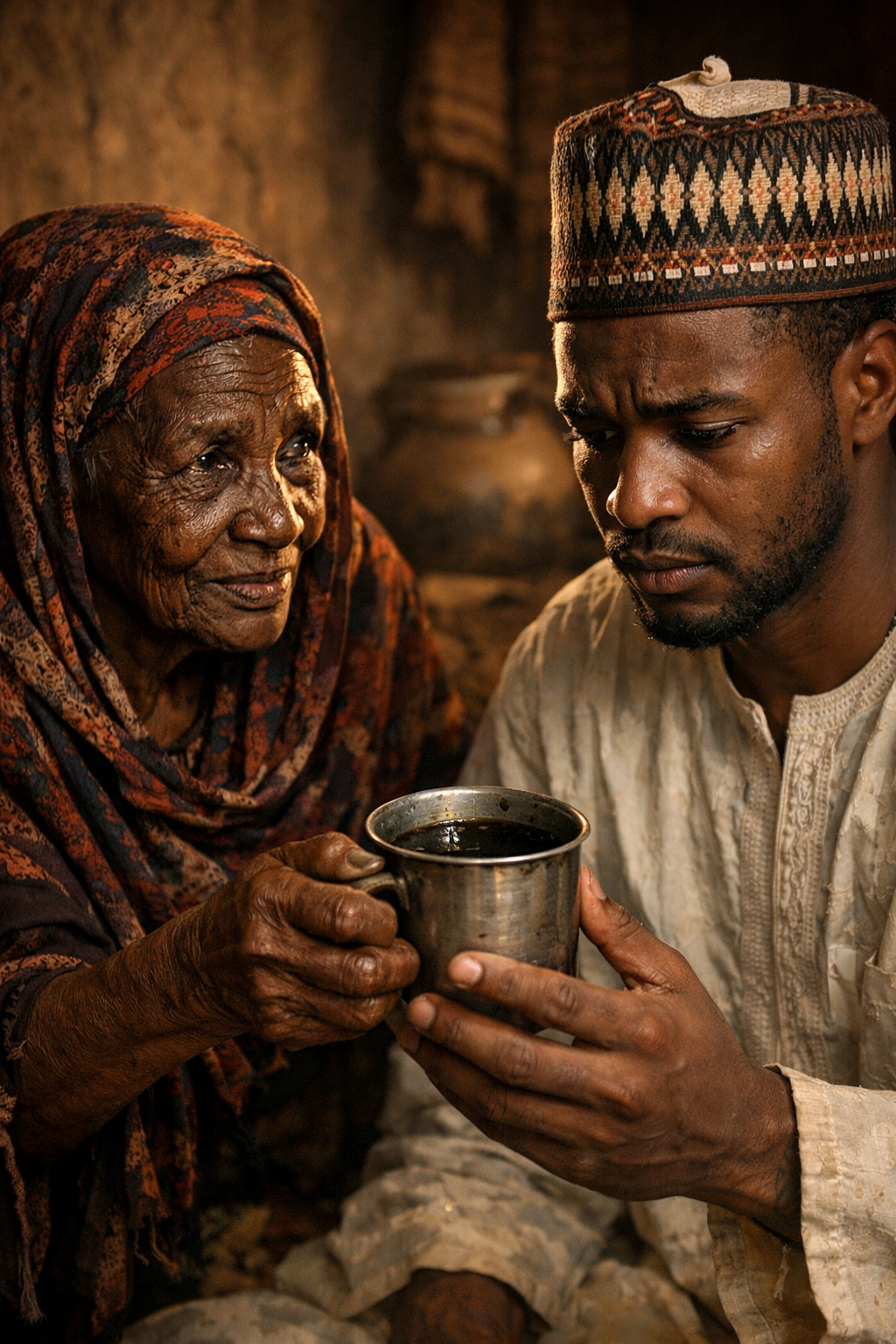
I live with my grandmother, Kaka. She is a wonderful woman, but she believes in the old ways. Whenever I fall ill—even if it is just a small fever (zazzabi)—she does not send me to the pharmacy. She believes the hospital is a waste of money.
Instead, she goes to the backyard, boils some bitter roots and barks, and brings me a cup of dark, smelling liquid.
“Sha wannan, Irfan,” she says, looking at me with love. “It will wash away the sickness better than those white pills.
It is very hard to say no to her. If I refuse, she feels I am rejecting our culture or I am being stubborn. She doesn’t understand that I am trying to protect my liver and kidneys.
So, just to make peace in the house, sometimes I collect the cup, pretend to drink it, and then pour it away when she is not looking.
Using My Own Money for Real Medicine
Once she is not watching, I quietly go out to the Chemist. I use the money I have saved (from my monthly stipend) to buy proper anti-malaria drugs or antibiotics.
Yes, real medicine costs money. But I cannot play gambling with my health. I know that the kidney does not respect sentiments; it only respects chemistry.
Conclusion: Let Science Lead
We need to separate Faith from Pharmacy.
It is not a sin to take medical drugs. It is not “haram” to trust modern science. If we want to survive, we must stop drinking unverified mixtures just because they are sold with a sermon.
Your kidney does not care if the medicine is labeled “Islamic” or “Western.” It only cares if it is toxic.
Let us choose science. Let us choose life.
Key Statistics & Context:
The Rising Kidney Crisis: Medical researchers at Teaching Hospitals across Northern Nigeria (such as AKTH and ABUTH) have reported a significant surge in Chronic Kidney Disease (CKD) among young adults. A major contributing factor cited is the consumption of nephrotoxic herbal concoctions often sold as “cure-all” remedies.
Regulatory Warnings: NAFDAC (Nigeria’s food and drug administration) has repeatedly warned the public against purchasing unregistered herbal mixtures from open markets, citing high levels of toxicity and lack of clinical trials.
The Scale of the Problem: In many rural communities, traditional medicine remains the primary source of healthcare for over 70% of the population due to accessibility and cultural beliefs, making scientific literacy a matter of life and death.