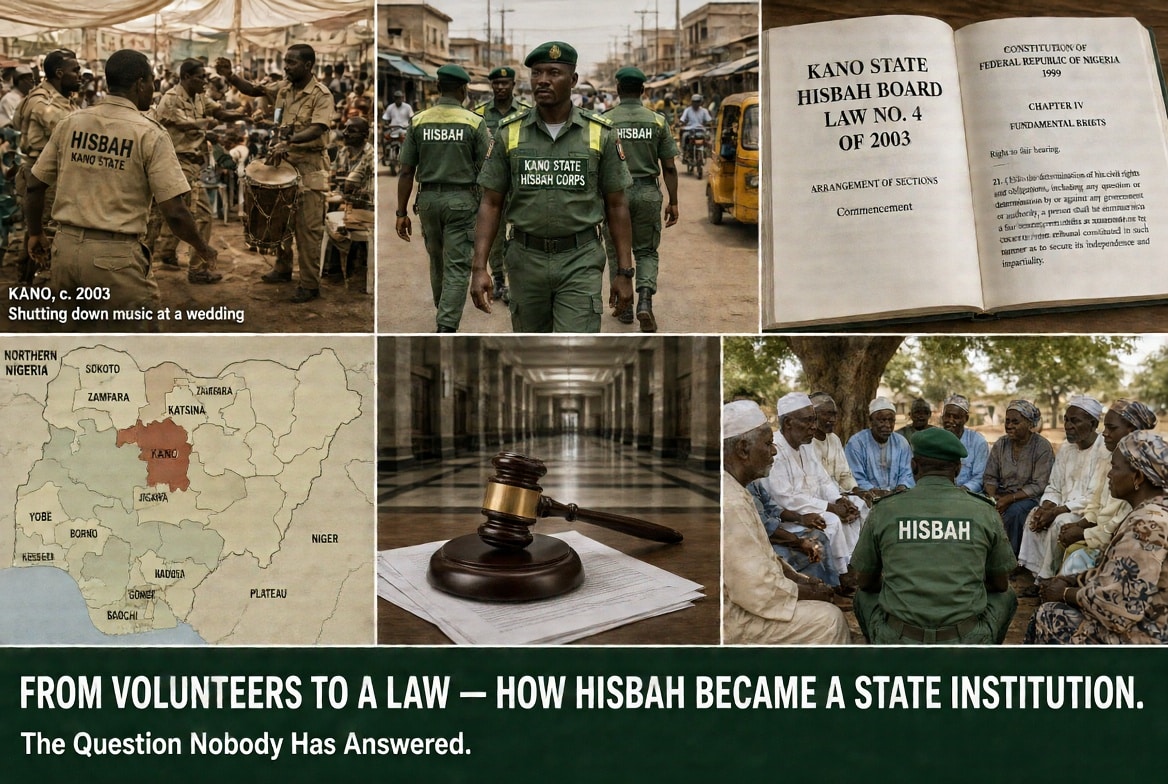
On 30 May 2003, approximately twenty Hisbah personnel entered a private wedding reception in Kano.
Declaring the event an “immoral gathering” due to musical entertainment, they summarily shut down the celebration. Human Rights Watch documented the incident in its 2004 investigation into northern Nigeria’s legal reforms. At that time, Kano’s statutory Hisbah framework had operated for only a few months. It possessed no settled constitutional footing, yet commanded sufficient authority and personnel to enforce public morality mandates across the state.
Today, the Kano State Hisbah Corps is one of the largest state-funded religious enforcement apparatuses in Nigeria. Yet whether its operational powers conform to the 1999 Constitution remains an unresolved constitutional question.
An old idea with a new job
Hisbah is not a modern Nigerian concept.
In classical Islamic administrative history, it designates the communal obligation to promote civic rectitude and prevent wrongdoing (al-amr bi’l-ma’ruf wa’n-nahy ‘an al-munkar). Historically, the municipal office was personified by the muhtasib, a civic market inspector tasked with overseeing weights and measures, municipal hygiene, commercial fair dealing, and public order disputes. The classical muhtasib functioned as a municipal market regulator rather than an armed constabulary.
Between 1999 and 2000, twelve northern states declarations of comprehensive Sharia implementation adapted this historical model to resolve an immediate administrative problem: how to enforce newly codified moral infractions.
Before the law, there were volunteers
The modern Hisbah began as an informal, community-driven vigilante initiative.
Following Kano’s adoption of Sharia criminal legislation in 2000, civil Islamic organisations organised volunteer monitoring units governed by private boards of trustees. These early corps responded to popular local demands for social order and anti-vice regulation.
However, civil liberties observers quickly identified acute structural deficiencies. As Human Rights Watch documented, the overwhelming majority of early volunteers had received no formal training in criminal procedure, legal thresholds for arrest, custodial protocols, or the handling of evidence. Consequently, private actors exercised coercive power across urban neighbourhoods with zero statutory restraint or institutional accountability.
November 2003: volunteers get a law
To institutionalise these informal brigades, the Kano State House of Assembly enacted the Kano State Hisbah Board Law No. 4 of 2003, later amended in 2005.
The legislature passed the statute exercising its residual authority under Section 4(7) of the 1999 Constitution, which empowers state assemblies to legislate for the peace, order, and good government of the state. Section 7 of the 2003 Law established a statutory Hisbah Board with broad civil mandates: dispute conciliation, moral counselling, municipal hygiene, and disaster assistance.
Crucially, Section 7(4) outlined its security function: “rendering necessary assistance to the police and other security agencies, especially in the areas of prevention, detection and reporting of offences.”
The statutory text created an auxiliary, reporting agency. It did not create an autonomous police force.
The gap between statutory text and operational power
Under both statutory drafting and general criminal law, Hisbah personnel do not possess independent constabulary arresting powers.
In formal criminal procedure, their apprehension of suspects operates under the doctrine of citizen’s arrest, codified under state criminal procedure legislation. When Hisbah personnel apprehended Sufi musician Yahaya Sharif-Aminu before transferring him to formal police custody, they exercised this common-law mechanism rather than regular police authority.
The critical constitutional friction arises when operational practice exceeds statutory limits. Civil rights groups have repeatedly documented Hisbah personnel maintaining their own detention facilities, conducting interrogations, carrying out corporal punishments, and enforcing municipal bans against non-Muslim residents and businesses. By maintaining custodial holding cells without immediate judicial arraignment or police transfer, Hisbah operations directly challenge the liberty guarantees of Section 35 of the Constitution.
Structural fragmentation across northern states
“Hisbah” does not denote a single, monolithic institution across Northern Nigeria.
Its statutory backing varies substantially across jurisdictions. Kano and Zamfara established civil-service bodies through legislative acts, funding thousands of salaried personnel from state revenues. Conversely, in states such as Gombe, local hisbah entities functioned without statutory backing or formal state subventions, operating as self-funded volunteer committees.
Consequently, identical titles describe fundamentally different legal entities across state lines: an official administrative body in one state, and a private vigilante committee in another.
Federal friction and the 2006 showdown
This institutional expansion provoked direct opposition from federal law enforcement.
The tension peaked in February 2006, when Inspector-General of Police Sunday Ehindero, backed by the federal presidency under Olusegun Obasanjo, publicly declared the Hisbah Corps an unlawful, parallel police force violating Section 214 of the Constitution. Federal police subsequently arrested senior Kano Hisbah leadership—including General Commander Sheikh Ibrahim Khaleel—on allegations of treasonable felony over reports of unauthorised paramilitary training.
The Kano State Government resisted federal suppression by instituting direct legal proceedings in Attorney-General of Kano State v. Attorney-General of the Federation (2007). Kano asked the Supreme Court to invoke its original jurisdiction and declare the Hisbah Board Law and its 2005 amendment constitutionally valid enactments.
On 2 March 2007, the Supreme Court unanimously struck out the suit. Delivering the lead judgment, Justice Sunday Akintan held that the apex court lacked original jurisdiction under Section 232(1) of the 1999 Constitution because the statement of claim disclosed no justiciable dispute between the Kano State Government and the Federal Government as an entity. The Inspector-General’s public threats, the court held, constituted administrative police conduct rather than an official act of the Federal Executive Council.
The Supreme Court did not validate the constitutionality of the Hisbah Corps, nor did it declare the state statute void. It simply held that the dispute had been filed in the wrong forum, leaving the substantive constitutional questions untouched.
The constitutional fault lines
Hisbah’s operational footprint intersects directly with four foundational constitutional provisions:
First, Section 214(1) establishes a strict federal monopoly over policing: “There shall be a Police Force for Nigeria, which shall be styled the Nigeria Police Force, and subject to the provisions of this section no other police force shall be established for the Federation or any part thereof.” Critics contend that providing uniform insignia, mobile patrols, and coercive enforcement duties amounts to establishing an unconstitutional parallel police force.
Second, field operations routinely test fundamental rights protected under Chapter IV:
Section 35 (Right to Personal Liberty): The unlawful prolonged detention of citizens in Hisbah holding centres without immediate arraignment before a court of competent jurisdiction.
Section 37 (Right to Private and Family Life): Warrantless searches, hotel raids, and intrusions into private domestic premises to monitor personal conduct.
Section 40 (Right to Peaceful Assembly): The forcible dispersal of secular social gatherings, youth events, and musical performances.
An open question
The evolution of the Hisbah Corps reflects an ongoing institutional improvisation.
What started as an informal volunteer brigade was retrofitted with state legislation in select jurisdictions, challenged by federal security agencies, and left unresolved by the Supreme Court in 2007.
Two decades later, the operational paradox persists. In a constitutional democracy governed by the rule of law, no regulatory institution can operate indefinitely in legal ambiguity. Any public enforcement agency must be able to justify its authority, its operational boundaries, and its accountability under the supreme law of the land.
Until Nigeria’s superior courts examine the merits of that statutory power directly, the boundary between community assistance and unlawful state policing remains dangerously undefined.