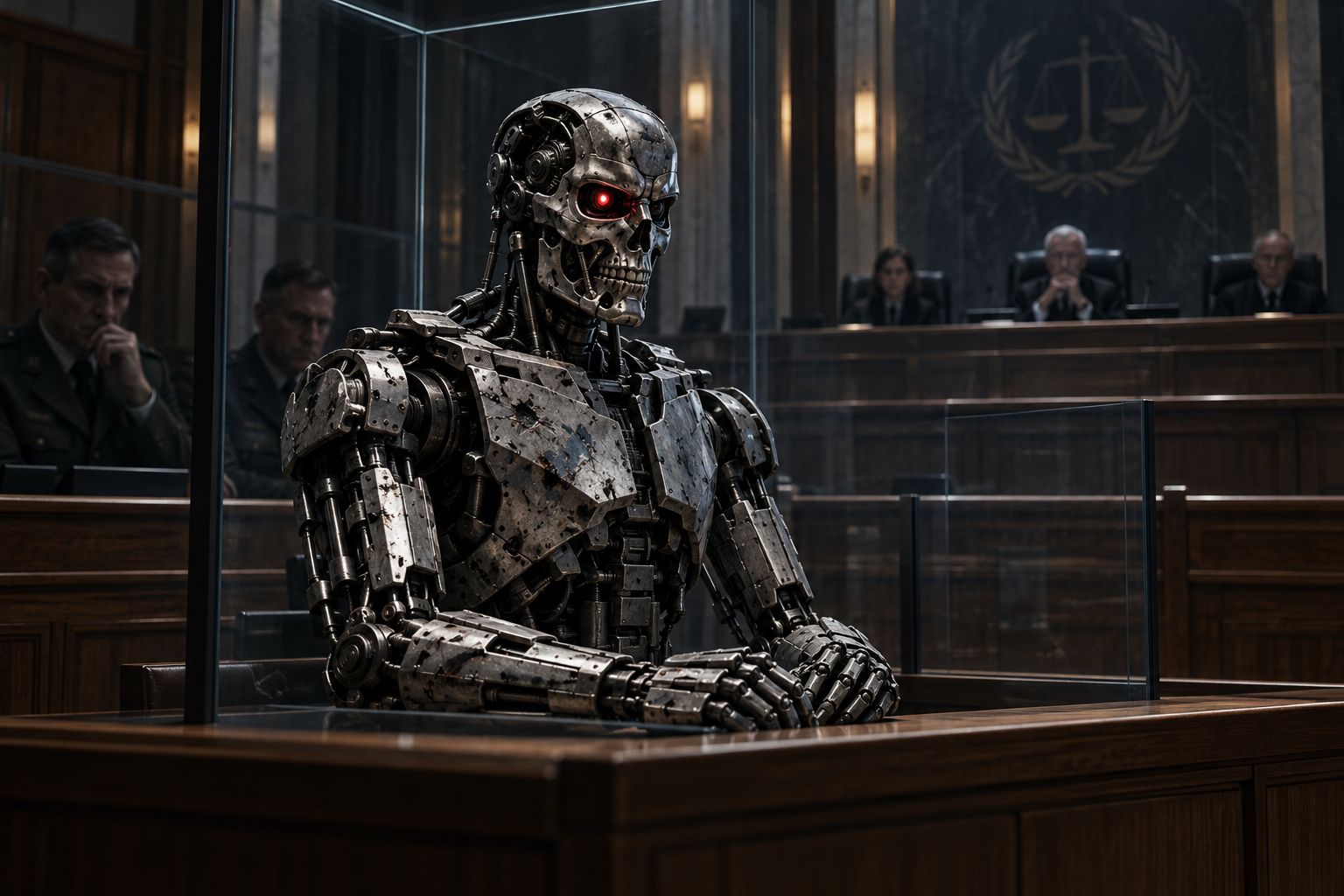
A soldier who deliberately kills civilians can face prosecution. A commander who orders an unlawful attack can also bear criminal responsibility. But what happens when a weapon selects its own target and fires before anyone approves that particular strike? The victims are just as dead, while the path to accountability may become much harder to establish.
On October 26, Peace Brigades International–Canada warned that autonomous weapons could endanger human rights defenders and weaken accountability for war crimes. Its warning highlights a disturbing possibility: governments could acquire greater power to kill while making it harder for victims to identify who should answer for unlawful attacks.
The machine does not need to look like a soldier
The phrase “killer robot” suggests a humanoid machine carrying a rifle. In practice, an autonomous weapon might be a drone, a defensive system, or a munition. The defining feature is its ability, once activated, to select and attack targets without further human intervention.
That distinction matters. A remotely piloted drone whose operator chooses the target and fires is not automatically an autonomous weapon. Nor is every military system that uses artificial intelligence. Software that recommends targets raises serious questions, but it differs from a weapon that selects and attacks them itself.
The danger therefore cannot be judged by appearance. A small device may raise profound questions about human control, while a sophisticated aircraft may still require a person to authorize each attack. The crucial issue is who makes the decision to use lethal force.
Responsibility can disappear between departments
Imagine an autonomous weapon attacks a civilian vehicle after incorrectly classifying it as a military target. The commander says the system passed its tests. The operator says they followed instructions. The manufacturer says the military used it outside its intended conditions. The software developer points to unreliable sensor data.
This is a hypothetical scenario, but it illustrates the problem. Each participant may have made a consequential decision, yet reconstructing the chain could require access to military orders, technical documentation, testing records, and software logs. Victims should not have to solve a dispute between institutions before anyone acknowledges their suffering.
Criminal prosecution presents an additional challenge. An unlawful outcome does not automatically prove that a particular person committed a war crime. Prosecutors must establish the relevant conduct and mental element, such as intent or knowledge, under the applicable law. Increasing automation can make those questions harder to answer, even when the harm itself is undeniable.
Delegating force does not erase human obligations
Autonomous weapons do not operate outside international humanitarian law. Humans remain responsible for assessing the lawfulness of attacks they plan, decide upon, or execute. The International Committee of the Red Cross stresses that those judgments cannot simply be transferred to a machine.
However, making a lawful assessment becomes difficult when users cannot reliably anticipate what the weapon will attack. A system suitable for intercepting incoming missiles in a controlled environment presents different risks from one searching for targets in a crowded neighborhood. Expanding its operating area, duration, or target categories can fundamentally change the danger.
“The machine decided” should therefore trigger further investigation. Who authorized that degree of autonomy? What limitations did they impose? Which failures did testing reveal? Who chose to deploy the weapon despite those findings? Responsibility must follow the decisions that made the attack possible.
Human approval must mean more than clicking a button
Keeping a person involved offers little reassurance if that person lacks the information or time to challenge the system. An operator who receives a recommendation and must approve it within seconds may provide formal authorization without meaningful scrutiny. A human signature can become a convenient way to assign blame after the institution has made independent judgment practically impossible.
Effective oversight should require understandable information, realistic decision times, and the authority to stop an attack. It should also require records that investigators can examine afterward. Governments should establish those safeguards before deployment, rather than promise to reconstruct events after civilians die.
Claims that automation will reduce mistakes deserve rigorous testing. Human soldiers can act out of panic, prejudice, revenge, or cruelty. Yet acknowledging those failures does not establish that a particular machine will perform better, especially in circumstances its designers did not anticipate.
Rules must arrive before the excuses
The ICRC calls for binding international rules prohibiting unpredictable autonomous weapons and systems designed or used to target people directly. It also advocates restrictions on other autonomous weapons. Its position recognizes that different systems present different risks while rejecting unlimited delegation of lethal force.
Accountability should be part of a weapon’s design and deployment requirements. Authorities should identify responsible decision-makers, preserve evidence, investigate unlawful harm, and provide victims with effective avenues for redress. Commercial secrecy and military complexity must not become automatic barriers to scrutiny.
A robot cannot take the place of a defendant, and scrapping a defective machine cannot deliver justice to a bereaved family. The people and institutions that develop, authorize, and deploy weapons must remain answerable for their own conduct. Greater technological power should bring greater scrutiny, not an easier way to escape it.