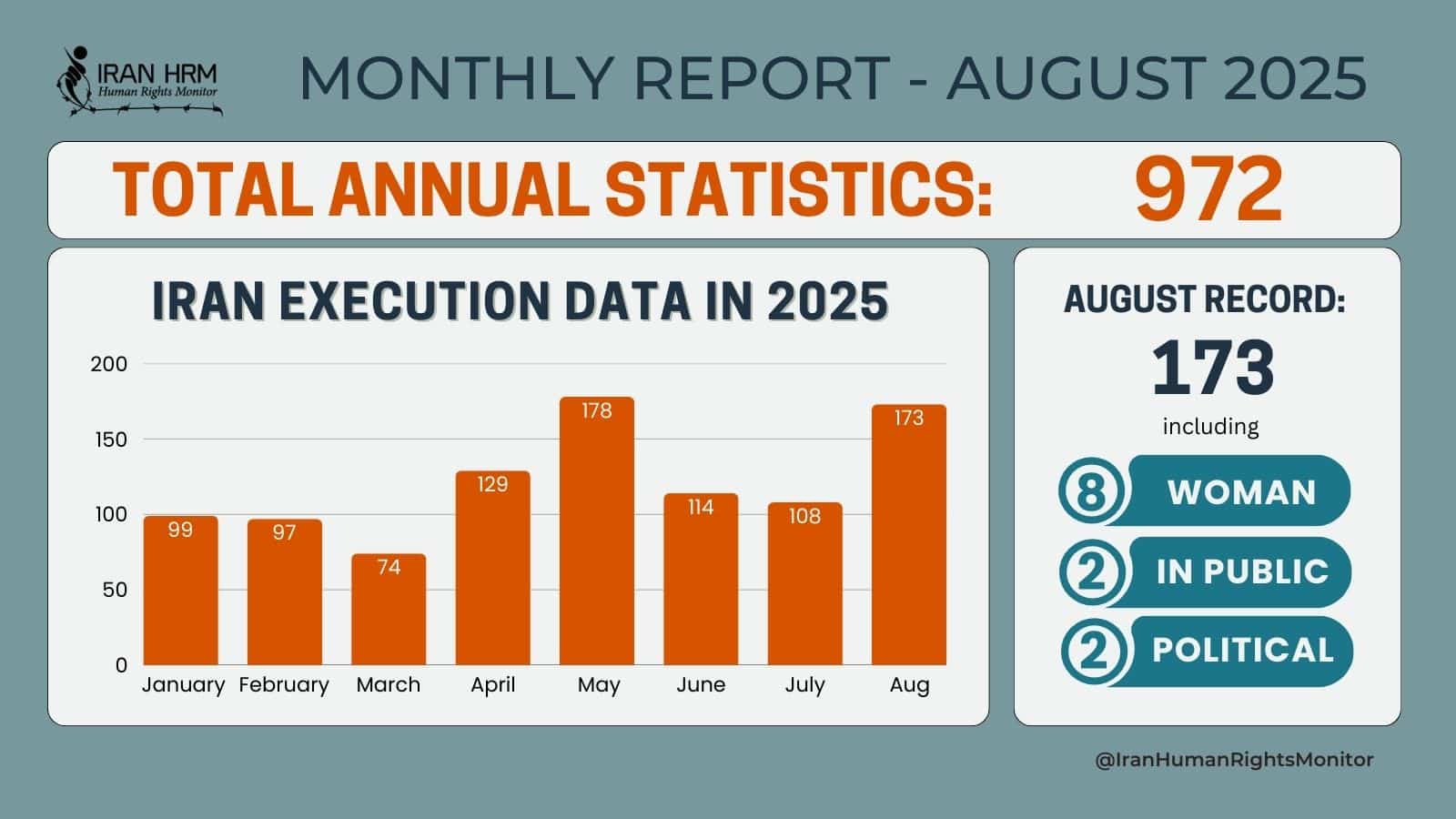
August 2025 marked one of the bloodiest months in Iran’s recent history, with the regime carrying out 173 executions in just 31 days, including eight women and two public hangings. Since President Masoud Pezeshkian assumed office in July 2024, over 1,670 individuals have been executed, underscoring the regime’s increasing reliance on fear and violence to maintain power.
A Machinery of Death
The regime’s pace of executions reached an unprecedented level in August, averaging five executions daily—one every five hours. At least 29 individuals were hanged in the first week alone, with mass hangings taking place in prisons across Shiraz, Mashhad, Isfahan, Tabriz, and Qezel Hesar.
Among the victims were Nahid Jokar, Mahtab Bayati, Soudabeh Ghasemzadeh, Maliheh Haghi, Mahsa Akbari, Mitra Yasini, and Banoo Moghaddam. One woman’s identity remains unknown, her life erased without acknowledgment.
The regime staged public hangings in Kordkuy and Larestan, using capital punishment as a tool for political messaging and intimidation.
Targeting Dissidents and Families
Beyond executions, August saw intensified repression of dissidents, particularly supporters and relatives of the People’s Mojahedin Organization of Iran (PMOI/MEK).
- Mohammad Banazadeh Amirkhizi (79), a former political prisoner battling cancer, was thrown into solitary confinement.
- Fatemeh (Houri) Ziaei Azad (68), who suffers from advanced multiple sclerosis and has spent 13 years in prison, was arrested for the seventh time.
- Others detained include dismissed academics, witnesses to the 1988 massacre, and young relatives of political prisoners.
The strategy of suppressions aims to break the spirit of resistance by punishing not only activists but their families.
Political Prisoners at Risk
Several political prisoners now face imminent execution.
- Five men—Vahid Bani-Amerian, Pouya Ghobadi, Shahrokh Daneshvarkar, Mohammad Taghavi, and Babak Alipour—were transferred to an undisclosed location in early August. Their families have had no contact since, a chilling sign that their executions may be imminent.
- Sharifeh Mohammadi, a Kurdish activist, had her death sentence upheld by the Supreme Court.
- Ali Younesi (25) and Amirhossein Moradi (26), both top students from Sharif University, saw their sentences extended under fabricated charges.
Erasing the Evidence of Past Crimes
Iranian authorities began destroying Section 41 of Behesht Zahra Cemetery, where thousands of political prisoners executed in the 1980s lie buried. Bulldozers leveled the site under the pretext of creating a parking lot. Tehran’s deputy mayor admitted the decision had been approved by high-ranking officials.
This act is part of a long-standing campaign to erase the evidence of the 1988 massacre, described by UN experts as “crimes against humanity and genocide.” Similar grave desecrations have been reported in Tabriz, Mashhad, Ahvaz, and Khavaran in recent years. By erasing these sites, the regime attempts to rewrite history and deny future generations the truth about its crimes.
International Outcry
The international community has condemned Iran’s actions:
- United Nations: On August 29, 2025, UN Human Rights Chief Volker Turk demanded that Iran immediately cease all executions and impose a moratorium on the death penalty. He stated that “the high number of executions indicates a systematic pattern of using the death penalty as a tool of State intimidation, with disproportionate targeting of ethnic minorities and migrants.”
- European Union: On September 4, 2025, the EU condemned the execution of Mehran Bahramian and the alarming pace of executions in Iran. The EU urged Tehran to end death sentences against individuals arrested in connection with the 2022 protests and to uphold international human rights standards. (EEAS)
- Amnesty International: In a report published on September 2, 2025, Amnesty warned of a repeat of the 1988 massacre, citing state-affiliated media advocating for such actions. The report highlighted that “senior officials, including Gholamhossein Mohseni Eje’i, the head of judiciary, have called for expedited trials and executions for ‘supporting’ or ‘collaborating’ with hostile states.” (Amnesty)
A Call to the World
The developments of August 2025 underscore a grim reality: the Iranian regime continues to treat human life with medieval cruelty, relying on executions, arbitrary arrests, and historical erasure as instruments of survival. The international community cannot look away. It must:
- Demand an immediate moratorium on executions in Iran.
- Condemn politically motivated death sentences.
- Press for the release of all political prisoners.
- Dispatch an international fact-finding mission to inspect Iran’s prisons.
As the UN General Assembly convenes, the families of the victims and Iranian communities urge states to advocate for strong action in the Third Committee, calling for a resolution that addresses the recent political executions in Iran. This year’s UNGA resolution should unequivocally condemn these killings and explicitly express deep concern over the risk of repeating the 1988 massacre, recalling this atrocity to prevent a recurrence. Early political signals like this are critical in preventing further escalation.
Now, the international community faces a test. Will it wait again until mass graves are unearthed before acting? Silence in the face of 173 executions in one month is not neutrality—it is complicity. The time for firm and united action is now.
For more information, visit Iran Human Rights Monitor.