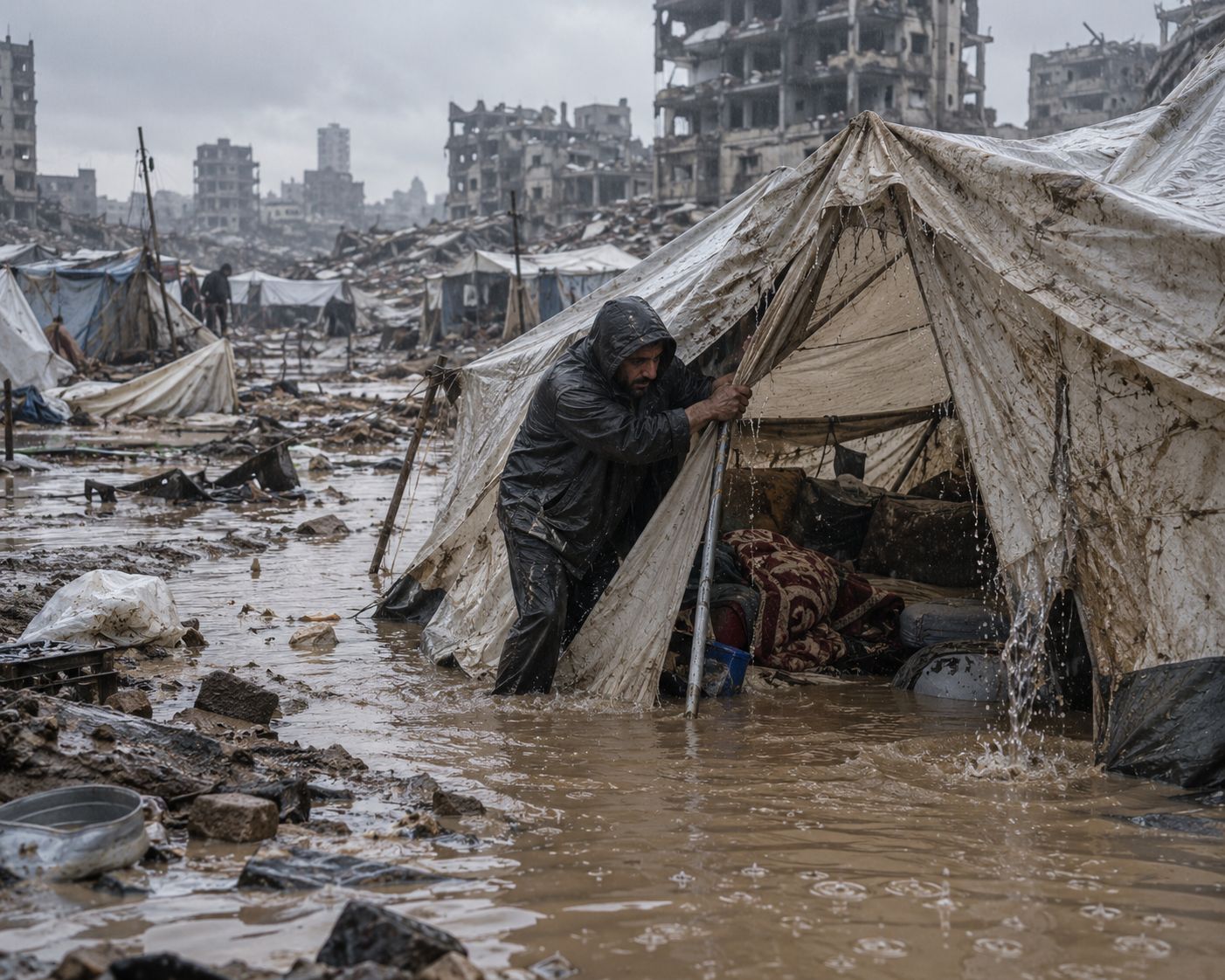
For Palestinians in Gaza, displacement has become a seemingly endless cycle. Families flee their homes, establish temporary shelters, and then find themselves forced to move again. Even after the ceasefire announced in October 2025, the territory available to civilians continues to shrink, while the dangers they are trying to escape remain.
On October 30, 2026, the United Nations Human Rights Office warned that Israeli military operations were pushing Palestinians into increasingly confined areas of Gaza, destroying remaining civilian infrastructure and generating renewed displacement. The office also expressed continuing concerns about ethnic cleansing.
For nearly two million people already struggling to survive, the prospect of returning to anything resembling normal life remains distant.
A territory that keeps shrinking
Much of Gaza has been devastated by years of warfare. Residential neighborhoods have been destroyed, essential infrastructure severely damaged, and enormous numbers of people displaced, often repeatedly.
Now, the so-called Yellow Line, marking the boundary of Israeli military deployment, has become another source of insecurity.
According to the UN Human Rights Office, Israeli military deployment areas expanded westward during the second half of October, triggering further displacement in Shujaiya in Gaza City and parts of Bureij, Deir al-Balah and Maghazi in central Gaza.
Israeli authorities have stated an objective of expanding their military deployment area to 70 percent of Gaza’s territory, according to the UN. This represents a stated goal, not a verified measurement of current control.
The consequences extend beyond geography. When military deployment areas expand, civilians can lose access to their homes, neighborhoods and whatever remains of their livelihoods.
For families already displaced several times, another advance may mean abandoning the few possessions they have managed to salvage.
Even temporary shelters are not safe
On October 25, according to reports received by the UN Human Rights Office, an Israeli drone dropped munitions on tents sheltering displaced Palestinians near the Yellow Line in Shujaiya. The resulting fire reportedly burned for hours.
Gaza’s Palestinian Ministry of Public Works and Housing reported that approximately 800 people belonging to 200 families were displaced by the incident.
These were people who had already lost the security of permanent housing. Now, even their temporary accommodation was gone.
The UN has also documented reports of attacks on displacement sites, continued shooting and the destruction of remaining buildings near the military deployment boundary.
Israel maintains that its military operations address security threats from Hamas and other armed groups. Security concerns, however, do not eliminate the obligation to protect civilians under international humanitarian law.
A ceasefire that leaves civilians exposed to repeated violence, displacement and the destruction of their shelters cannot provide the stability necessary for meaningful recovery.
Nearly two million people need shelter
The humanitarian crisis extends far beyond the immediate danger of military operations.
In October, the International Organization for Migration estimated that nearly two million people in Gaza required shelter assistance. Humanitarian organizations had secured supplies covering only about 17 percent of identified winter shelter needs.
The UN Office for the Coordination of Humanitarian Affairs reported that approximately 950,000 displaced people were living in sites exposed to medium or high flooding risks, including more than 400,000 at high risk.
Another approximately 44,000 people were living in structurally unsafe buildings.
For these families, remaining indoors is not necessarily safer than sleeping outside. Damaged walls and ceilings threaten collapse, while tents provide limited protection from wind, rain and cold.
Humanitarian organizations have warned that restrictions on the entry of essential shelter materials, together with insufficient funding, are preventing assistance from reaching the necessary scale.
Israel cites security concerns, including the potential military use of some restricted materials. Yet the shortage of suitable civilian shelter remains an urgent and documented humanitarian problem.
With winter approaching, families face another season in which even staying dry may become a struggle.
Children growing up without security
The consequences for children are especially severe.
UNICEF reported in October that approximately 800,000 children remained displaced across Gaza, many without homes to return to.
Children who should be attending school, playing with friends and enjoying ordinary family life instead confront damaged buildings, overcrowded shelters and continuing uncertainty.
Some have lost parents or siblings. Others have experienced repeated displacement, interrupted education and the constant threat of renewed violence.
The humanitarian consequences also extend into public health. Overcrowded displacement sites, damaged sanitation systems, insufficient clean water and inadequate medical services increase the risks facing already vulnerable populations.
An October investigation by the Danish Refugee Council and its Palestinian partner PARC documented severe overcrowding, unsafe sanitation, rodent infestations and profound psychological distress among displaced residents.
Displacement is therefore not simply a matter of changing location. It can mean losing access to safety, privacy, education, health care and the social structures that make a dignified life possible.
Displacement cannot become permanent
International humanitarian law provides protections for civilians, including those forced to flee armed conflict.
The UN Human Rights Office has called on Israel to cease the forcible transfer of Palestinians within Gaza and facilitate safe, voluntary and dignified returns. It has warned that unlawful forcible transfer constitutes a war crime and may, depending on the circumstances, amount to a crime against humanity.
The underlying principle should not be controversial: civilians must not be treated as obstacles to military objectives.
Palestinians should not have to choose between remaining near dangerous military positions, moving into overcrowded displacement camps or taking shelter inside buildings that may collapse.
Nor should temporary displacement gradually become a permanent condition through the destruction of homes and the continuing inaccessibility of entire neighborhoods.
The international community must press for civilian protection, unhindered humanitarian assistance, effective monitoring of violations and conditions that allow displaced families to return safely.
After years of destruction, Gaza’s civilians need much more than another temporary place to sleep. They need security, adequate housing, essential services and a realistic prospect of rebuilding their lives.
A population cannot recover while the space available to it keeps disappearing.
And a ceasefire cannot deliver meaningful peace if families are still searching for somewhere safe to live.