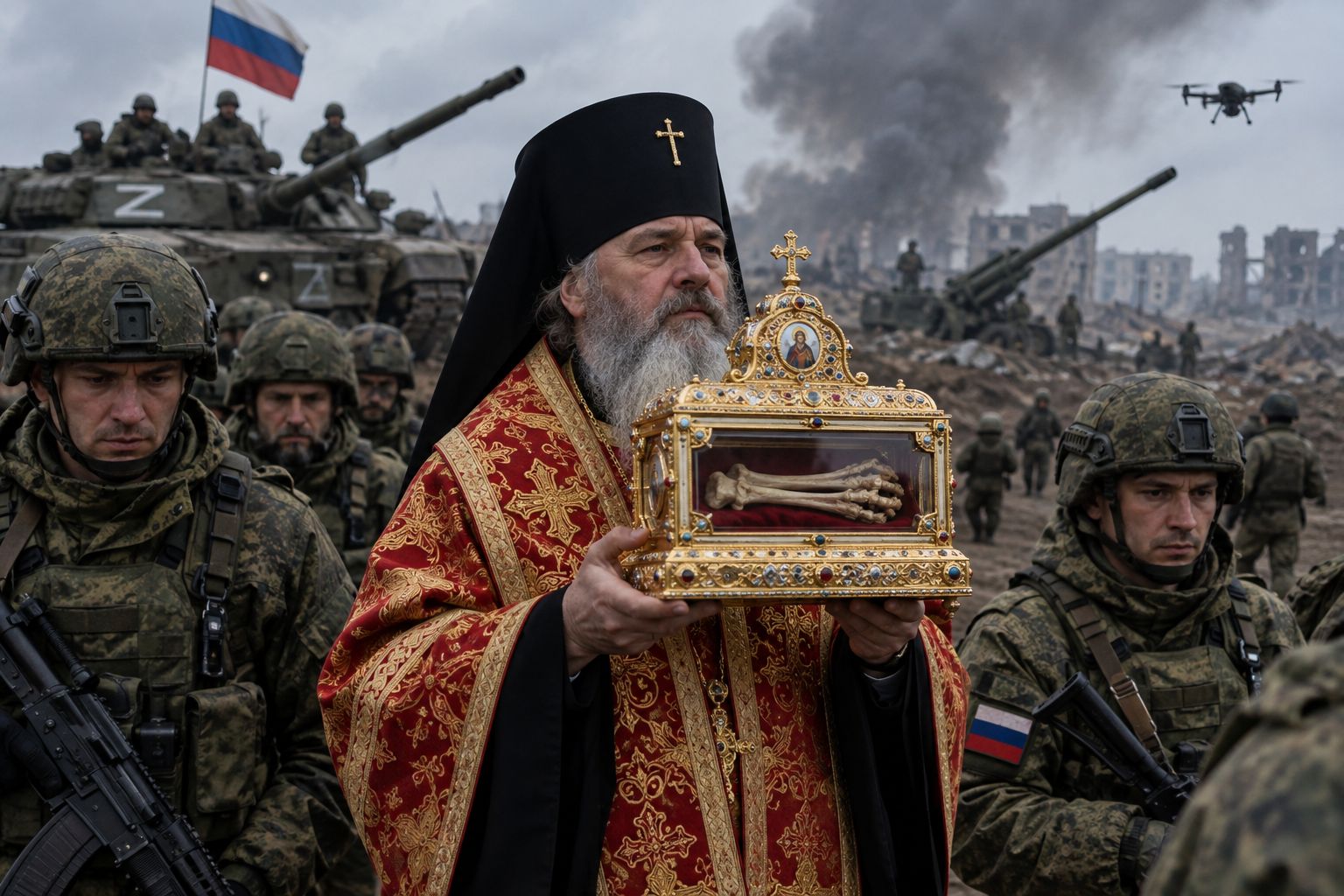
In a move that strains credulity even by the standards of wartime propaganda, the Russian Orthodox Church has dispatched a fragment of a 14th-century prince’s right hand to the Ukrainian front lines, claiming it will “spiritually strengthen” troops. The relic belongs to Grand Prince Dmitry Donskoy, who died in 1389 and was canonized in 1988. Church officials say the bone fragment — specifically from the hand that allegedly wielded a sword at the 1380 Battle of Kulikovo — has been placed in an ornate casket and is being toured along the more than 1,000-kilometer front line.
This development represents religious manipulation at its most brazen. The Russian Orthodox Church, which has openly backed Vladimir Putin’s war since 2022, claims the medieval prince will “invisibly take his place in the same battle ranks as our defenders”. Sergei Kiriyenko, Putin’s first deputy chief of staff, personally kissed the relic at a ceremony in Donetsk. The timing is particularly notable: the relic tour comes ahead of parliamentary elections and as Russian forces struggle to maintain momentum in a war now in its fifth year.
No evidence, no logic
The fundamental problem with this religious spectacle is that there is no evidence whatsoever that viewing a 700-year-old bone fragment improves combat performance. The Russian Orthodox Church has offered no empirical basis for its claims — only assertions that the relic will help troops achieve victory. This is superstition dressed in ecclesiastical vestments, not a serious military strategy.
Religion has long been used to justify wars and boost morale, but the scale of this particular exercise reveals something deeply troubling about the Russian state’s approach to the conflict. Rather than addressing the material factors that actually determine military outcomes — training, equipment, logistics, manpower — the Kremlin appears to be betting that mystical intervention will compensate for battlefield deficiencies.
Russia’s real problems
If Russia genuinely wanted to improve its position in Ukraine, the evidence suggests it should focus on entirely different priorities. The country faces a severe manpower crisis that no amount of religious pageantry can solve. According to Western intelligence estimates, Russia’s total casualties since the invasion began have reached approximately 1,400,000, with monthly losses ranging from 30,000 to 35,000 fighters. In the first quarter of 2026 alone, contract enlistment rates fell by 20% compared to the previous year, despite one-time payments of up to $80,000 and debt forgiveness of up to $140,000.
The Center for Strategic and International Studies reported in July 2026 that Russia was losing between 30,000 and 34,000 troops per month while recruiting only 27,000 — meaning the army was shrinking faster than it could be replenished. The casualty ratio, which had stood at around two or three Russian losses for every Ukrainian loss earlier in the war, has now shifted dramatically to approximately 8:1 in Ukraine’s favor.
Russia’s offensive has correspondingly slowed to a crawl. Near Kostiantynivka, Russian forces are advancing at an average of about 50 meters per day. Around Pokrovsk, the pace is roughly 70 meters per day. The CSIS report describes this as one of the slowest offensives in modern military history, comparable to the Battle of the Somme during World War I.
The Church as propaganda tool
The Russian Orthodox Church’s role in this war has evolved into something resembling a government propaganda department. Under Patriarch Kirill, the Church has sent priests to front lines, instituted mandatory prayers for Russian victory in every church, and flown icons over cities. The relic tour represents the latest escalation in this campaign.
Alexander Zanemonets, an Orthodox priest and historian based outside Russia, noted the unusual timing of the relic’s discovery. Donskoy was canonized in 1988, but his remains were only officially excavated last month. “By the fifth year of war, the Church leadership in Moscow began to wonder what else it could do to show its support for what Russia terms its ‘special military operation,'” Zanemonets wrote.
Critics have also questioned why the Church would break with religious protocol to please the Kremlin, and why remains whose location was broadly known for decades were recovered and venerated only now.
A pattern of desperation
This is not the first time the Russian Orthodox Church has sent medieval relics to the front. Earlier in 2026, the Church dispatched relics of Alexander Nevsky, another medieval warrior prince, to the front lines. The pattern suggests an institution scrambling to demonstrate relevance and support for a war that is not going well.
The Russian public appears to be losing faith — not necessarily in God, but in the war effort. Putin’s approval ratings have dropped to their lowest levels since 2022, with the decline attributed primarily to severe fuel shortages and the ongoing war. Trust in Putin fell by 3.4 percentage points in a single week in July 2026 — the fastest drop since the full-scale invasion began.
Meanwhile, Ukrainian forces continue to push back Russian troops in key sectors. The Institute for the Study of War reported in September 2026 that Ukrainian forces had advanced along the Sloviansk sector in Donetsk and conducted successful counterattacks in multiple areas.
Conclusion
The dispatch of Dmitry Donskoy’s bones to the Ukrainian front represents religious stupidity at its most dangerous. It is a cynical attempt to substitute superstition for strategy, to distract from mounting casualties and territorial losses with the spectacle of holy relics. If Russia genuinely wants to gain an advantage in this war, it needs to address its manpower crisis, improve its tactical approach, and reconsider whether the conflict is worth the catastrophic cost. Processions featuring medieval bones will not accomplish any of these objectives. They will only further demonstrate that the Russian leadership has run out of real ideas.