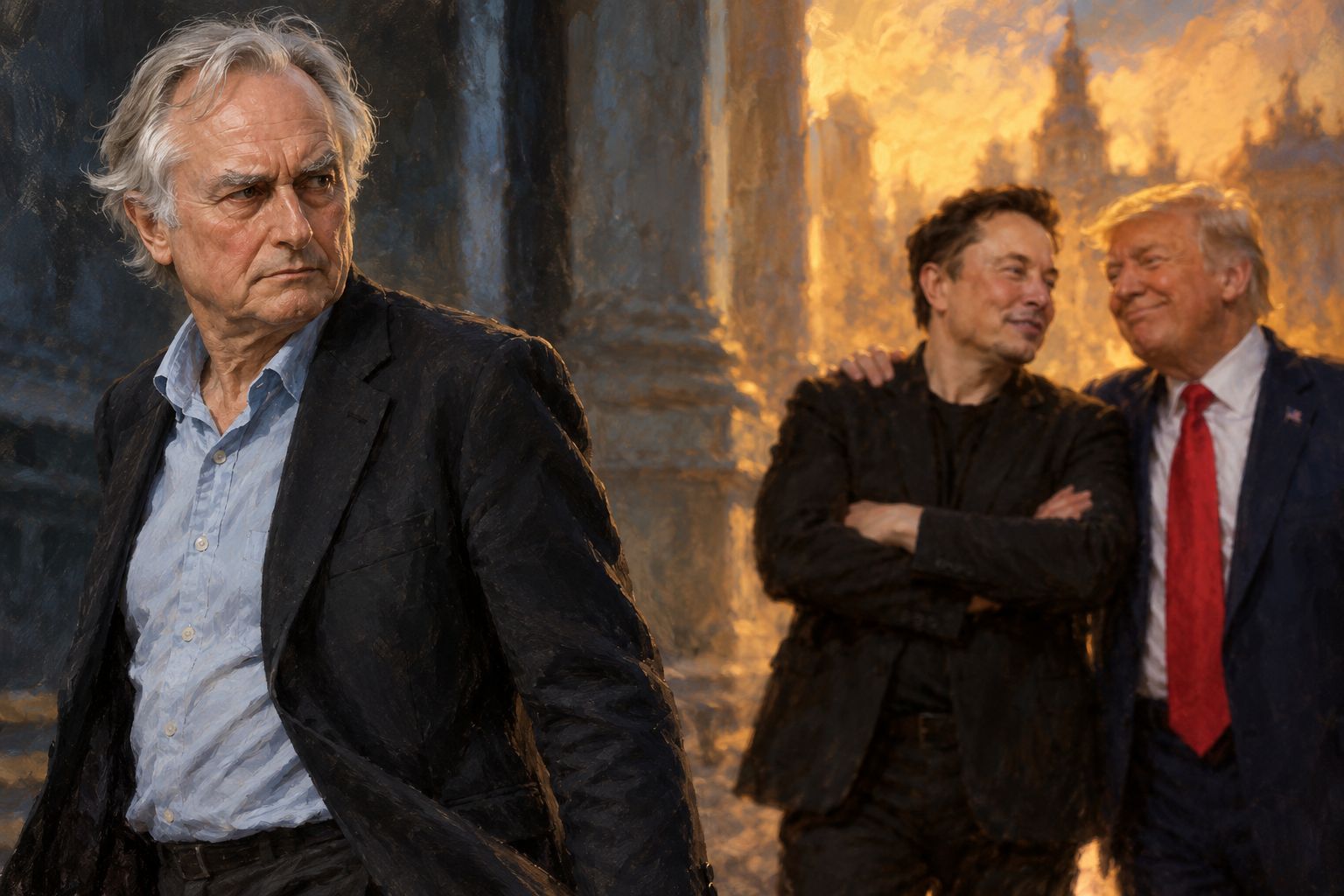
Richard Dawkins once regarded Elon Musk as a hero. Now, the evolutionary biologist and prominent atheist says Musk’s support for Donald Trump has reversed his opinion.
In an interview with The Australian published on October 22, Dawkins explained: “His championing of Donald Trump has rather reversed my opinion.” He had previously dedicated Flights of Fancy to Musk and admired him following their personal interactions. His rejection of that earlier judgment marks a significant change.
For someone famous for challenging unsupported beliefs, the episode raises an uncomfortable question. Why did Dawkins place so much confidence in a billionaire’s moral character in the first place?
The warning was already there
In November 2024, Dawkins publicly condemned Trump while defending Musk. He described Musk as highly intelligent and claimed that he had “the welfare of the world at heart.” Despite their political alliance, Dawkins portrayed the two men as fundamentally different.
Musk promptly challenged that interpretation. In his response, he defended Trump and blamed hostile media coverage for the negative assessment. The exchange exposed a problem with Dawkins’s position: the man he hoped would provide a beneficial counterweight to Trump was openly defending him. The Poke
Consequently, the contradiction did not emerge only with this latest interview. It was already visible when Dawkins offered his earlier defense. Critics did not need hindsight to question whether admiration had overtaken scrutiny.
Intelligence does not establish moral character
The central mistake was the leap from intelligence to benevolence. Someone can understand difficult technical problems while exercising poor political judgment. Likewise, commercial ambition and concern for humanity can coexist, conflict, or become almost impossible for outsiders to distinguish.
Technological achievements deserve assessment on their merits. However, they cannot establish that the person associated with them deserves political trust. A successful company provides no automatic evidence that its owner respects democratic accountability or understands the lives of people with far less power.
This distinction should come naturally to skeptics. We would not accept a religious leader’s popularity as proof of moral authority. Nor should we accept a billionaire’s achievements as proof that his political influence serves everyone else.
Moreover, the standard must apply consistently. If Musk’s political allegiance warrants scrutiny, the same scrutiny should extend to wealthy figures whose preferred candidates we support. Agreement does not eliminate conflicts of interest or make concentrated power harmless.
Changing your mind is the right response
Dawkins deserves credit for abandoning a judgment he no longer accepts. Public figures often defend earlier positions because admitting error threatens their reputation. Revising an opinion is healthier than inventing excuses to preserve it.
Nevertheless, the more useful lesson concerns how the original judgment formed. Personal charm, apparent brilliance, and exciting technological ambitions can encourage people to infer virtues they have not established. Scientific expertise does not make anyone immune to that temptation.
Freethought requires more than skepticism toward gods. It also requires skepticism toward admired scientists, political allies, and billionaires promising a better future. Dawkins has reconsidered Musk. The broader challenge is to stop treating impressive people as though their achievements place their judgment beyond question.