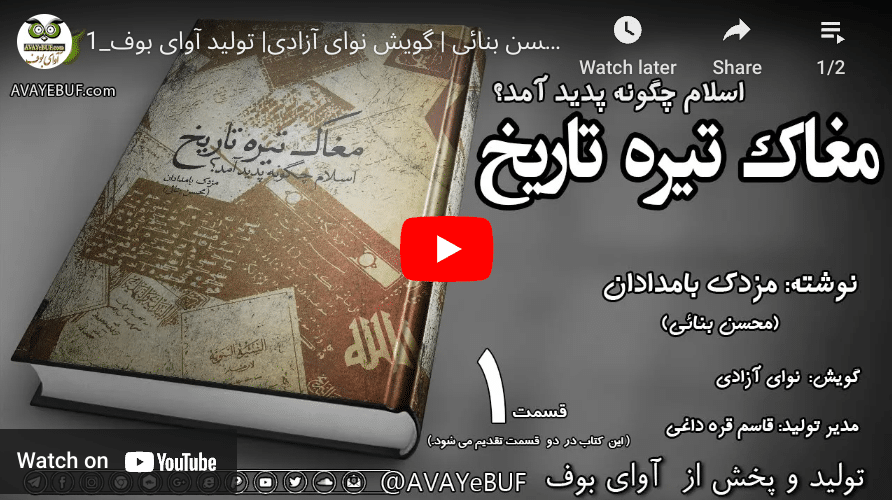
How did Islam emerge?
by Mazdak Bamdadan (Dr. Mohsen Banaie)
Abstract
Since the very lecture of Ignatz Goldziher in Paris from the year 1900, Islamic Studies have faced a sustainable revision, which questions the reliance and authenticity of traditional Islamic historiography through multiple academic methods and perspectives.
From Goldziher onwards, numerous notable scholars from different academic disciplines, such as linguistics, numismatics, archaeology etc. analyzed Islam especially regarding its genesis and early history. This new movement of revision reached a new level at the beginning of the the current millennium, by an originally German group of scholars, who call themselves “Inârah” and are referred to as the “School of Saarbrücken” or “Saarbrücken school”, by combining all the aforementioned disciplines due their broad analysis of the appropriate subject of discussion. The main thesis of this association, is the denial of the Islamic prophet Muḥammad as a historical person, since the Islamic historiography, as the essential source for this, has to be regarded as a salvation narrative, rather than a historiography in terms of a scientific understanding, which it claims to be. Accordingly, Islam is not an autonomous religion, emerged by its own, but more likely a corruption of Eastern Nestorian Christianity.
In his book “The Dark Crypt of History – How did Islam emerge?” the author Mohsen Banaie critically discusses this thesis undertaking traditional historiography of Islam in terms of an interreligious analysis, by comparing it broadly with the Qurʾān itself.
In doing so, it is important to outline the development of the aforementioned historiography on the base of an accurate analysis of all available primary sources, which evidently unveils a plenty of numerous contradicting and abstruse statements and narratives of the appropriate historians.
The following example, as one of many others, may illustrate this contradicting abstruseness:
According to al-Ṭabarī the total amount of war victims due those military campaigns, which were carried out during the reign of the first two Califs, i. e. ʿUmar b. al-Ḫaṭṭāb (r. 633-634) and ʾAbū Bakr (r. 632-634), and exclusively took place in the historical regions of al-Šām and Mesopotamia, conducts the almost fanciful number of more than 5 million deads(!). That means 5 million deads in 12 years. We know that a large population of this amout is almost impossible time and more than exaggerated. Even if this “facts” would prove correct, the whole region must have been depopulated for many generations if not permanently or at least be hardly able to recover from such a devastation. Nevertheless, the same al-Ṭabarī describes shortly after this period the prosperous trade and economy of the same former massacred region. How can this be even possible?
Usually the historiography of a religion would be assumed more or less identical with its religious literature. Concerning Islam this is not the case. By comparing the traditional histography of Islam and the Qurʾān, the Author proves a contentual congruency of less than 5%. Even keyword and technical terms such as šarīk (“idol”, “tin god”), masǧid (“mosque”), mušrik (idolater, polytheist), kāfir (“infidel”) etc. differ remarkably between the two sources. The author concludes by this, as another example, that mušrikūn and kāfirūn does not describe “idolater“ or (pagan) “infidel”, but rather Christians, i.e. those Christians who believe in trinity.
In his last chapter the author introduces a scheme for the emergence of Islam out of Christianity, through the aforementioned perspective, and concretizes this by the example of the Bahá’í Faith and its genesis in Iran of the 19th century, which also originally emerges out of Islam to become an independent religion later. As a possible origin of Islam the Author suggest the Arian and Nestorian Churches. While the first understood trinity as denial of monotheism, the latter believes in the human nature of Jesus Christ, i. e. a messenger and not an element of god or even god himself, as conventional Christianity declares. Both of these teachings are integral parts of Islam, where Jesus Christ (ʿIsā) is described as one of god‘s (Allāh) numerous messengers and god is one, not three (al-šahāda). By this, the author suggests, like the Inârah group too, that the Qurʾān is originally a polemic dispute between those eastern branches of Christianity, who believed in Jesus Christ as a prophet and denied the trinity of god and all other Christian churches and branches, who believed in the outcome of the councils of Nicaea, Chalcedon and Ephesus, which concluded the trinity of god.
The traditional historiography of Islam is therefore a rear projection of those events, which occurred in the early decades of the ʿAbbasid era and transfigures and consciously manipulates the aforementioned Christian dispute into a new anti-pagan religion, which should later become the Islamic religion.