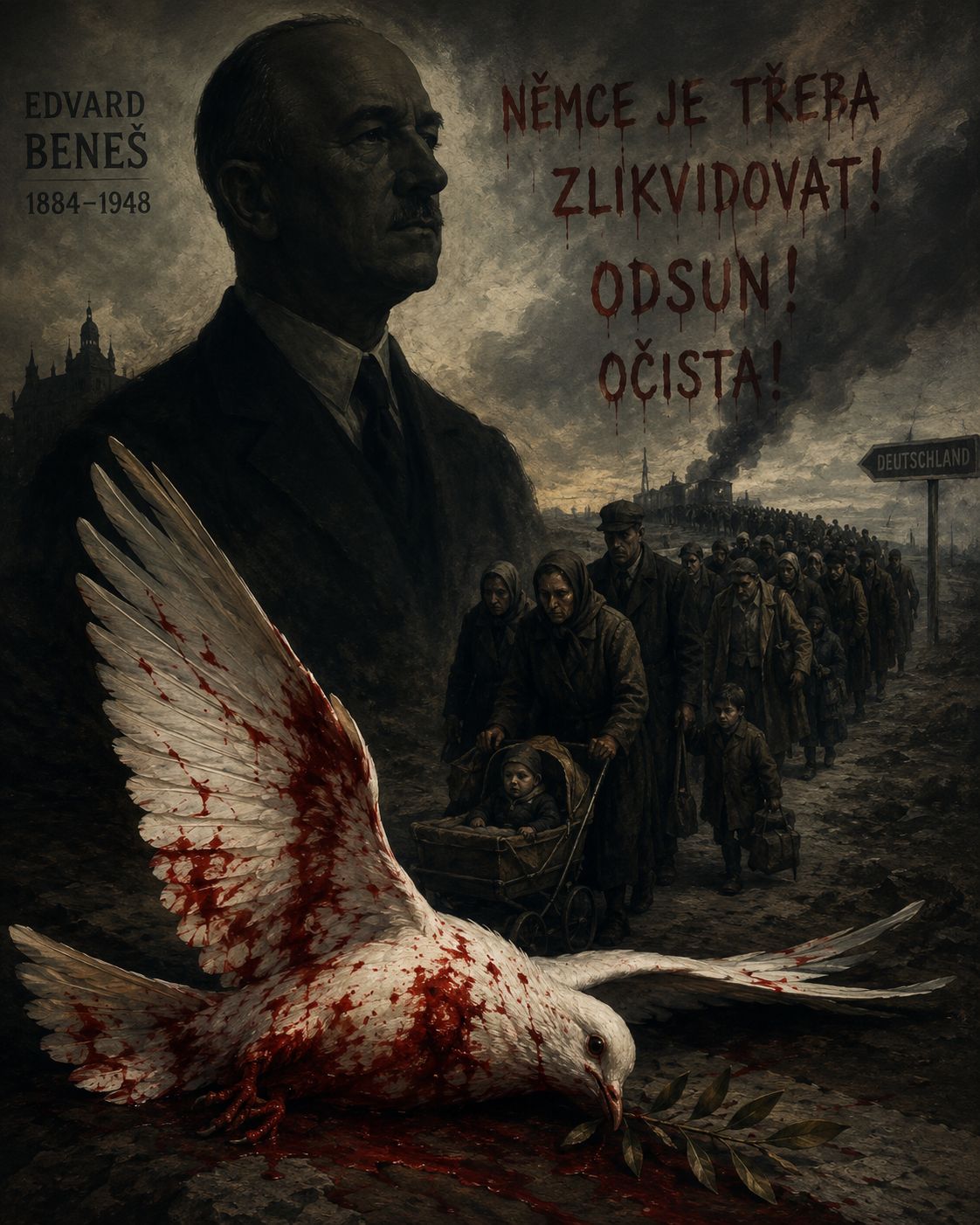
Edvard Beneš, the second president of Czechoslovakia, inherited a nation shaped by the ideals of its founder, Tomáš Garrigue Masaryk. Masaryk believed in democracy, humanism, the rule of law, and respect for human dignity. Beneš was an intellectual of exceptional ability—a brilliant diplomat, an accomplished scholar, and one of the principal architects of Czechoslovakia’s foreign policy before the Second World War.
Yet his legacy remains deeply controversial.
No one can dispute the horrors that Nazi Germany inflicted upon Czechoslovakia. The occupation brought executions, concentration camps, forced labor, the destruction of villages such as Lidice and Ležáky, and the murder of hundreds of thousands of innocent people. By the time the war ended in May 1945, the Czech population had experienced six years of terror. Hatred, grief, and the desire for revenge were widespread.
Understanding those emotions, however, is not the same as justifying what followed.
In the chaotic months after Germany’s surrender, violence against ethnic Germans erupted across Czechoslovakia. During the so-called “wild expulsions,” thousands of civilians were killed or abused. Men were executed without trial. Women, children, and elderly people also became victims. Historical records describe numerous atrocities, including mass shootings, beatings, torture, and deaths during forced marches. In some places, entire families were murdered. These events have been documented by historians for decades.
Historians continue to debate the precise impact of Beneš’s speeches and public statements on this atmosphere of retribution. His rhetoric toward the German minority became increasingly uncompromising during and immediately after the war. While interpretations differ regarding whether he explicitly encouraged unlawful killings, there is little doubt that his speeches reflected and reinforced a political climate in which collective punishment of ethnic Germans became widely accepted.
That raises an uncomfortable question.
Collective guilt
Can a democratic leader committed to the rule of law tolerate or encourage collective revenge?
International humanitarian law is built upon a simple principle: guilt is individual, not collective. A person is responsible for his or her own crimes—not for their nationality, ethnicity, or family background. A mother pushing a baby carriage is not guilty because she speaks German. A child is not guilty because of his father’s actions.
When civilians are deliberately killed after the fighting has ended, those acts cannot be defended as combat. They are crimes.
Imagine similar events occurring today. If a modern political leader publicly created an atmosphere in which civilians belonging to an ethnic minority were assaulted or killed after a war had officially ended, the international response would likely be swift. Political leaders have faced prosecution before international tribunals for encouraging or facilitating violence against civilians. International justice does not excuse atrocities simply because they are committed by the victorious side.
History should be judged by the same moral standards regardless of who committed the crimes.
Recognizing crimes committed against ethnic Germans after the Second World War does not diminish the suffering inflicted by Nazi Germany. The Holocaust, the occupation of Czechoslovakia, and countless other Nazi atrocities remain among the darkest chapters in European history. Nothing in that history excuses aggression or genocide.
At the same time, acknowledging Nazi crimes should not require silence about crimes committed in revenge.
A mature democracy is capable of holding two truths simultaneously: Nazi Germany committed horrific crimes against the Czech people, and innocent ethnic Germans also became victims of unlawful violence after the war. One injustice does not erase another.
The dark legacy of Edvard Beneš
Edvard Beneš remains one of the most important figures in Czech history. His leadership during the country’s darkest years deserves recognition, as do his diplomatic achievements before the war. But admiration for his accomplishments should not prevent honest discussion of the moral and political responsibility carried by leaders whose words and decisions influenced the turbulent aftermath of the conflict.
Historical figures are rarely entirely heroic or entirely villainous. Their legacies often contain profound contradictions. Beneš may be remembered both as a defender of Czechoslovak independence and as a leader whose post-war policies and rhetoric continue to raise difficult ethical questions.
History should not be a search for saints. It should be a search for truth.