By: Irfan Bayei
Every morning, before people even step out of their homes to face the day, they are already there.
Small shadows huddled on porches and dakalai (verandas). Young boys clutching cracked plastic bowls. Their clothes are worn, and their eyes hold a maturity no child should possess. They are the Almajirai.
But what the world sees—the poverty and the begging—is just the surface. Beneath this system lies a structure of exploitation and cruelty that few outsiders understand.
The Tyranny of the “Gardi”
In the hierarchy of the Tsangaya (religious school), there is a figure known as the Gardi—a senior student, often a grown man, to whom the younger children must answer.
The cruelty begins with food. When these little boys roam the streets under the scorching sun doing bara (begging), they are not begging for themselves. They are gathering tribute.
When a child returns with a bowl of food, he cannot eat it immediately. He must present it to the Gardi first. This senior figure, who often sits idle while the children labor, takes the best portion—the meat, the fish, the fresh rice. In many cases, these Gardawa (plural of Gardi) depend entirely on the labor of these children to feed not only themselves but sometimes even their wives.
The child is left with scraps—or sometimes nothing at all.
The Tawada on the Hand: A Method of Control
The most heartbreaking part of this system is the mechanism used to prevent hunger from winning.
The Gardi knows that a starving child might be tempted to eat the food he begged for before returning to the school. To prevent this, he uses a cruel verification method. Before the children leave, he writes Arabic inscriptions or marks on the palms of their hands using Tawada (local organic ink).
The logic is brutal: In our culture, one must wash their hands before eating. If a child begs, gets food, and washes his hands to eat it secretly, the Tawada will wash off or smear.
When the child returns, the Gardi inspects his hands, checking if the writing is intact. The child cannot rewrite it himself because he likely hasn’t reached that level of writing proficiency yet. If the ink is gone or faded, the verdict is laifi (guilty). The punishment is a severe beating (duka mai tsanani).
So you see children starving, holding bowls of hot food, afraid to take a single bite—because the Tawada on their hands is more powerful than the yunwa (hunger) in their stomachs.
The Invisible Chains: Beyond Physical Abuse
But the exploitation doesn’t end with beatings and food deprivation. These children face a systematic erasure of their childhood and potential.
Many Almajirai are as young as five or six years old when they are sent away from their families—sometimes hundreds of kilometers from home—to study under a Malam (Islamic teacher). Parents, often struggling with poverty themselves, believe they are giving their sons a religious education and a better future. What they don’t always see is what happens behind the walls of the Tsangaya.
The children wake before dawn for prayers, then spend hours begging in the streets. In the afternoon, they may receive some Qur’anic instruction, but many Tsangayas lack a proper curriculum, qualified teachers, or even basic infrastructure. There are no desks, no books beyond worn Qur’anic tablets, and certainly no preparation for modern economic life.
Education—true education—is replaced with survival skills: how to beg effectively, how to avoid the Gardi’s wrath, how to sleep on a floor with dozens of other boys in a single room.
The Economics of Exploitation
Let’s be clear about what this system really is: it’s an economic model built on child labor.
A single Gardi can control ten, twenty, or even thirty young boys. If each child brings back even a modest amount of food or money daily, the Gardi lives comfortably without working. Some Gardawa have turned this into a business, treating children as assets to be managed and exploited.
The Malam who runs the school often benefits too, either directly from the children’s begging or indirectly through the labor the Gardi provides in exchange for his position of power. It’s a pyramid of exploitation, with the smallest and most vulnerable at the bottom.
And what do the children get? Hunger. Abuse. A childhood stolen. And often, not even the education they were promised.
A Question We Must Ask
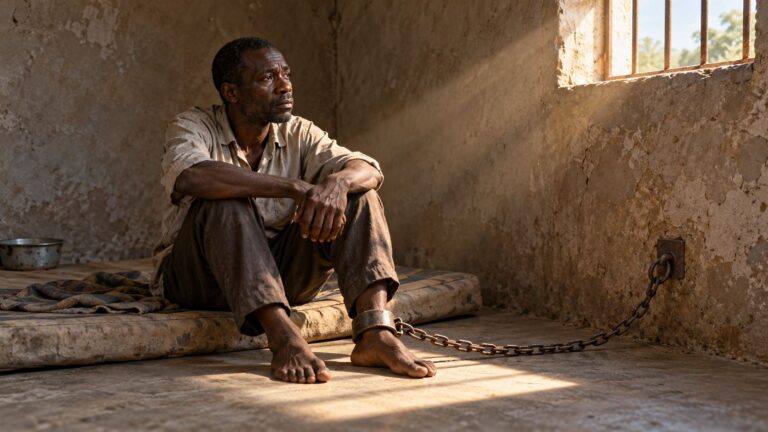
This is not education. This is bauta (slavery) disguised as piety.
As freethinkers and humanists, we must ask: Is it godly to build a system where grown men feed on the sweat and starvation of children? Is this what faith demands—or what our failures have created?
These millions of children are the future engineers, doctors, and leaders of Africa. But instead of learning logic, science, and critical thinking, they are learning how to survive the tyranny of the Gardi. Instead of building nations, we are breaking spirits.
It is time to separate education from exploitation. Al’ada (tradition) should nurture our children, not consume them. Religion should elevate the human spirit, not provide cover for its degradation.
The shadows on the porch are not just begging for food. They are begging for justice.
Author’s Note:
Irfan Bayei is a Staff Writer for Freethinkers International. He writes from Northern Nigeria, advocating for the rights and dignity of the African child.