In 2003, Nigeria accounted for 45 percent of all wild poliovirus infections globally.
It was also the country where the machinery of eradication abruptly ground to a halt.
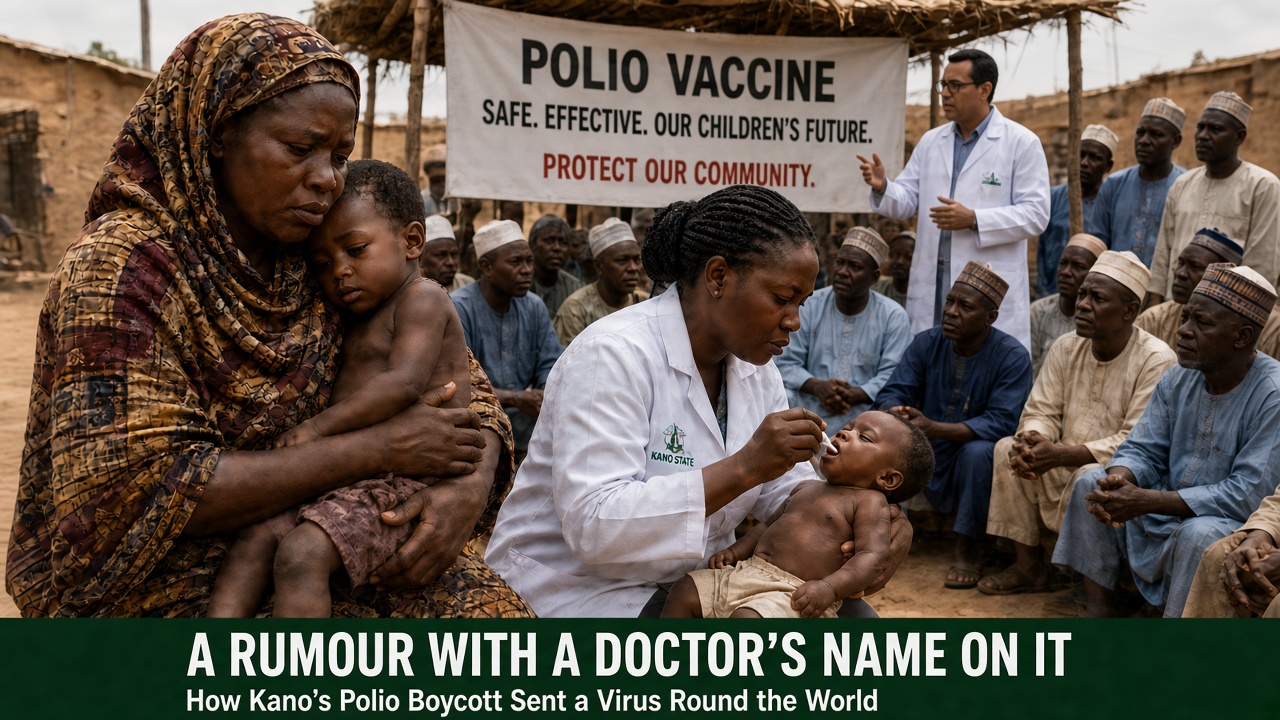
Between July 2003 and mid-2004, five northern states Kano, Zamfara, Kaduna, Niger, and Bauchi suspended the administration of the Oral Polio Vaccine (OPV). While neighboring states quietly reinstated campaigns after brief reviews, Kano enforced a rigid twelve-month embargo.
That boycott derailed the global effort to eradicate a paralyzing childhood pathogen at the exact moment the world believed it was within reach of total containment.
The epidemiological surge: 202 to 780
The epidemiological cost was immediate and measurable.
In 2002, surveillance recorded 202 wild-poliovirus cases in Nigeria. By 2004, following the disruption of mass immunization campaigns, the number had surged to about 780—roughly three-fifths of the global total that year.
Professor Oyewale Tomori, the leading Nigerian virologist coordinating scientific oversight for eradication, noted that clinical surveillance units were registering an average of three paralytic cases daily.
The pathogen did not respect jurisdictional boundaries. Genomic sequencing later demonstrated that the Nigerian viral strain migrated across frontiers, reinfecting 20 previously polio-free countries across West, Central, and the Horn of Africa, before traveling across the Red Sea as far as Yemen and Indonesia. By 2012, Nigeria remained the epicenter of more than half of all cases recorded worldwide.
Authority without evidence
The resistance was not instigated by grassroots unrest; it was anchored by medical authority.
Dr. Ibrahim Datti Ahmed, a prominent Kano physician and president of the Supreme Council for Sharia in Nigeria, leveraged his professional credibility to challenge federal health directives. In mid-2003, he publicly declared the vaccine compromised, claiming without empirical data that international donor batches had been adulterated with anti-fertility agents and contaminants associated with HIV.
The underlying premise tapped into a potent narrative: that Western humanitarian agencies were deploying public health campaigns to enforce demographic suppression on Muslim communities.
The assertion possessed no biochemical foundation. Consecutive laboratory assessments conducted by the National Agency for Food and Drug Administration and Control (NAFDAC), alongside independent foreign laboratories, established the chemical integrity of the vaccine batches. However, public confidence collapsed because clinical assurance collided with deep-seated institutional distrust.
Anatomy of the contagion
A subsequent behavioral study analyzing the crisis identified the intersection of geopolitical anxiety and severe public health communication failures.
The 2003 Anglo-American military campaign in Iraq had deepened suspicion of Western interventions across Northern Nigeria. Against this tense background, public health communication suffered from an enormous comprehension gap. An independent health survey in Kano revealed that roughly 70 percent of surveyed caregivers assumed the oral polio vaccine provided universal protection against common childhood afflictions, including malaria and diarrheal infections.
When high-mortality endemic diseases continued to afflict families while international agencies focused single-mindedly on polio drops, clinical priorities seemed suspicious to communities. Dr. Ahmed’s rhetoric capitalized on this discrepancy: if foreign donors genuinely prioritized child survival, why neglect lethal endemic killers in favor of an invisible, localized paralytic condition?
The logic of false equivalence
The executive leadership of Kano State legitimized the boycott under the newly inaugurated administration of Governor Ibrahim Shekarau.
The administration’s public rationale framed the dilemma as a balance of probabilities, asserting that accepting localized cases of paralytic polio represented a lesser evil than risking widespread chemical sterilization among future generations.
This reasoning demonstrated a fundamental breakdown in risk assessment. It elevated an unsubstantiated conspiracy theory to the same empirical weight as an active, debilitating viral outbreak that was already filling local hospital wards.
Resolving the impasse
Resolving the crisis required diplomatic and theological diplomacy rather than federal coercion.
The breakthrough occurred in late 2003 when the Organisation of the Islamic Conference (OIC), alongside the African Union and the Arab League, formally endorsed the international immunization protocol, effectively dismantling the claim of sectarian targeting.
To resolve local doubts, the federal and Kano state governments dispatched a joint committee of scientists and religious leaders to evaluate manufacturing facilities in South Africa, India, and Indonesia. Following independent scientific verification, Kano officially ended the moratorium on 31 July 2004, approving the procurement of vaccine supplies sourced from PT Bio Farma in Indonesia.
The political turnaround was swift. Governor Shekarau publicly immunized his daughter at an administrative launch, and in September 2004, 150 Islamic scholars and traditional leaders from across the Sahel convened in Kano to endorse cross-border vaccination. The boycott was broken not by secular decrees, but by Muslim scholars relying on empirical verification.
Lingering vulnerabilities
The campaign eventually achieved historic success: on 25 August 2020, the WHO officially declared the African continent free of wild poliovirus transmission, following four years without an indigenous case.
Yet the operational legacy remains fragile. Nigeria continues to confront circulating vaccine-derived poliovirus type 2 (cVDPV2), an outbreak variant that emerges in low-immunity populations where routine immunization coverage has lapsed. By 2024, surveillance indicators showed that the proportion of children receiving zero routine vaccinations across the North-West rose above 40 percent.
Wild polio has been eliminated, but the underlying vulnerability—the breakdown of critical thinking and routine coverage—remains active.
Critical inquiries from the record
The 2003 boycott demonstrates how quickly speculative rhetoric can defeat empirical medicine:
- Scientific Credibility: When medical credentials are used to advance unsubstantiated claims, does the public require clinical trials and published laboratory analysis, or mere verbal assertion?
- Resource Prioritization: How effectively have federal and state ministries integrated vertical eradication campaigns into primary healthcare to treat concurrent killer diseases?
- Institutional Verification: What independent mechanisms exist today at the municipal level to counter medical disinformation before it disrupts public health?
Misinformation diffuses far more rapidly than any biological vaccine. In an interconnected society, the sole barrier against medical catastrophe is institutional transparency, empirical literacy, and verifiable evidence.