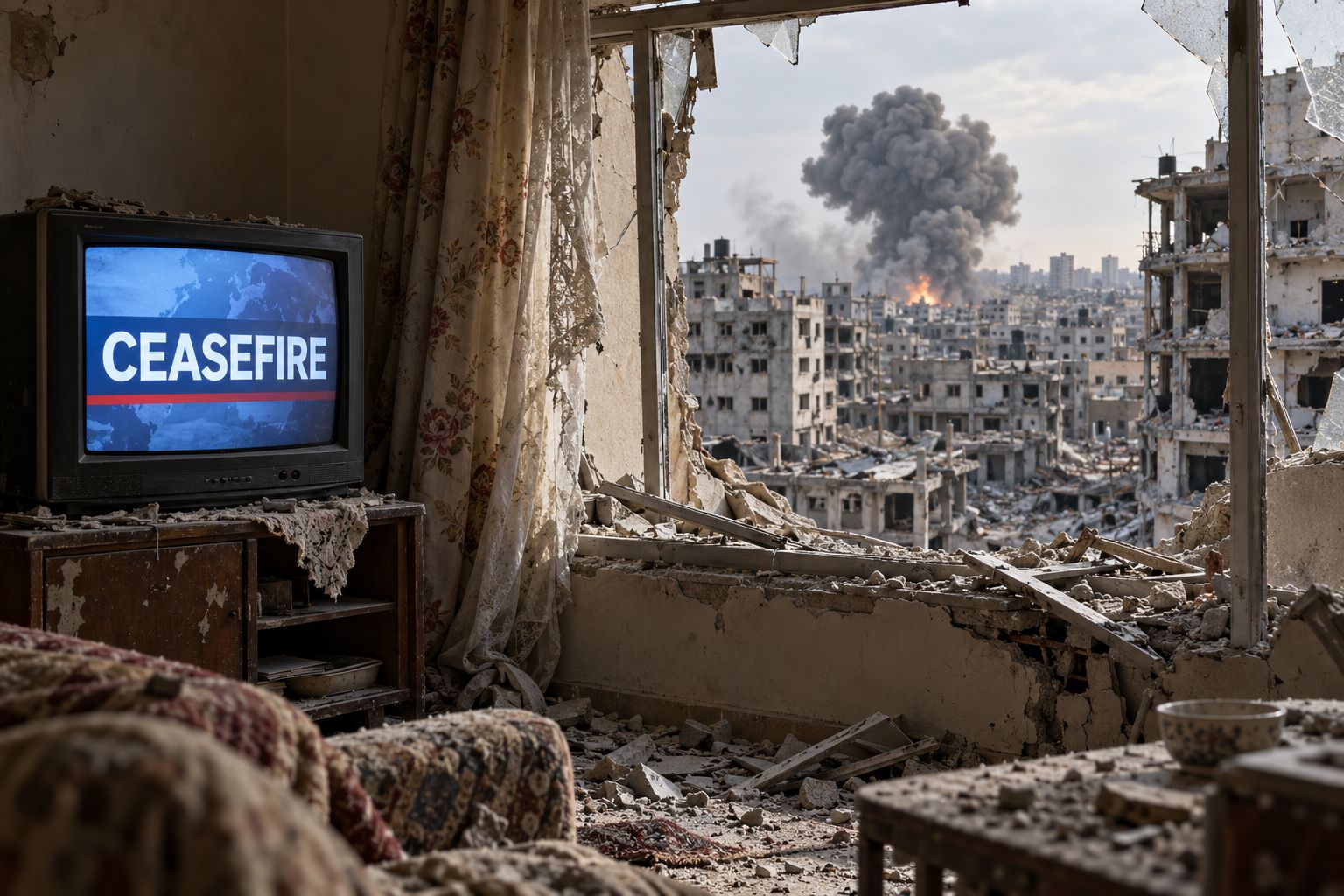
A ceasefire should mean that civilians stop dying and begin rebuilding their lives. However, a new UN inquiry says the agreement in Gaza did not end Israel’s genocidal acts. The announcement of a truce and the reality experienced by Palestinian families remain profoundly different.
On October 26, the UN Independent International Commission of Inquiry accused Israeli authorities of continuing acts intended to destroy Palestinians in Gaza, in whole or in part, after the October 2025 ceasefire. Israel rejected the findings as a misinformation campaign. These are the commission’s findings, not a final judgment by an international court. Nevertheless, they demand an answer that goes beyond dismissing the investigators.
A ceasefire measured in civilian lives
According to the inquiry, Israeli airstrikes, artillery, drones, and gunfire continued after the agreement. Investigators also warned that Israel was expanding its territorial control and turning the temporary ceasefire line into something resembling a permanent border. A truce that leaves civilians exposed to lethal attacks and further territorial encroachment cannot constitute a satisfactory peace.
The question is therefore larger than whether the intensity of fighting declined. Can families return home safely? Can children receive treatment and resume their education? Can people obtain food, water, and shelter without depending on unpredictable military decisions? Those are the tests by which any ceasefire deserves to be judged.
Israeli American genocide scholar Omer Bartov has challenged the destruction of Palestinians’ ability to rebuild their collective existence. Discussing that process in July 2025, he said: “This is precisely what Israel is trying to do.”
His warning directs attention beyond individual military strikes. A population needs functioning institutions, homes, healthcare, and the possibility of a future. Destroying those foundations has consequences that cannot be measured solely by the number of explosions on a particular day.
Jewish critics reject the excuses
Jewish critics of Israeli policy have expressed both grief and fury over the government’s conduct. Israeli novelist David Grossman described his decision to call the campaign genocide as coming “with immense pain and with a broken heart.” His words challenge the assumption that such criticism must reflect hatred of Israel or indifference to Jewish suffering.
American Jewish economist Jeffrey Sachs has been considerably more blunt. Speaking about Netanyahu during a Breaking Points discussion of Iran, he declared: “He is a vulgar, blatant, genocidal liar. I hope I’m being clear.” The accusation is Sachs’s own, but its force reflects how far criticism of Netanyahu extends beyond Israel’s traditional opponents.
These voices do not speak for all Jewish people, and their identities do not determine whether an accusation is true. However, their dissent exposes the dishonesty of treating Jewish communities and the Israeli government as interchangeable. Condemning a government’s actions can express a commitment to human dignity, including the dignity that government claims to defend.
Antisemitism remains unacceptable. So does invoking its existence to avoid examining evidence of atrocities. Protecting Jewish people from hatred and Palestinians from state violence are compatible obligations.
No wealth, no power, no protection
Jewish American intellectual Noam Chomsky described the imbalance behind Washington’s treatment of Palestinians in stark terms: “In contrast the Palestinians offer nothing: no wealth, no power, just a nuisance. Hence [they have] no rights.” He was condemning the priorities of US foreign policy, not denying that Palestinians possess human rights. His argument was that their rights receive little protection because they offer powerful governments few strategic advantages.
That distinction cuts to the heart of the problem. Human rights are supposed to protect people regardless of their wealth, military strength, or usefulness to an ally. When governments make protection depend on those advantages, they turn universal rights into privileges for the powerful.
A Palestinian child should not need an influential lobby, a lucrative trade agreement, or a powerful military patron to deserve protection. Nor should governments require a strategic incentive to oppose that child’s killing. The moral obligation exists before any calculation of national interest.
October 7 cannot justify unlimited retaliation
Hamas’s murder of civilians and hostage-taking on October 7 were atrocities. Recognizing those crimes does not require accepting every subsequent Israeli action as legitimate. Palestinian civilians do not inherit collective guilt for Hamas, just as Jewish civilians do not bear collective responsibility for Israel’s government.
A serious commitment to human rights must survive precisely these circumstances. If civilian protection disappears whenever a government invokes a terrible crime against its population, it ceases to offer meaningful protection. Every state could turn its own victims into a justification for creating more.
Israelis have the right to live safely. Palestinians have the same right. Neither principle needs to be qualified by religious identity, nationality, or political convenience.
Accountability cannot stop at expressions of concern
Political leaders should answer for the foreseeable consequences of the policies they authorize. Scrutiny must extend through political and military chains of command. Governments supplying support must also examine what their assistance enables and act when evidence indicates that it facilitates abuses.
The inquiry’s findings demand effective civilian protection, humanitarian access, independent investigation, and accountability. Reconstruction must give Palestinians a viable future in their homeland. Permanent displacement cannot become the price they must pay for survival.
A ceasefire can open the way to peace. It can also become a reassuring label that allows the outside world to look elsewhere. Gaza’s civilians deserve more than a change in the language used to describe their suffering.