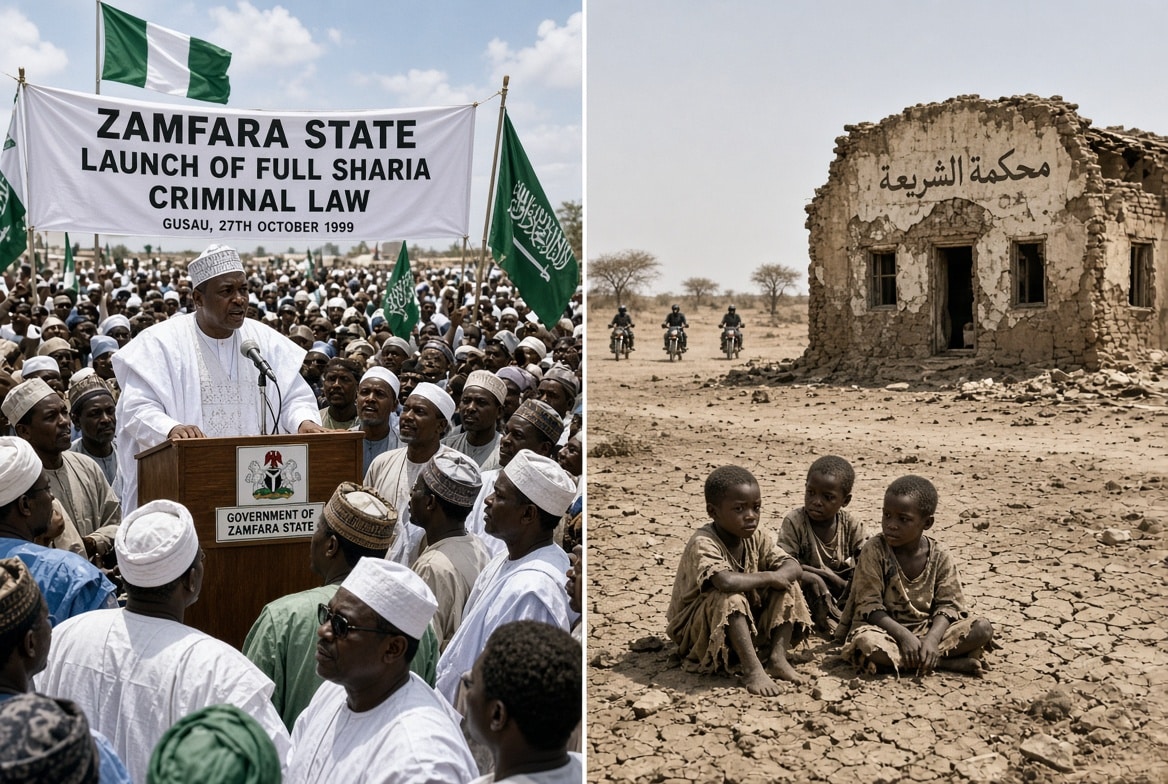
On October 27, 1999, Governor Ahmed Sani Yerima of Zamfara State launched the state’s new Sharia legal system at a major public rally in Gusau, making Zamfara the first Nigerian state to extend Sharia jurisdiction into criminal law after the return to civilian rule.
The move was met with widespread public support. Many people were deeply frustrated with a government and legal system they believed were failing them. Poverty was widespread, particularly in the north, while the police and courts were widely seen as inefficient and corrupt. For many supporters, Sharia appeared to offer a faster, more accountable alternative.
By 2002, eleven more northern states had followed Zamfara Bauchi, Borno, Gombe, Jigawa, Kaduna, Kano, Katsina, Kebbi, Niger, Sokoto, and Yobe. Twelve states. Tens of millions of people. One of the most consequential legal changes in Nigeria’s post-independence history.
More than two decades later, Zamfara the state that started it all continues to face severe insecurity, poverty, and weak state capacity. Armed groups have established a powerful presence in parts of the state, challenging the government’s ability to provide security and enforce the law.
This is the story of what the Sharia experiment actually produced.
Why it happened
To understand 1999, you have to understand what came before it.
Nigeria had spent sixteen of its thirty-nine years of independence under military rule. By 1999, the country was emerging from the brutal Abacha years — a period of mass corruption, arbitrary detention, execution of activists, and the complete collapse of public institutions.
The appeal of Sharia was therefore rooted in more than religious identity. Many supporters saw it as a response to problems they experienced every day: poverty, rising crime, inefficient courts, and distrust of the police and other state institutions. It promised a system that would be faster, less corrupt, and more accountable.
These institutional failures were particularly acute in parts of Northern Nigeria. Courts were corrupt and slow. Police were unreliable. Many basic public services were weak or unreliable. Crime was visible and largely unpunished. The legal system was a complex mixture of inherited common-law institutions, customary law, legislation, and in parts of Northern Nigeria Islamic legal institutions. By 1999, many citizens viewed the courts and police as slow, corrupt, or inaccessible, creating fertile ground for demands for a different approach to justice.
For many of its political supporters, the Sharia campaign was also a response to the failures of the existing political and legal order. It presented Islamic law as an alternative to institutions that many citizens regarded as corrupt, ineffective, or disconnected from their needs. The promise was not only religious; it was also political: that a different legal framework could deliver greater justice, accountability, and social order.
Large numbers of northern Nigerians took to the streets to demand the implementation of Sharia, reflecting widespread dissatisfaction with the existing legal and political order. For many supporters, Islamic law represented an alternative to institutions they believed had failed to provide justice and accountability.
The political consequences were significant. Yerima quickly became a national figure, while other northern governors followed Zamfara’s lead. For politicians facing strong public demand for Sharia, adopting the system offered a way to respond to popular sentiment and strengthen their political legitimacy.
The people who supported the change were responding to real failures in governance and the justice system. The harder question is whether the Sharia experiment delivered the justice, accountability, and social order that many of its supporters expected.
What the law actually changed
The re-introduction of full implementation of Islamic law in Northern Nigeria quickly attracted heated debates, nationally and internationally, about its constitutional legality and human rights implications.
The constitutional question was serious. Nigeria’s 1999 Constitution guarantees freedom of religion and equality before the law. It prohibits religious discrimination. Article 10 of Nigeria’s 1999 Constitution provides that neither the Federation nor a State shall adopt any religion as a State Religion, while Section 38 protects freedom of thought, conscience, and religion. Critics of state-level Sharia criminal legislation have therefore raised constitutional questions about the relationship between religious law and Nigeria’s constitutional framework. The Supreme Court has, to this day, never definitively ruled on whether Sharia criminal law is constitutional. It has avoided the question.
What the twelve states actually put in place was a parallel court system. All twelve states extended Sharia jurisdiction into criminal matters, although the form and degree of implementation varied from state to state. The twelve states also established or expanded Sharia court structures, operating alongside the existing common-law courts. The jurisdiction and implementation varied between states, with Sharia courts generally handling Muslim cases under state Sharia legislation.
Many states also established Hisbah boards religious enforcement bodies responsible for ensuring compliance with moral and social norms according to Islamic principles. Early implementations saw abuses: Human Rights Watch documented cases in the early 2000s where Hisbah personnel disrupted public gatherings, seized alcohol, and enforced gender-based segregation.
The criminal provisions included hudud punishments such as flogging, amputation, and death by stoning for specific offences. Some of these punishments were imposed by Sharia courts, although the most severe penalties became the subject of major legal challenges and were generally overturned or not carried out.
Safiya. Amina. And what the law did to women.
Two cases defined the international perception of Sharia in Nigeria. Both involved women. Both involved the same asymmetry.
Safiya Hussaini was a divorced woman from Sokoto State. She had a child after her divorce. A Sharia court sentenced her to death by stoning for adultery in October 2001. She claimed she had been raped repeatedly by a married neighbour. The neighbour was acquitted for lack of evidence. During her trial, Hussaini had no legal representation and was not informed of her legal rights. She was eventually acquitted on appeal in March 2002 not because the court found the sentence unjust, but because of a procedural argument about when the alleged act occurred.
Amina Lawal was a woman from Katsina State sentenced to death by stoning in March 2002 for conceiving a child outside marriage. The man she identified as the father was acquitted after taking an oath denying the allegation, while Lawal’s pregnancy was treated as evidence against her under the applicable rules of the Sharia court. Her sentence was overturned in 2003.
In both cases, the men identified as the fathers were not convicted of adultery. The cases highlighted the stark evidentiary imbalance created by the requirement for four male witnesses in proving zina, while pregnancy could be treated as evidence against a woman under some interpretations and applications of Sharia criminal law.
The case became a powerful example of how the application of Sharia criminal law could expose women to severe legal consequences in circumstances where men accused of the same sexual conduct were not necessarily treated in the same way.
These cases drew international condemnation and exposed serious questions about how the new Sharia criminal codes were being applied. Both convictions were eventually overturned on appeal, but the cases highlighted a fundamental concern: the evidentiary rules for adultery could operate very differently for men and women, particularly where pregnancy could be used as evidence against a woman while the alleged father was not convicted. They also raised concerns about access to legal representation and procedural safeguards.
What happened to corruption and crime
The original promise of Sharia was justice. A system more accountable than the broken colonial courts. An end to the corruption that had made ordinary legal recourse meaningless for ordinary people.
Twenty-six years later, there is little evidence that the adoption of Sharia criminal law by itself produced the improvements in governance, security, or economic conditions that many supporters had hoped for.
A child born in northern Nigeria faces stunting rates more than twice as high as a child in the South. Northern rates stayed near 50 percent while the South fell toward 21 percent. The gap in 1999 was 18 percentage points. After 2000 it began to widen. By 2018, the North had levels close to the poorest parts of the Sahel.
The child health gap between north and south widened during the years after Sharia implementation, but the available evidence does not establish that the adoption of Sharia criminal law caused the deterioration. Zamfara, meanwhile, has continued to face severe insecurity, poverty, and weak state capacity despite being the state where the Sharia experiment began.
The introduction of Sharia also intensified religious and political tensions in some mixed communities. In Kaduna, for example, the adoption of Sharia was followed by deadly riots in 2000, exposing how the new legal order could deepen existing divisions in communities with significant Christian and Muslim populations. Communal violence has continued in different forms in parts of Northern Nigeria since then.
The corruption that motivated the original demand for Sharia did not end. Characterisations of Sharia have ranged from it being labelled a form of militant religious extremism to a toothless legal system that is at best ineffectual and frequently discriminatory towards the poor and women.
The cases raised a deeper question about who bears the greatest burden when a legal system is applied unevenly. Women facing accusations of zina could face severe penalties, while poor defendants often had fewer resources to navigate the courts and challenge decisions. The promise of justice meant little if access to legal protection depended on a person’s gender, wealth, or ability to defend themselves.
What it did to blasphemy
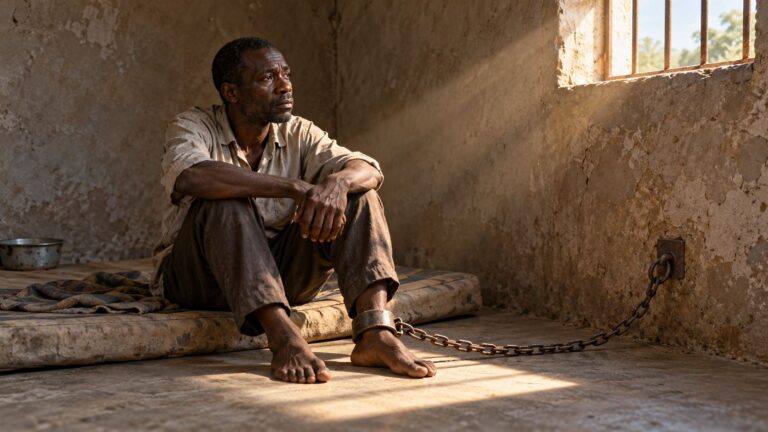
In 2020 two decades after Sharia criminal law was introduced in Northern Nigeria – a Kano State Sharia court sentenced Yahaya Sharif-Aminu to death after convicting him of blasphemy over a song he had shared on social media. He was twenty-two years old.
The original death sentence was overturned by the Kano State High Court in January 2021, which ordered a retrial. The Court of Appeal upheld that decision in 2022, and Sharif-Aminu appealed to the Supreme Court. The Supreme Court began hearing the case in September 2025, but proceedings were later delayed again in 2026. He remains in detention while the constitutional challenge to his conviction and Kano’s blasphemy provisions remains unresolved.
I am a Law student in Bauchi State, one of the twelve states that adopted Sharia criminal law. I study both common law and Islamic law, and I understand the jurisprudential arguments surrounding religious criminal legislation. But I also understand the broader question at stake: what happens when criminal law imposes the death penalty for speech, and when a case involving freedom of expression remains unresolved through years of appeals and procedural challenges?
What the evidence says
The Sharia experiment in Northern Nigeria tells us something important about the relationship between law, politics, and governance.
Law can respond to institutional failure, but it cannot by itself replace effective governance. The adoption of Sharia criminal law was driven by a combination of public frustration, religious conviction, political calculations, and demands for greater justice and social order. But a new legal framework could not, on its own, build hospitals, staff schools, create jobs, or eliminate poverty. Those problems required functioning institutions, sustained investment, and accountable government.
The people who celebrated in Zamfara in 1999 were demanding justice, accountability, and a different approach to governance. The experiment did produce a parallel legal framework, but its implementation also generated serious controversies over due process, women’s rights, freedom of expression, and the use of severe criminal punishments. Meanwhile, the wider problems that had fuelled the demand for change poverty, weak institutions, insecurity, and poor public services remained unresolved.
From a Freethinker’s perspective, this outcome is not surprising. When a population in genuine distress is offered divine law as the solution to human institutional failure, the promise cannot be kept because the problem was never the absence of divine law. The problem was the absence of functional institutions, economic investment, and political accountability.
Those problems require human solutions. Evidence-based, enforceable, accountable human solutions.
But criminal law cannot substitute for the institutions that make a society function. Courts can interpret and enforce laws; they cannot replace hospitals, schools, employment programmes, or effective public administration. If the goal is to improve people’s lives, legal reform must be accompanied by investment in healthcare, education, employment, and accountable government.
The people of Northern Nigeria deserved a justice system that protects their rights, applies the law fairly, and works alongside effective institutions of government. They still do.