There is an old and deeply unpleasant tradition in music: an artist says something politically unacceptable, powerful people object, and suddenly that artist discovers that certain stages are no longer available.
Communist regimes became particularly accomplished at this. Musicians could lose permission to perform, disappear from radio, find their records unavailable, or be forced underground because the authorities considered their music politically undesirable.
That history makes the controversy surrounding Macklemore’s removal from the U.S. leg of Ed Sheeran’s Loop Tour uncomfortable.
Macklemore was scheduled to support Sheeran at eight of his remaining ten U.S. concerts. After making pro-Palestinian remarks, including saying “Free Palestine” at a September 4 concert in New Jersey, he was dropped from those dates.
But there is an essential distinction. Sheeran says he did not make the decision.
“Macklemore coming off tour was the promoter’s decision, it was not mine,” Sheeran said. Messina Touring Group said owners of upcoming venues had informed the promoter that they would not allow concerts to proceed with Macklemore on the lineup.
That makes the headline question deliberately provocative, but the underlying issue remains serious: should musicians lose access to stages because powerful institutions object to their political speech?
Communist Czechoslovakia knew how to silence musicians
Czechoslovakia provides some of the clearest historical examples.
The Plastic People of the Universe lost their professional status in 1970 during the communist “normalization” that followed the crushing of the Prague Spring. They continued playing, but their opportunities to perform publicly became increasingly restricted. By December 1973, they had effectively played their last genuinely public concert for years. Later performances were private or clandestine affairs where even members of the audience risked police attention.
The repression became considerably more serious in 1976. Members of the band and other figures from the underground music scene were arrested. Ivan Martin Jirous received an 18-month sentence, Pavel Zajíček a year, while Svatopluk Karásek and Vratislav Brabenec spent eight months in prison. The prosecution of the underground music scene helped catalyze the creation of Charter 77.
This was not merely criticism of musicians. The state possessed the institutional power to determine whether they could operate professionally at all.
Marta Kubišová simply disappeared from public music
The communist authorities also silenced individual performers.
Marta Kubišová had become one of Czechoslovakia’s biggest singers, and her “Prayer for Marta” became associated with resistance to the 1968 Warsaw Pact invasion.
Then her public career was effectively terminated.
In 1970, communist authorities prohibited her from performing. She remained excluded from mainstream public musical life for nearly two decades, until the collapse of the communist regime in 1989.
The message was straightforward: political unreliability could cost an artist the ability to practice her profession publicly.
East Germany had its own examples
The German Democratic Republic operated a similarly controlled cultural system.
The Klaus Renft Combo became one of East Germany’s most successful rock bands, but its increasingly rebellious lyrics repeatedly brought it into conflict with the authorities. The band was ultimately prohibited in 1975. A third LP that had already been produced was not released.
The surviving Stasi records are especially revealing. They describe the musicians in explicitly political terms and document the authorities’ concern about performances of songs with “anti-socialist” content. The regime continued monitoring the musicians after the group had been dissolved.
In other words, censorship did not necessarily require someone literally standing on a stage and pulling out the electrical cable. Control over licenses, venues, record companies and professional opportunities could accomplish the same objective.
Macklemore is not living in communist Czechoslovakia
The comparison has obvious limits, and ignoring them would weaken the argument.
Macklemore has not been prohibited by the American government from making music. He has not lost a state-issued professional license. His records have not been banned. He has not been imprisoned for his music. He remains free to perform elsewhere and to criticize Israel, the United States, Ed Sheeran or anyone else.
The immediate mechanism was also private rather than governmental. According to the tour promoter, venue owners said they would not host the concerts if Macklemore remained on the bill. Sheeran says the resulting decision was not his.
That distinction matters.
But “this is not communist censorship” does not automatically make every form of private political exclusion desirable.
A free society can legitimately ask whether wealthy venue owners, promoters and other powerful private actors should function as political gatekeepers for artists.
Then the other musicians walked away
The reaction from Sheeran’s other musicians made the controversy much bigger.
Finneas, Lukas Graham and Aaron Rowe announced that they were withdrawing from the tour. Beoga, Sheeran’s touring band, also pulled out. They expressed support for Macklemore and solidarity with Palestinians.
Finneas summarized his objection simply: artists should not be silenced for speaking for people they regard as oppressed.
Their response illustrates another important feature of a free society. Private institutions can refuse to associate with an artist, but other artists can refuse to associate with them in return.
Nobody needs a Ministry of Culture for either decision.
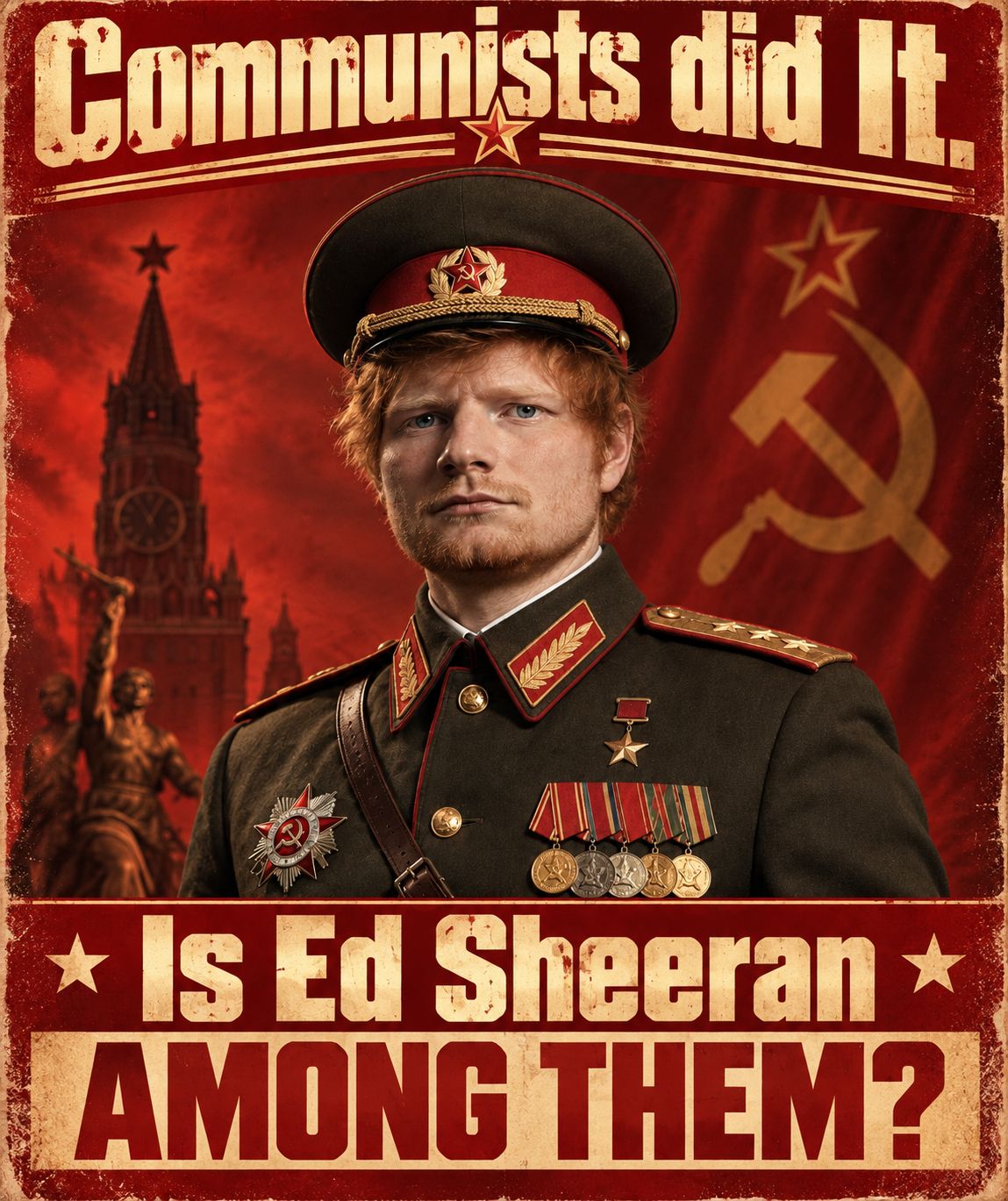
So is Ed Sheeran a communist?
No serious argument establishes that.
And the historical comparison should not depend upon pretending otherwise.
The more interesting question is whether societies that correctly condemn political censorship by governments should become comfortable when political pressure achieves a superficially similar result through private institutions.
The differences are substantial. A communist dictatorship could use police, courts, imprisonment and complete state control over cultural institutions. A private concert promoter cannot.
But there is also an uncomfortable similarity: political speech can still determine who gets access to a stage.
The Plastic People of the Universe discovered what happens when the state decides which musicians are acceptable. Marta Kubišová discovered it. The Klaus Renft Combo discovered it.
Macklemore’s situation is nowhere near that level of repression.
But the principle behind artistic freedom deserves attention long before it reaches that level.
A society does not have to wait for a Ministry of Culture, a blacklist and the secret police before asking whether musicians should lose opportunities to perform because somebody powerful dislikes what they say.