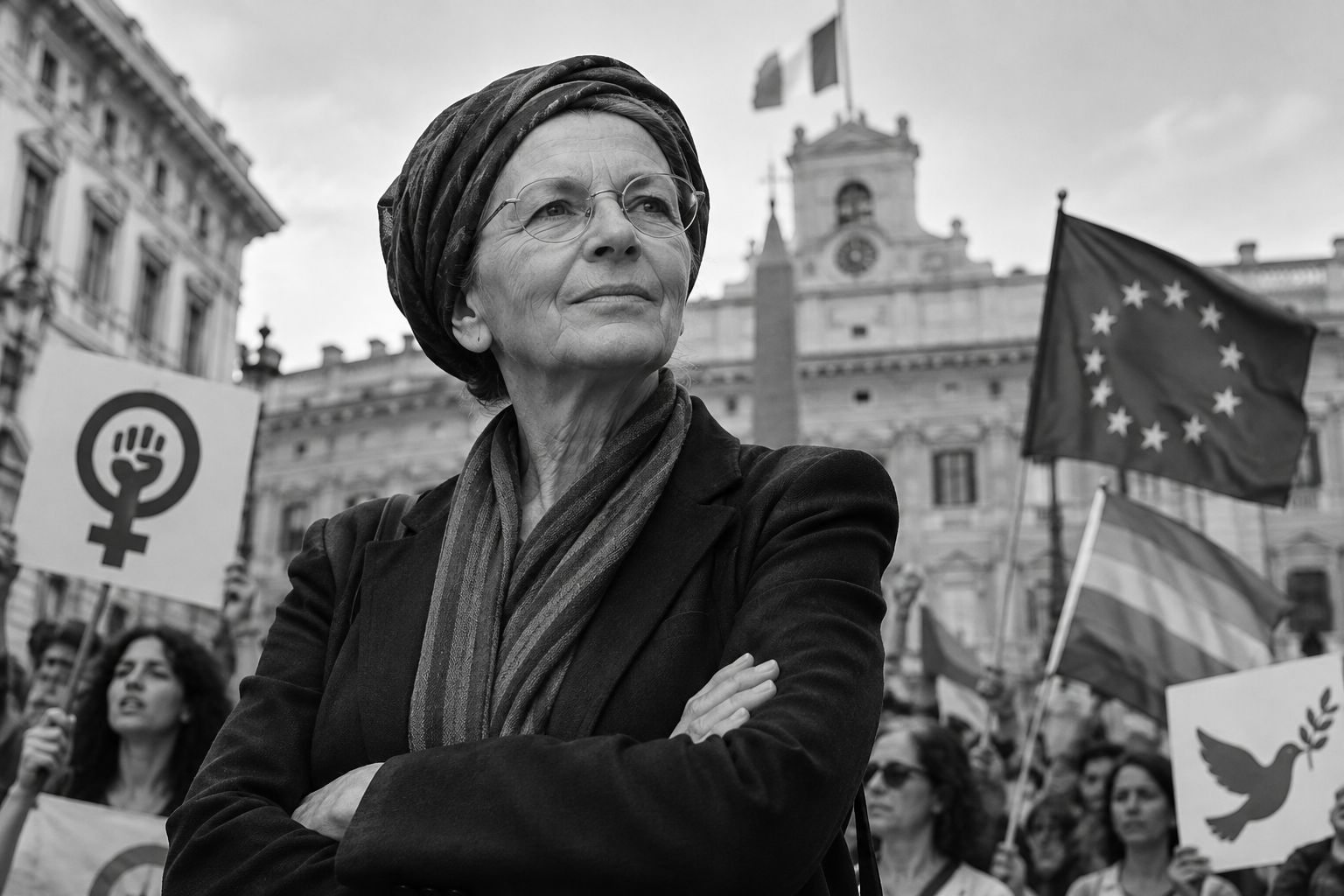
Emma Bonino, one of Italy’s most prominent defenders of civil liberties, secular politics and human rights, died on September 11, 2026, at the age of 78. Her death brings to an end more than five decades of political activism that repeatedly placed her in conflict with religious conservatism, authoritarianism and restrictions on individual freedom.
Bonino served as Italy’s foreign minister, minister for European affairs and international trade, a member of both the Italian and European parliaments, and a European commissioner. Yet her legacy cannot be understood simply by listing political offices. Long before reaching the highest levels of government, she became famous by deliberately challenging laws and social conventions she considered unjust.
From illegal abortion to political activism
One of the defining moments of Bonino’s life came in 1974, when abortion was still illegal in Italy. At 26, she underwent an illegal abortion at a clandestine clinic in Florence. The experience convinced her that other women should not have to endure the same ordeal. The following year, she publicly acknowledged what she had done and turned herself in to the police.
Rather than hiding an act that could expose her to prosecution, Bonino transformed it into political protest.
She subsequently became one of the leading figures in the Radical Party’s campaign for reproductive rights. Abortion was legalized in Italy in 1978, despite fierce opposition from the Catholic Church. Bonino and the Radicals were also prominent in the broader struggle for divorce and other reforms that helped loosen the Church’s influence over Italian public life.
The confrontation represented something larger than individual social policies. Italy was a deeply Catholic country in which religious doctrine had exercised enormous influence over politics and private life. Bonino argued throughout her career that religious teachings should not automatically become laws governing everyone.
As she put it decades later while discussing disagreements with the Catholic Church: “In a free and democratic country, sin cannot become a crime.”
A lifetime of civil-rights campaigns
Abortion was only one of Bonino’s causes. Through the Radical movement, she campaigned for LGBTQ+ rights, conscientious objection, drug-law reform, gender equality and individual autonomy. She opposed the death penalty and female genital mutilation and advocated for migrants and minorities.
Her methods were often deliberately confrontational. The Radical Party used hunger strikes, civil disobedience and referendums to force subjects that established political parties preferred to avoid into public debate. Despite its relatively small electoral presence, the movement had a substantial influence on Italy’s transformation into a more secular society.
Bonino never stopped warning that rights once obtained could also disappear.
“I have been fighting for rights all my life, warning people to defend them, because they don’t last forever,” she told Italian broadcaster Rai in 2024.
That warning feels particularly relevant today.
Human rights beyond Italy
Bonino’s activism extended far beyond Italian politics. As European commissioner from 1995 to 1999, she was responsible for humanitarian aid alongside other portfolios and became an unusually visible presence in international crises. Her work took her to conflict zones including Rwanda, Somalia and the former Yugoslavia.
Afghanistan became another important part of her human-rights work. In 1997, Taliban fighters briefly detained Bonino during a visit after members of her delegation took photographs inside a women’s hospital, something prohibited under Taliban rules. She subsequently became an outspoken critic of the international community’s failure to defend Afghan women.
Her other international campaigns included opposition to female genital mutilation, efforts against world hunger and a long campaign for the abolition of capital punishment. She viewed fundamental rights as universal rather than privileges determined by nationality, culture, religion or sex.
A committed European
Bonino was also an unapologetic European federalist. At a time when nationalist and Eurosceptic movements were becoming increasingly powerful, she continued arguing for deeper European integration.
In 2017, she co-founded +Europa, a liberal and strongly pro-European political party. The party struggled electorally, but Bonino remained one of Italy’s most recognizable advocates of a more integrated Europe. Even in her later years, she continued campaigning for the idea of a federal Europe capable of transcending nationalism.
Her Europeanism was consistent with the philosophy underlying much of her political career: individuals should not have their fundamental rights determined by the tribe, religion or nation into which they happened to be born.
A nonbeliever who could respect believers
Bonino’s secularism was not based on hostility toward religious individuals. She openly described herself as a nonbeliever while maintaining that she respected the Catholic Church’s right to hold its own theological positions. What she rejected was turning those theological positions into restrictions imposed on everyone else.
This distinction also allowed her to maintain an unusual relationship with Pope Francis despite their profound disagreements over abortion and other ethical questions. When Bonino suffered a serious health crisis in 2024, Francis personally visited her at her home in Rome.
Their relationship demonstrated that deep disagreement about religion and morality does not require personal hatred. A secular society does not require silencing religion. It requires ensuring that religious authority does not determine the rights of those who do not share its beliefs.
More than half a century of resistance
Bonino had suffered serious health problems for years, including lung cancer. She nevertheless remained politically active into her 70s. Earlier this week, she was hospitalized in Rome in serious condition after suffering respiratory problems. She left intensive care on September 10 and was transferred to a private medical facility, before her death was announced the following day.
Her career lasted more than half a century. During that time, the political landscape around her changed enormously. Causes once regarded as radical entered mainstream political life, while some freedoms she fought for have again come under pressure.
Bonino herself understood that progress is not necessarily permanent. Rights survive because people continue defending them.
A secular legacy
Emma Bonino was not merely an Italian politician. She represented a tradition of secular humanism in public life: distrust of imposed authority, defense of individual autonomy, internationalism and the conviction that human rights should not depend on religious doctrine.
One need not agree with every political position she took to recognize the consistency with which she defended those principles.
Italy in which abortion was illegal, the Vatican wielded enormous political influence and many questions of personal autonomy remained taboo was the Italy in which Bonino began her activism. She lived long enough to see much of that society transformed — partly because people like her were willing to challenge it.
Emma Bonino spent more than 50 years fighting for the right of human beings to make fundamental decisions about their own lives.
For a secular and democratic society, there are few legacies more important than that.