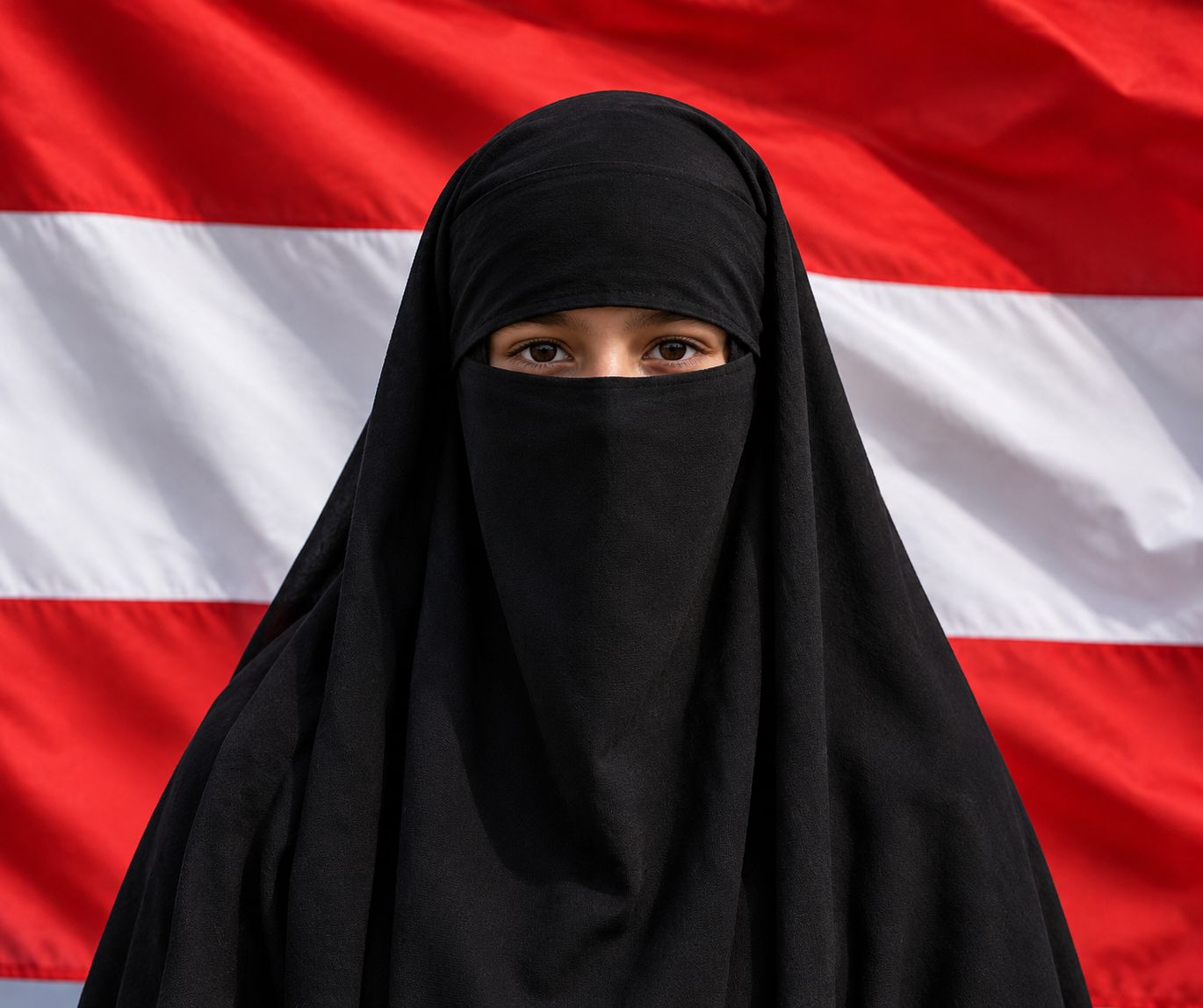
Austria has begun enforcing a controversial ban on Islamic headscarves for girls under the age of 14, reopening a difficult European debate about religious freedom, children’s rights, gender equality and the limits of religion in public schools.
The law took effect on September 1, 2026. Its first major practical test came this week as pupils returned to schools in Vienna, Lower Austria and Burgenland. The remaining Austrian states will begin their school year a week later.
The Austrian government presents the measure as a defense of girls rather than an attack on Islam. Critics see precisely the opposite: a law explicitly targeting one religious practice and therefore discriminating against Muslim children.
Both arguments deserve serious consideration.
What exactly has Austria banned?
The legislation prohibits female pupils who have not yet turned 14 from wearing a headscarf that covers the head “according to Islamic traditions.” It applies inside both public and private schools.
It does not apply to home schooling, lessons conducted outside school premises or school events taking place elsewhere.
The wording is important. Austria has not introduced a general prohibition on religious clothing or symbols. The legislation specifically identifies head coverings associated with Islamic tradition.
Enforcement is intended to proceed gradually rather than beginning immediately with punishment. A first violation leads to a discussion involving the girl, her parents or guardians and the school. Repeated violations bring in education authorities, and continued noncompliance can lead to child-welfare authorities becoming involved.
Eventually, parents or guardians can receive an administrative fine of between €150 and €800. Austrian parliamentary information says an unpaid fine can ultimately result in substitute imprisonment of up to two weeks.
The government says it is protecting girls
Austria’s governing coalition argues that the measure promotes children’s development, female equality and self-determination.
This raises a genuine problem that liberal democracies cannot simply ignore.
Children do not choose the cultures into which they are born. Religion is normally transmitted by parents and communities long before children possess the intellectual independence necessary to evaluate theological claims for themselves.
The same applies to religious clothing.
A girl wearing a headscarf may genuinely want to wear it. Another may wear it because her parents expect her to. A third may face enormous social pressure even without anyone explicitly forcing her.
Distinguishing among these situations is extraordinarily difficult.
The Austrian law attempts to solve that problem by drawing a line at the age of 14. Before that age, the state effectively argues that girls should be protected from a religious dress requirement that can carry expectations concerning modesty and female behavior.
But freedom from religion cuts both ways
For secularists, the controversy presents an uncomfortable question.
Freedom of religion necessarily includes freedom from religion. A child should not be coerced into religious observance simply because her parents happen to believe in a particular religion.
But the principle works in the opposite direction as well.
If a girl genuinely wishes to wear a headscarf, should the government be able to order her to remove it?
A secular state is not supposed to determine which religious beliefs citizens may express. Its role should generally be to protect people’s ability to believe, disbelieve, convert and abandon religion.
The strongest secularism therefore does not necessarily require removing religion from individual people. It requires preventing religious institutions from acquiring coercive power over everyone else.
A Muslim pupil wearing a headscarf is not the same thing as a government requiring pupils to wear one.
That distinction matters.
Why only the Islamic headscarf?
The law’s explicitly Islamic character creates perhaps its greatest legal vulnerability.
A general rule applying equally to conspicuous religious symbols would raise one set of questions. A law specifically identifying Islamic dress raises another.
Austria has been here before.
In 2020, the country’s Constitutional Court struck down an earlier prohibition applying to younger schoolgirls. The court concluded that the measure discriminated against Muslims and emphasized the state’s obligation to maintain religious and ideological neutrality.
The government believes the new legislation has been written carefully enough to survive constitutional scrutiny.
That remains to be seen.
Austria’s main Muslim organization, the Islamic Religious Community in Austria, has condemned the new measure as an infringement of fundamental rights and intends to challenge it.
Previous attempts to challenge the new law were rejected by the Constitutional Court in July, but crucially, the court did not rule that the law was constitutional. It rejected those applications because the legislation had not yet entered into force and therefore did not yet directly affect the applicants.
Now that the law is actually in force, the constitutional battle can begin in earnest.
A mother and her daughters have already challenged it
That battle did not take long.
On the first day of practical implementation, a mother and her two daughters filed a new challenge with Austria’s Constitutional Court, according to DPA.
The case could force the court to confront the substantive question it avoided in July: whether Austria can constitutionally single out Islamic headscarves while claiming to preserve state religious neutrality.
The answer could have consequences extending far beyond Austria.
European countries have spent decades struggling with the boundaries between secular government, religious expression and increasingly diverse populations. France has adopted particularly strict restrictions on religious symbols in schools, while other European states have taken different approaches.
Austria is now conducting another experiment in where that boundary should lie.
The far right wanted even more
The law was approved in December 2025 by Austria’s governing People’s Party, Social Democrats and liberal NEOS. The far-right Freedom Party also supported it.
The Greens were the only parliamentary party to oppose the measure.
Significantly, the Freedom Party argued that the legislation did not go far enough. It wanted restrictions to extend to teachers as well.
That illustrates another danger surrounding policies of this kind.
A measure initially justified as protecting young children can gradually become a broader attempt to suppress an unpopular minority’s religious expression.
There is an enormous difference between protecting an eight-year-old from coercion and telling an adult teacher what she may wear because the state disapproves of the religious meaning of her clothing.
Children’s autonomy is the real issue
The debate becomes much clearer if we remove Islam from the equation.
Should Christian parents be entitled to force a child to participate in religious practices against the child’s wishes?
Should strictly Orthodox Jewish parents be able to impose religious rules on a child who rejects them?
Should atheist parents be able to prevent their teenage child from practicing a religion simply because they regard it as irrational?
In all three cases, the child’s developing autonomy matters.
Children are not the property of their parents. Parents inevitably make decisions for young children, but that authority should diminish as children become capable of forming their own views.
The difficult question is therefore not simply whether the headscarf is religious.
It is whether the child is choosing it.
Secularism should protect choice
There are legitimate reasons to oppose forcing young girls to cover their hair for religious reasons. Ideas about female modesty deserve exactly the same criticism as any other religious doctrine. They do not become immune from scrutiny merely because they are culturally sensitive.
But criticizing a religious practice and criminalizing its expression are fundamentally different things.
A democratic society should be particularly cautious when the state begins deciding which clothes symbolize acceptable beliefs.
If there is evidence that a particular girl is being coerced, authorities should protect her. Schools should teach children that they have the right to believe, not to believe, to change religion and eventually to reject the religion of their parents altogether.
Girls should know that nobody has the right to force a headscarf onto them.
They should also know that the government will not force it off them merely because they are Muslims.
That is the harder principle to defend, but it is also the more genuinely secular one.
Austria says its new law liberates girls from religious pressure. Its opponents say it replaces pressure from families and religious communities with pressure from the state.
The Constitutional Court may ultimately decide whether the law survives.
The broader philosophical question will remain regardless of its verdict: Who should control what a girl wears—her religion, her parents, her government, or eventually the girl herself?