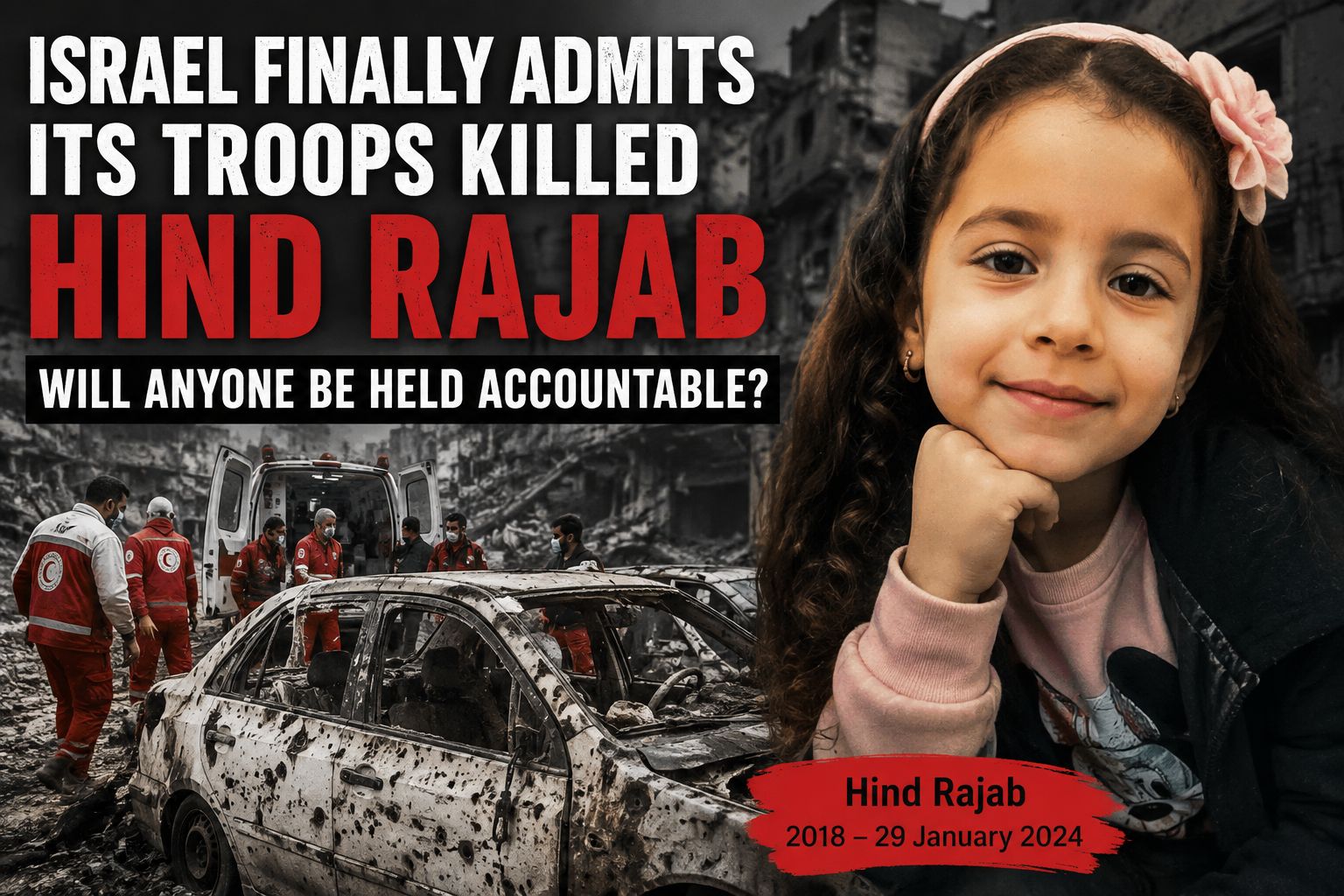
For more than two years, the killing of five-year-old Hind Rajab stood as one of the most haunting episodes of the war in Gaza. A terrified child was trapped in a car surrounded by dead relatives. She called for help. An ambulance eventually came for her. Hind died, and so did the two paramedics sent to rescue her.
For much of that time, Israel denied that its forces were responsible. Israeli authorities initially maintained that their troops were not present near the car when the family was killed.
Now the Israeli military has acknowledged that its soldiers opened fire on the vehicle. It has also opened a criminal investigation into the incident.
That is an important change. But an admission followed by an internal investigation is not the same thing as accountability.
The question is no longer simply who fired at Hind’s car. The question is whether anyone will actually face consequences.
A five-year-old waiting to be rescued
On January 29, 2024, Hind was traveling with relatives through the Tel al-Hawa area of Gaza City as the family attempted to flee the fighting.
Their car came under Israeli fire.
According to the Israeli military’s newly released findings, its troops fired at the vehicle as it approached them. Five passengers were killed in that initial attack. Hind and her cousin Layan Hamada survived.
The Palestine Red Crescent Society received calls from the trapped family. Recordings of those conversations later became some of the most disturbing evidence associated with the Gaza war.
Layan spoke to an emergency dispatcher. Gunfire could be heard. Her call ended.
Hind remained alive.
For hours, the five-year-old waited among her dead relatives while rescue workers tried to reach her. The Palestine Red Crescent eventually dispatched an ambulance after coordinating its movement. Two paramedics, Yusuf Zeino and Ahmed al-Madhoun, went to rescue the child.
They never returned.
Twelve days later, Hind’s body was discovered in the car. The bodies of the two paramedics were found in their destroyed ambulance nearby.
Hind had not simply disappeared into the enormous statistics of the Gaza war. The world had heard her voice.
Israel denied its forces were there
The initial Israeli account presented a serious problem.
The military denied that Israeli forces had been in the immediate vicinity when Hind and her relatives were killed. But outside investigations increasingly contradicted that explanation.
In July 2024, independent UN human rights experts said forensic analysis provided compelling evidence concerning the position of the vehicle, the proximity of an Israeli tank and the weapons used. They described the lack of a proper investigation as deeply troubling and warned that the killings could constitute a war crime.
An independent UN Commission of Inquiry went considerably further.
It investigated the January 29 attack and concluded on reasonable grounds that Israel’s 162nd Division had been operating in the area. The commission found Israeli forces responsible for killing the seven members of the family and for shelling the ambulance, killing both paramedics.
In other words, serious evidence challenging the original Israeli account was available long before the latest announcement.
Now Israel’s own military review has acknowledged that Israeli troops did, in fact, fire on the family’s vehicle.
That raises another uncomfortable question: Why did it take more than two years to reach this point?
An investigation begins
The Israeli military says its General Staff Fact-Finding and Assessment Mechanism reviewed the case and found grounds for a criminal investigation.
The Military Police Criminal Investigation Division will now examine the incident.
According to the military, the investigation follows findings concerning the shooting of the family’s vehicle and alleged failures in coordinating the movement of the Red Crescent ambulance.
Opening a criminal investigation is preferable to simply closing the case. Israel has a duty to investigate credible allegations of unlawful killings by its forces, and individual soldiers cannot be presumed criminally guilty before the evidence concerning their actions and intentions is established.
But there is an obvious problem.
The institution investigating what happened ultimately belongs to the same state whose armed forces carried out the attack.
Hind’s mother, Wesam Hamada, has therefore demanded an independent and transparent investigation rather than relying solely on the military process.
Her skepticism is understandable.
Investigation does not mean accountability
Announcing an investigation can sound impressive. What matters is what happens afterward.
The Hind Rajab case is part of a much larger argument about accountability for Israeli military conduct in Gaza. Israel maintains that its military justice system is capable of investigating wrongdoing by soldiers. Critics argue that the system has repeatedly failed to produce meaningful consequences.
The Associated Press reported that critics point to an extremely low prosecution rate in cases involving alleged wrongdoing against Palestinians. Israel’s military has reviewed around 150 wartime incidents, while only a small number have progressed to criminal investigations.
The contrast became especially visible this week.
Alongside the Hind Rajab investigation, the Israeli military announced a criminal investigation into the March 2025 killings of 15 Palestinian medics and emergency workers in Rafah.
Yet it declined to pursue criminal investigations into several other high-profile incidents, including the Israeli strikes that killed seven World Central Kitchen workers in April 2024.
That decision prompted criticism from the governments of Britain, Australia and Canada, whose citizens were among the World Central Kitchen victims.
This matters because accountability cannot simply mean investigating the handful of cases that become internationally famous.
If laws protecting civilians and humanitarian workers mean anything, they have to apply when there are no recordings, films, international campaigns or newspaper headlines.
Hind became impossible to forget
There is a grim reason Hind’s case became different.
We know her name, we know her age. And we know what happened to her family.
Most importantly, we can hear her fear.
The enormous casualty figures from Gaza can become psychologically abstract. Tens of thousands of dead people become numbers on screens. Individual human beings disappear inside statistics.
Hind did not.
Her story traveled around the world, and the recordings associated with her final hours gave the tragedy a human voice. Her story later inspired Kaouther Ben Hania’s The Voice of Hind Rajab, bringing still more international attention to the case.
Yet a justice system should not depend on whether a victim becomes famous enough to make ignoring her politically uncomfortable.
For every Hind Rajab whose name the world knows, there are many victims whose final moments were never recorded.
Their deaths matter just as much.
The protection of medical workers matters too
Hind’s killing cannot be separated from the deaths of the paramedics who tried to save her.
Medical personnel receive special protection under international humanitarian law. Ambulances do not lose that protection merely because they operate inside a war zone.
The UN Commission of Inquiry documented broader attacks and restrictions affecting medical services during the Gaza war. In its investigation of Hind’s case, it specifically concluded that Israeli forces were responsible for shelling the ambulance and killing the two paramedics.
That makes the incident about more than one child’s death.
If rescue workers cannot safely reach wounded civilians after coordinating their movements, the consequences extend far beyond a single ambulance. Every attack on medical personnel potentially leaves other wounded people without help.
War does not eliminate rules.
It makes those rules more important.
October 7 does not make this acceptable
Any serious discussion of Gaza also has to acknowledge what preceded the war.
Hamas and other Palestinian armed groups attacked Israel on October 7, 2023, killing civilians and taking hostages. Those crimes cannot be minimized or excused.
But atrocities committed by one side do not create a legal or moral exemption for the other.
Israeli civilians do not become legitimate targets because of actions committed by the Israeli government. Palestinian children do not become legitimate targets because Hamas murdered Israeli civilians.
That principle should be extraordinarily simple.
Human rights cease to mean anything if they apply only to people we sympathize with.
The laws of war exist precisely because wartime hatred makes societies extraordinarily good at finding reasons why the other side supposedly deserves fewer protections.
A five-year-old child does not bear responsibility for Hamas.
What real accountability would look like
A credible investigation must determine much more than whether Israeli troops fired the shots.
Investigators need to establish who fired, what the soldiers could see, what orders they had received, what commanders knew, whether the vehicle presented any genuine threat, why the ambulance was attacked, whether its movement had been properly communicated and whether anyone attempted to conceal or misrepresent what happened afterward.
Responsibility may also extend beyond the person who physically fired a weapon.
Command decisions matter. Rules of engagement matter. Coordination procedures matter. So does the accuracy of information subsequently provided to the public.
If crimes occurred, those responsible should face appropriate prosecution based on evidence and due process.
If the Israeli investigation cannot establish public confidence in that process, an independent international investigation becomes even more important.
Accountability should not mean choosing a convenient low-ranking soldier, issuing a disciplinary reprimand and declaring the system functional.
It means establishing what happened from beginning to end.
The original denial matters
There is another issue that should not disappear now that Israel has opened an investigation.
The original account was wrong.
Israel’s military previously denied having troops in the area. Its own review now acknowledges that Israeli troops fired on the vehicle.
That discrepancy deserves investigation of its own.
Was the initial denial based on incomplete information? Was the military mistaken about troop positions? Did commanders provide inaccurate information? Or did people within the system know more than they publicly acknowledged?
There is an enormous difference between an honest factual error during the chaos of war and a deliberate attempt to conceal responsibility.
The investigation should determine which occurred.
Governments at war routinely ask the public and journalists to trust military statements because outsiders often lack immediate access to battlefields. That trust becomes dangerous when official claims are treated as facts rather than claims requiring verification.
Hind’s case demonstrates exactly why independent journalism, forensic investigation and international monitoring matter.
Justice delayed
More than two years have passed since Hind sat inside that car waiting for someone to rescue her.
She was five years old.
There was never any plausible moral universe in which she was responsible for October 7, Hamas, Israeli security policy, Palestinian politics or the century-long conflict surrounding the land where she happened to be born.
She was a child caught in a war created by adults.
Israel’s acknowledgement that its soldiers fired on the car is therefore significant. So is the decision to open a criminal investigation.
But neither should be confused with justice.
Justice will depend on whether the investigation is independent enough to be credible, whether its findings become transparent, whether responsibility reaches everyone who bears it and whether criminal conduct, if established, results in actual prosecution.
Hind Rajab does not need another statement expressing regret.
Her family does not need another investigation that quietly disappears from public attention.
They need the same thing every victim deserves, whether Palestinian or Israeli: the truth, established independently and followed wherever the evidence leads.
After more than two years, Israel has finally acknowledged that its troops fired on Hind Rajab’s car.
Now comes the harder test.
Will anyone actually be held accountable?
The latest development is particularly important because the acknowledgment and criminal investigation were announced only this week, on August 19, 2026. Reuters, AP, TIME and the earlier UN Commission of Inquiry broadly corroborate the central facts, while the precise criminal responsibility of individual soldiers remains for the investigation to determine.