Five years ago, the Taliban marched back into Kabul. Governments condemned them. Western politicians promised that Afghanistan would not simply disappear from the world’s conscience. Women’s rights were repeatedly described as a test of whether the new Taliban regime could ever gain international legitimacy.
Five years later, the Taliban have not become more moderate. Women have not regained their freedom. Girls have not returned to secondary schools. Instead, the opposite has happened: repression has become more systematic, while much of the outside world has gradually become more willing to deal with the people responsible for it.
The Taliban have learned a useful lesson about international politics. You do not necessarily have to change your behavior. Sometimes you only have to wait until everyone else gets tired of caring.
That process is now well underway.
Five years later
On August 15, 2026, the Taliban celebrated the fifth anniversary of their return to power. Armored vehicles paraded outside the former American embassy in Kabul, while the regime presented its victory over the Western-backed Afghan government as a triumph over foreign domination.
Behind the celebrations lies a very different Afghanistan.
Almost 22 million people need humanitarian assistance. The country has endured drought, earthquakes, mass returns of Afghans from neighboring countries and severe reductions in foreign aid. Meanwhile, Taliban restrictions have made humanitarian work itself more difficult, particularly when organizations need female employees to reach Afghan women.
For women, however, the crisis is not simply economic or humanitarian. It is political by design.
The Taliban have constructed a system in which being female determines whether a person can study, work, travel freely or participate normally in public life.
That is why Afghan activists and international human-rights advocates increasingly use a much stronger term for what is happening: gender apartheid.
A country where girls cannot go to school
The numbers alone are extraordinary.
According to UNESCO, approximately 2.4 million Afghan girls have been prevented from receiving secondary education since the Taliban returned to power. Afghanistan is now the only country in the world where girls and women are formally prohibited from both secondary and higher education.
Imagine the consequences over an entire generation.
A girl who was eleven when Kabul fell in 2021 is sixteen today. Much of the education that should have prepared her for university, employment and independent adulthood has simply been taken away.
This is not an unfortunate side effect of poverty. Nor is it a temporary emergency measure.
It is government policy.
Women have also been pushed out of large parts of employment and public life. Restrictions affect their movement, healthcare, access to justice and ability to participate in society. UN Women says the Taliban have imposed more than 100 decrees restricting women’s rights since returning to power.
More than half of 3,200 Afghan women surveyed by UN Women reported leaving their homes only once or twice a month.
That is not merely discrimination. It approaches the construction of an entire parallel social order based on sex.
Gender apartheid is not rhetorical exaggeration
The word “apartheid” carries enormous historical and legal weight, so it should not be used casually.
But the comparison is increasingly coming from human-rights organizations, UN discussions and Afghan women themselves.
Human Rights Watch has argued for gender apartheid to be recognized as an international crime, pointing specifically to Afghanistan as evidence of a gap in international law. South African President Cyril Ramaphosa has also spoken about the Taliban’s systematic oppression of Afghan women, while Malala Yousafzai has urged governments to recognize the system as gender apartheid.
A recent UN Security Council discussion likewise described documentation supporting what Afghan women call gender apartheid: an institutionalized and deliberate system of gender-based oppression.
The important word is “system.”
Individual Afghan women are not merely encountering sexist employers, conservative relatives or discriminatory customs. The authorities themselves enforce the hierarchy.
The state determines that women and girls should possess fewer opportunities and less autonomy because they are female.
The Taliban promised moderation before
When the Taliban returned to power in 2021, their representatives attempted to reassure the world.
Many observers hoped that the Taliban of the 2020s might prove different from the Taliban that governed Afghanistan between 1996 and 2001. Perhaps international pressure, economic necessity and two decades of social change would force pragmatism upon them.
Those hopes have collapsed.
The Taliban initially presented some restrictions as temporary. Yet five years later, girls remain excluded from secondary schools and universities. The regime has instead continued adding restrictions.
Human Rights Watch reported that repression intensified during 2025, including additional restrictions on women and girls and tighter controls on the media.
There has been no great ideological transformation.
What has transformed is the world’s willingness to live with the Taliban.
Isolation is slowly becoming engagement
Russia has gone furthest. It remains the only country formally recognizing the Taliban government.
But formal diplomatic recognition tells only part of the story.
China, India, Turkey, Iran, Uzbekistan and other countries have maintained or expanded various forms of engagement with Taliban authorities. Economic interests, regional security, migration and geopolitical competition all encourage governments to deal with whoever controls Kabul.
Even Europe has moved toward direct engagement.
In June, Belgium issued visas to five Taliban representatives for migration talks in Brussels. It was the first time the European Union had hosted a Taliban delegation since the group returned to power.
The reason is particularly revealing.
European governments want to deport some Afghans, and deportation requires cooperation with the authorities controlling Afghanistan. The European Commission had already planned talks with Taliban officials over migration despite warnings from human-rights organizations.
Political reality therefore produces a disturbing bargain.
European governments condemn Taliban repression while discovering that the Taliban can be useful partners when Europe wants to send Afghans back.
Engagement is not automatically endorsement
There is an important distinction here.
Talking to a dictatorship does not necessarily mean supporting it.
Governments routinely negotiate with regimes they despise. Humanitarian organizations may need Taliban cooperation to distribute food or medicine. Neighboring countries cannot pretend that the government controlling Afghanistan does not exist. Diplomats may need negotiations over terrorism, refugees, trade and regional security.
Absolute isolation can also hurt ordinary Afghans more than their rulers.
The problem begins when pragmatic engagement becomes normalization without meaningful conditions.
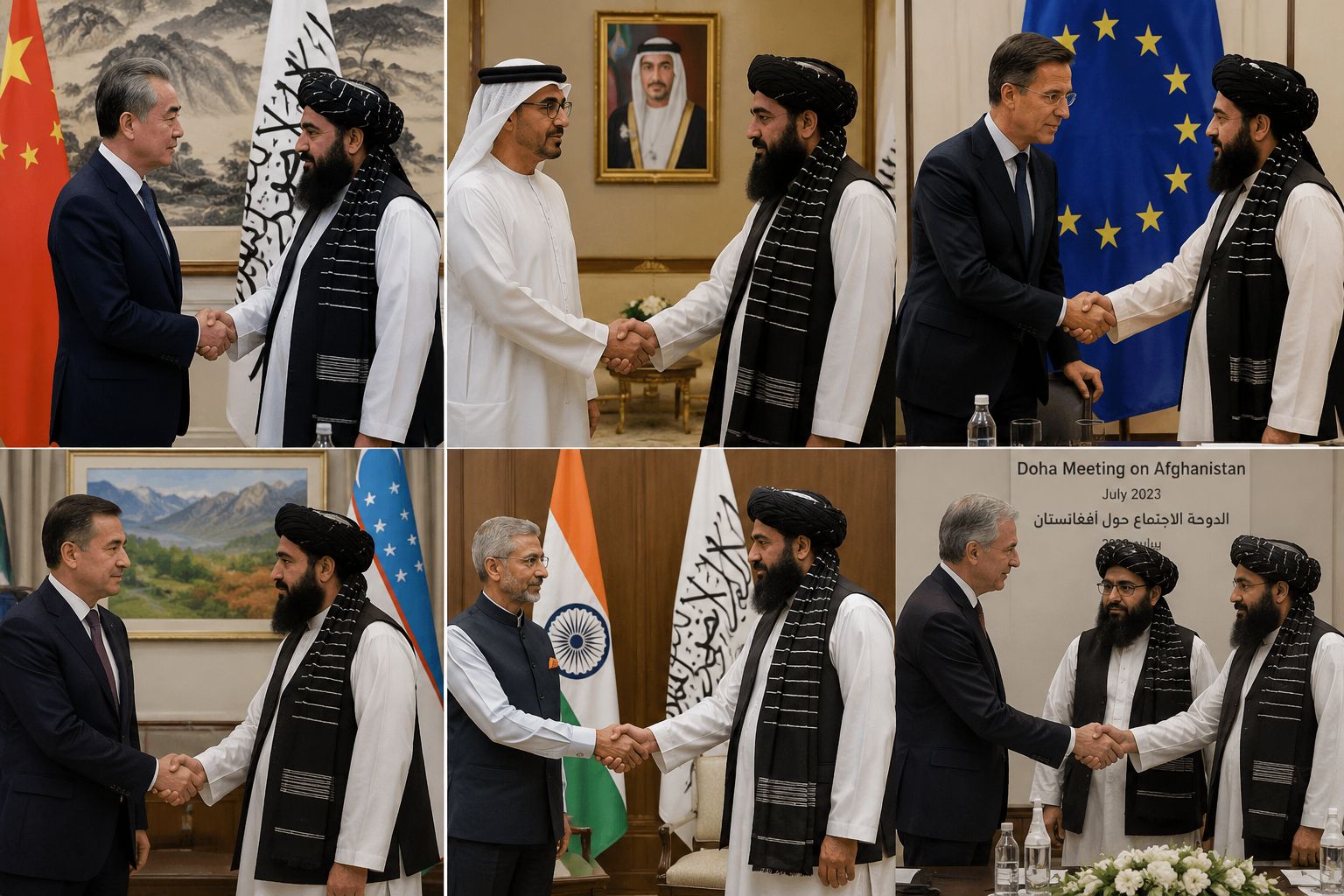
A Taliban minister shaking hands with foreign officials gains something from the photograph even if no treaty is signed. Every international meeting helps demonstrate that the regime is becoming an ordinary participant in international affairs.
The Taliban want precisely that.
Recognition and legitimacy can arrive gradually long before an embassy formally changes the name on its diplomatic credentials.
Diplomatic isolation is disappearing country by country
The normalization of Taliban rule is no longer an abstract possibility. It can be seen in specific diplomatic decisions made by governments that once kept the new regime at arm’s length. Only Russia has formally recognized the Taliban government, but several other countries have moved toward de facto diplomatic relations without taking that final legal step.
Russia crossed the line furthest in July 2025, when it became the first country to formally recognize the Taliban government. Moscow had already removed the Taliban from its list of banned terrorist organizations earlier that year. Russian officials presented closer relations as an opportunity for cooperation on security, counterterrorism, energy, transportation, agriculture and infrastructure. The symbolism was enormous: a movement internationally isolated after taking Kabul in 2021 finally had formal recognition from a major power and permanent member of the UN Security Council.
China has stopped short of formal recognition, but the distinction is becoming increasingly peculiar in practice. Beijing kept its embassy operating in Kabul and became the first country to appoint a new ambassador to Taliban-controlled Afghanistan. In January 2024, President Xi Jinping accepted the credentials of Bilal Karimi, the Taliban-appointed Afghan ambassador to China. Beijing continues to describe its relationship carefully, yet accepting ambassadors while developing trade, investment and security cooperation looks remarkably similar to ordinary interstate diplomacy.
The United Arab Emirates followed a similar path. In August 2024, it accepted the credentials of a Taliban-appointed Afghan ambassador, becoming the second country after China to accept a Taliban envoy at that diplomatic level. Relations have since expanded further, including meetings between senior Emirati and Taliban officials and growing transportation and economic links.
Central Asia, India and Europe
Central Asian governments have also increasingly chosen pragmatism over isolation. Uzbekistan has accepted a Taliban-appointed ambassador and developed relations centered on trade, transportation and regional connectivity. Kazakhstan has likewise accepted Taliban diplomatic representation. These governments have obvious reasons to deal with the authorities controlling Afghanistan: geography, commerce, security and the possibility of connecting Central Asia with markets farther south. Yet every additional ambassador, ministerial meeting and economic agreement also makes Taliban rule look less exceptional.
India provides another particularly striking example. New Delhi closed its embassy after Kabul fell in 2021 but gradually restored a presence through a technical mission. In October 2025, India announced that it would upgrade that mission back to full embassy status. India still does not formally recognize the Taliban government, but the restoration of an embassy demonstrates how dramatically relations have changed since the chaotic evacuation of 2021.
Even European engagement is becoming more visible. In June 2026, Taliban representatives traveled to Brussels for talks concerning the return of Afghan migrants. European governments can reasonably argue that negotiating with Afghanistan’s de facto authorities is sometimes unavoidable, particularly over migration and humanitarian issues. Nevertheless, such meetings contribute to a broader transformation: officials who were international pariahs five years ago are increasingly sitting across the table from foreign diplomats.
This distinction between formal recognition and practical normalization therefore matters. Saying that “the world has recognized the Taliban” would be inaccurate. Most governments have not. But recognition does not have to arrive everywhere through a dramatic announcement. It can happen incrementally: first technical contacts, then diplomatic meetings, then reopened missions, accepted ambassadors, trade agreements and official visits.
And what did Afghan women receive in return?
This should be the central question whenever another government expands relations with Kabul.
What concession did the Taliban make?
Did girls return to secondary school?
No.
Did women return to universities?
No.
Were restrictions on employment removed?
No.
Did women regain normal freedom of movement and participation in public life?
No.
Instead, international engagement has expanded while the basic architecture of repression remains intact.
That creates a dangerous incentive structure. If governments eventually cooperate with the Taliban regardless of what the Taliban do to women, why would the regime change?
Patience becomes a political strategy.
The Taliban can simply wait.
The world has other problems
There is another reason Afghanistan is disappearing from international attention.
The world moved on.
Ukraine, Gaza, Iran, Sudan, migration, economic instability and geopolitical competition dominate governments and news organizations. Afghanistan is no longer the central international story it was in August 2021.
That is understandable. Governments have limited political attention, journalists have limited space, and the public cannot concentrate equally on every humanitarian disaster.
But dictatorships benefit enormously from this exhaustion.
A spectacular atrocity generates headlines. Institutionalized oppression eventually becomes routine.
A girl being banned from school is shocking.
Millions of girls remaining banned from school year after year becomes a statistic.
That transformation from outrage into familiarity is one of the most powerful allies authoritarian governments possess.
There is another uncomfortable reality
Afghanistan also exposes the limits of Western intervention.
The United States and its allies spent two decades, enormous amounts of money and thousands of lives trying to build a different Afghanistan. The resulting state collapsed with astonishing speed in 2021.
Pretending that this history does not matter would be absurd.
Military intervention failed to create a sustainable political system. Corruption plagued the former Afghan government. Western governments made disastrous mistakes, and the eventual withdrawal left many Afghans who had cooperated with Western forces behind.
Five years later, some former Afghan soldiers and other Western allies still live in fear of deportation back to a country controlled by the people they fought.
None of this, however, requires accepting the Taliban’s treatment of women.
Opposing another twenty-year war and opposing gender apartheid are perfectly compatible positions.
The alternative to military occupation cannot simply be indifference.
Afghan women have not disappeared
It is also important not to describe Afghan women exclusively as passive victims.
They continue working where they can. Some teach secretly. Others run businesses, document abuses, provide healthcare, write, campaign or maintain underground educational networks.
Recent accounts from Afghan women describe former teachers, journalists, students, workers and writers attempting to preserve pieces of independent life under extraordinary restrictions.
That resistance deserves attention precisely because the Taliban have worked so aggressively to remove women from public visibility.
When a government tries to make a group invisible, forgetting that group becomes an unintended form of cooperation.
Recognition should have a price
The international community cannot magically transform Afghanistan.
Sanctions alone will not liberate Afghan women. Refusing every diplomatic conversation will not reopen schools. Another foreign invasion would be neither realistic nor desirable.
But governments still possess leverage.
Diplomatic recognition is leverage. Development assistance is leverage. Trade is leverage. Access to international financial systems is leverage. Official visits are leverage. International organizations are leverage.
Those tools should not be surrendered for nothing.
At minimum, meaningful normalization should require measurable improvements in fundamental rights, particularly education.
Allowing girls to attend secondary school is hardly an extremist Western demand. Allowing women to study at universities is not cultural imperialism. Allowing adults to work, travel and participate in society is not an attack on Afghanistan.
These are basic freedoms.
Human rights cannot depend on geopolitical convenience
There is a broader principle at stake.
Human rights mean very little if governments defend them only when doing so is politically convenient.
It is easy to condemn a regime when there is no cost. The real test comes when that regime controls migration routes, mineral resources, strategic territory or security relationships that other governments want.
Afghanistan is becoming such a test.
Countries understandably need to communicate with the Taliban. But communication should never be confused with moral rehabilitation.
A government does not become respectable merely because it survives long enough.
Five years is already too long
A generation of Afghan girls is growing up while the international community debates terminology, diplomatic strategy and geopolitical necessity.
For those girls, five years is not an abstract diplomatic interval.
It is childhood.
It is secondary school.
It is the difference between entering university and never being allowed through its doors.
It is knowledge they were prevented from acquiring, careers they may never begin and independence deliberately placed beyond their reach.
The Taliban have survived. They control Afghanistan. Governments therefore face the unpleasant reality that some engagement with them may be unavoidable.
But inevitability is not legitimacy.
The world can talk to the Taliban without pretending that the Taliban have become normal. It can negotiate humanitarian access without forgetting women. It can discuss migration without exchanging fundamental rights for convenient deportation arrangements.
Above all, governments should remember what has actually changed during the past five years.
It wasn’t the Taliban.
It was our willingness to tolerate them.