

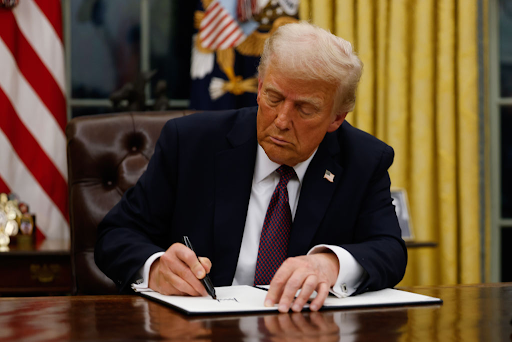
On January 20, 2025, President Donald Trump resumed office with a flurry of executive orders that reflect sweeping changes in immigration, energy policy, military structure, and governance. These actions have sparked polarized reactions across the political spectrum, but for freethinkers and secularists, they pose profound questions about the trajectory of American democracy, human rights, and the balance between tradition and progress.
Immigration: A Wall of Exclusion or a Shield of Sovereignty?
Trump’s reinstatement of the “Remain in Mexico” policy and declaration of a national emergency at the U.S.-Mexico border signal a return to stringent immigration enforcement. Perhaps most controversial is his proposal to end birthright citizenship for children of undocumented migrants and those on temporary visas. This move not only challenges the 14th Amendment—a cornerstone of American identity—but also raises ethical concerns about statelessness and the treatment of vulnerable populations.
For secularists who advocate for evidence-based policies, the question is: do these measures address the root causes of migration, or are they symbolic gestures aimed at appeasing a base that equates nationalism with security? Freethinkers must grapple with the tension between maintaining national sovereignty and upholding universal human rights.
Energy Independence: Progress or Regression?
The declaration of a “national energy emergency” to expedite oil permits and the withdrawal from the Paris Climate Accord mark a stark shift away from the renewable energy policies of the previous administration. By scrapping federal regulations promoting electric vehicles, Trump’s administration has effectively doubled down on fossil fuels.
While energy independence may appeal to a pragmatic desire for economic stability, it comes at the cost of accelerating climate change—a reality that science unequivocally warns us against. For a community grounded in reason and long-term thinking, this raises an existential question: how do we reconcile immediate economic interests with the pressing need to mitigate environmental collapse?
Military Restructuring: A Blow to Inclusion?
In a move that has alarmed advocates for equality, Trump’s orders to ban transgender individuals from military service and dismantle Diversity, Equity, and Inclusion (DEI) programs signal a rollback of hard-won progress. Coupled with the reinstatement of service members discharged for refusing COVID-19 vaccines, these measures reflect a broader shift toward prioritizing conformity over diversity.
For secularists and humanists, this raises critical concerns. How do we ensure that the military, an institution funded by all taxpayers, represents and serves all citizens equitably? And what does this exclusion mean for the broader fight against systemic discrimination?
Foreign Policy: Isolationism in Disguise?
Trump’s decision to withdraw from the World Health Organization and designate human trafficking cartels as Foreign Terrorist Organizations aligns with his broader “America First” doctrine. While combating human trafficking is laudable, withdrawing from global health initiatives during a time of increasing pandemics could have catastrophic consequences.
Freethinkers must question whether these moves reflect genuine policy solutions or a retreat into isolationism that undermines international cooperation and collective problem-solving.
Governance: Efficiency or Authoritarianism?
The implementation of “Schedule F,” aimed at reducing job protections for federal employees, and the creation of a Department of Government Efficiency raise alarms about the erosion of bureaucratic independence. Critics argue that these measures could politicize the civil service, turning it into an apparatus for partisan agendas.
For freethinkers, who value checks and balances as a safeguard against authoritarianism, this development demands scrutiny. How do we ensure accountability without undermining the expertise and neutrality of the federal workforce?
A Call to Thoughtful Engagement
President Trump’s executive orders are undeniably transformative, but transformation without critical evaluation can lead to unintended consequences. For freethinkers and secularists, the challenge is to navigate these policies with nuance, balancing pragmatism with principles and immediate needs with long-term goals.
These actions demand robust debate and conversation. What kind of nation do we aspire to be? How do we address the complexities of a rapidly changing world while staying true to the ideals of liberty, equality, and reason?
As these policies unfold, it is imperative for those who champion evidence-based thinking and humanistic values to remain engaged, vigilant, and vocal. The stakes are too high for silence.
Your thoughts? Let us know in the comments below. How do you see these policies shaping the future of America? Are they steps toward progress or regressions into division?






