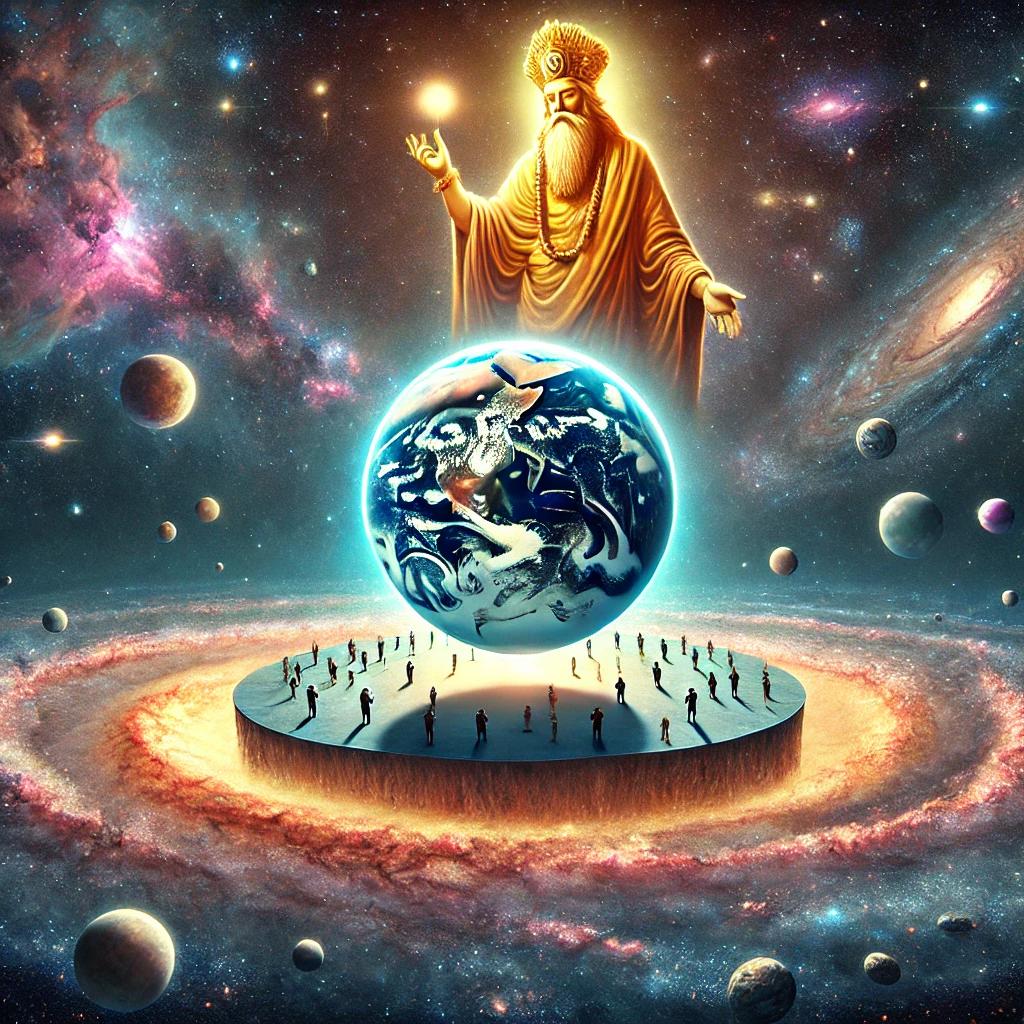
Monotheism, the belief in a single, all-powerful God, is a relatively recent development in the grand timeline of the universe and even Earth’s history. To understand its emergence, we must consider the context of humanity’s intellectual and social evolution against the backdrop of an ancient cosmos.
The vast timeline of the universe
The universe is approximately 13.8 billion years old, while Earth formed about 4.5 billion years ago. For the vast majority of this time, life—and certainly human-like cognition—did not exist. Belief in a monotheistic God arose only within the last few thousand years, a mere blink in the immense timeline of cosmic and terrestrial history. If we were to scale the universe’s age to a single calendar year, humanity would only appear in the final seconds of December 31.
Planets, including Earth, are tiny compared to the vast distances between them. For example, the Sun is about 1.3 million times the volume of Earth, and yet it is just one star among hundreds of billions in our galaxy. If the Earth were the size of a small ball, like a ping-pong ball, the Moon would be another ping-pong ball about 11 meters away, while the nearest star would be over 40,000 kilometers away—a staggering distance that dwarfs our understanding of size and proximity. In this perspective, humans are as small as ants scurrying on this tiny ball, attempting to make sense of an incomprehensibly vast universe.
The evolutionary context
Humans evolved only about 300,000 years ago, and for the majority of this time, early humans lived as hunter-gatherers with no organized religion or concept of monotheism. Instead, they likely had animistic beliefs, attributing spiritual significance to natural phenomena like rivers, trees, and animals. These beliefs were shaped by immediate survival needs and a lack of understanding about the natural world.
Monotheism as we understand it today began to emerge only after the advent of agriculture, roughly 10,000 years ago. This shift allowed for the establishment of permanent settlements, surplus resources, and social hierarchies. The rise of monotheism coincided with these developments because organized religion served practical purposes: it unified communities, justified authority, and provided explanations for life’s mysteries.
Why monotheism appeared recently
-
Cognitive development: The cognitive revolution, which occurred around 70,000 years ago, enabled humans to think abstractly, communicate complex ideas, and share collective myths. This development laid the groundwork for monotheism, as humans began to conceptualize an all-powerful deity governing the universe.
-
Agriculture and civilization: As human societies grew larger and more complex, they needed unifying ideologies to maintain order. Monotheism provided shared beliefs and moral codes that transcended individual communities. Stories of an omniscient God and divine will were powerful tools for ensuring cooperation and compliance.
-
Ignorance of natural phenomena: Early humans had limited understanding of the natural world. Phenomena like storms, eclipses, and earthquakes were terrifying and inexplicable. Belief in an all-powerful God offered explanations and a sense of control over these uncontrollable forces.
-
Existential questions: As humans became self-aware, they grappled with questions about life, death, and purpose. Monotheism offered comforting answers, such as the promise of an afterlife or divine justice, which helped humans cope with uncertainty and fear.
The scale of the universe and human insignificance
The emergence of monotheism is a testament to humanity’s desire to find meaning in a universe that seems indifferent to our existence. Consider the scale of the cosmos: our galaxy alone contains around 100 billion stars, and there are more galaxies in the observable universe than grains of sand on all the world’s beaches. The distances between celestial objects are so immense that light, traveling at 300,000 kilometers per second, takes years to traverse even a fraction of the cosmos.
In this context, humans are indeed like ants on a tiny ball. Our perceptions and beliefs, including monotheism, are shaped by our limited perspective and the challenges of understanding a universe far beyond our scale. When viewed against this backdrop, the emergence of monotheism can seem almost ridiculous—a species of tiny creatures, confined to an insignificant planet, creating the concept of an omnipotent God concerned with their affairs amidst a universe they barely comprehend. The sheer disparity between human beliefs and the cosmos’s vastness highlights how absurd it can feel to imagine a divine being intervening in the minutiae of human lives.
The flawed internal logic of monotheism
Monotheism also suffers from internal logical flaws. For instance, the belief in an omnibenevolent, omniscient, and omnipotent God renders practices like prayer inherently contradictory. If God is all-knowing and all-powerful, then He is already aware of our needs and desires, making prayer redundant. Furthermore, an omnibenevolent God would act for the ultimate good regardless of human pleas, so the act of praying seems to hold little practical or theological sense.
Similarly, the very existence of humans in a universe supposedly governed by a perfect, all-powerful deity raises questions. If such a God exists, why create beings so flawed, so insignificant, and so prone to suffering? The existence of evil and imperfection in the world challenges the coherence of monotheistic claims. These contradictions highlight how the concept of a monotheistic God often clashes with its own foundational principles.
The historical emergence of monotheism
Belief in a monotheistic God has a rich, albeit recent, history in human civilization. This God is often thought to have created humanity or guided its evolution. Yet, monotheistic claims themselves emerged surprisingly late in human history. Quasi-monotheistic ideas first appeared during the Late Bronze Age, such as Akhenaten’s Great Hymn to the Aten from the 14th century BCE in ancient Egypt. In the Iron Age South Asian Vedic period, a possible inclination toward monotheism also emerged. For example, the Rigveda contains notions of Brahman monism, particularly in its comparatively late tenth book, such as the Nasadiya Sukta, which dates to the early Iron Age.
Monotheism’s place in human history
While monotheism has played a crucial role in human history, it is important to recognize its limitations in explaining the natural world. Scientific advancements over the last few centuries have provided more accurate and testable explanations for phenomena once attributed to divine intervention. However, monotheism remains deeply ingrained in human culture and continues to evolve, reflecting humanity’s enduring quest for meaning and connection.
In conclusion, monotheism appeared recently in the timeline of the universe because it is a product of human cognition and social structures, not a reflection of cosmic necessity. As humans on a tiny ball in an unfathomably vast universe, our beliefs are both a testament to our creativity and a reminder of our limitations—and sometimes, the disparity between our ideas and the cosmos can border on the absurd.