

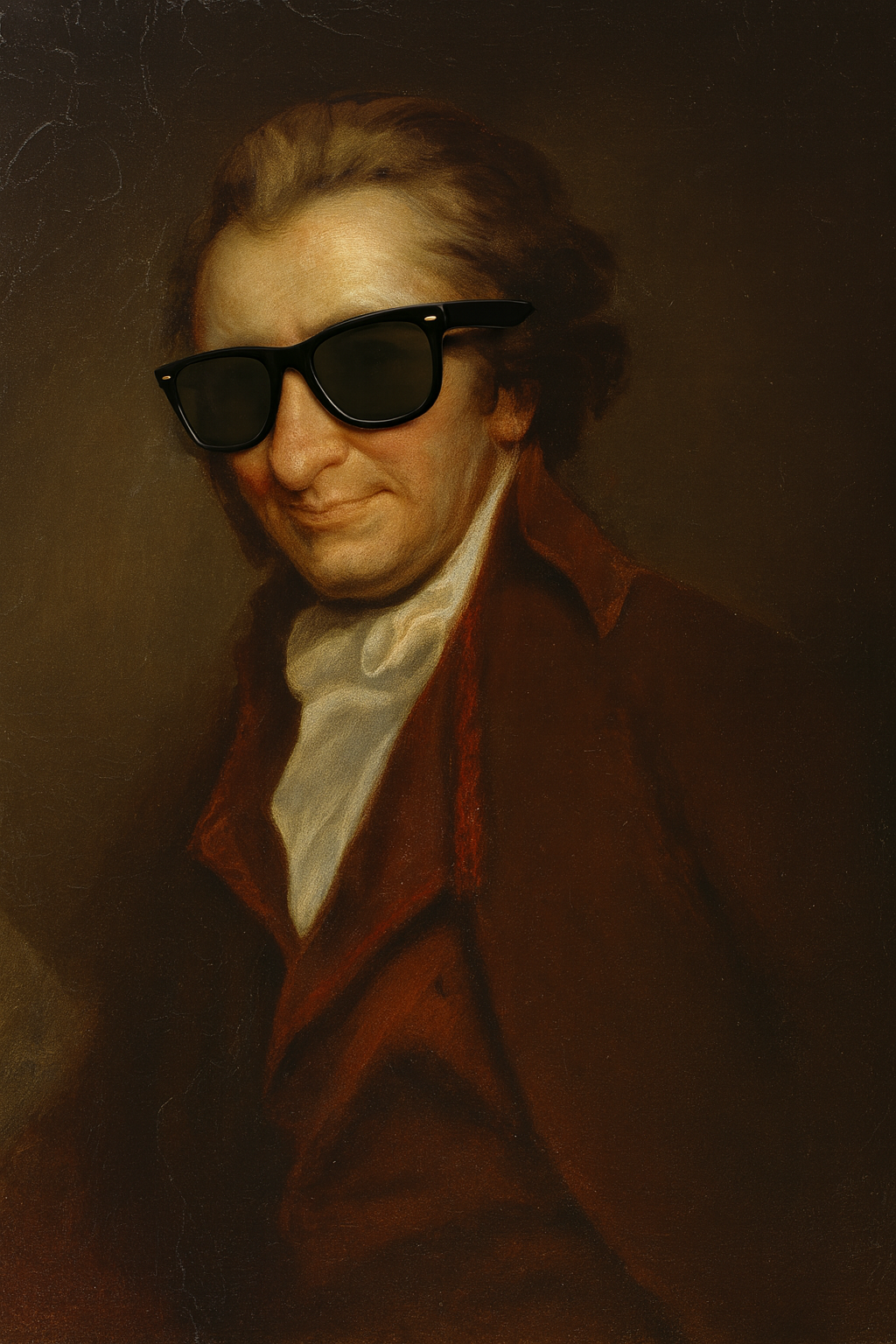
Thomas Paine is best known for sparking revolutionary ideals both in America and Europe with his fiercely independent writings. His pamphlet Common Sense (1776) fueled the American Revolution by making a clear, bold case for independence from Britain. But Paine’s legacy extends far beyond political revolution; his later work, The Age of Reason (1794-1807), ignited a new kind of rebellion—one against organized religion. Paine’s arguments for deism and his searing critiques of institutionalized Christianity shaped the intellectual landscape of Enlightenment thought, inspiring freethinkers for centuries.
The Life of a Radical
Born in Thetford, England, in 1737 to a Quaker father and an Anglican mother, Paine grew up amidst religious tension and economic instability. His early career was full of false starts: he worked as a corset-maker, a sailor, a tax collector, and even ran a small shop, none of which brought him much success. But in 1774, Paine emigrated to America, where his life took a remarkable turn after meeting Benjamin Franklin, who recognized his potential and encouraged his radical ideas.
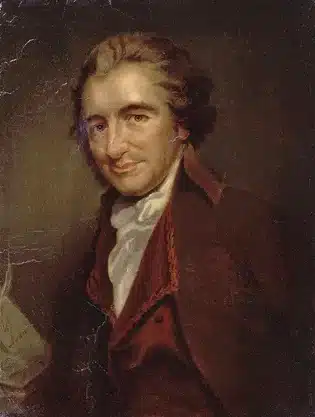
Just two years later, Paine published Common Sense, a scathing indictment of British colonial rule. The pamphlet, written in plain, passionate language, sold over 500,000 copies in a country with a population of just over two million. Paine wasn’t simply advocating for independence; he proposed a whole new system of government—a democratic republic.
After the American Revolution, Paine returned to Europe, where his involvement in the French Revolution nearly cost him his life. While imprisoned during the Reign of Terror in France, Paine began writing The Age of Reason, a polemic against organized religion that would later cement his role as one of the most controversial thinkers of his time.
Dogmas Disputed
Paine was deeply opposed to the dogmas of Christianity, especially its reliance on miracles, mysteries, and the authority of clergy. In The Age of Reason, Paine makes his case for deism—a belief in a creator god who does not intervene in human affairs. He rejected the Bible as a divine text, viewing it instead as a historical document full of contradictions and moral inconsistencies. His critique of religious institutions was harsh: he saw the church as a corrupt body that manipulated people for power and profit.
Paine’s most famous line, “My own mind is my own church,” encapsulates his belief that individuals should rely on reason and personal conscience rather than religious authorities.
Core Beliefs
At the heart of Paine’s philosophy was a deep faith in human reason and the natural rights of man. He believed in the inherent equality of all people and that governments should exist to protect these rights, not to rule over them. While he was a fierce critic of monarchy, Paine also championed social welfare policies, such as progressive taxation and pensions for the elderly, laying the groundwork for modern social democracy.
Paine’s deism was equally revolutionary. He argued that true religion should be based on reason and the study of nature, not on revelations from prophets or sacred texts. This view aligned him with other Enlightenment thinkers, though it also earned him powerful enemies.
Opposition Faced
Paine’s ideas were incendiary, and the backlash was fierce. After publishing The Age of Reason, he was vilified as an atheist (though he identified as a deist) and traitor, even in the country he helped to liberate. Religious leaders and politicians alike condemned him; Theodore Roosevelt later called him a “filthy little atheist” (ironically, Paine’s criticisms were aimed not at belief in God but at organized religion).
In England, Paine’s radicalism made him a target of the government. His Rights of Man (1791), which supported the French Revolution and attacked hereditary monarchy, led to his being tried for sedition in absentia. He narrowly escaped execution in France, saved only because of American diplomatic intervention. His final years were marked by poverty, obscurity, and slander.
Legacy and Modern Relevance
Despite the controversies, Paine’s influence has endured. His clear, compelling arguments for democracy, human rights, and reason have left an indelible mark on Western thought. The American Revolution may not have succeeded so swiftly without his clarion call for independence, and his critiques of religious orthodoxy paved the way for more open, secular societies.
In today’s context, Paine’s work on human rights, separation of church and state, and skepticism toward authoritarian institutions feels prescient. His arguments in The Rights of Man and Agrarian Justice also foreshadow modern discussions on wealth inequality, social safety nets, and basic income.
Critical Analysis
While Paine’s contributions to both political and religious thought were groundbreaking, his relentless attacks on organized religion alienated many who might otherwise have been sympathetic to his political ideas. His uncompromising style—whether in his support for revolution or his denouncement of Christian doctrine—was both his greatest strength and his Achilles’ heel. Paine’s belief that reason alone could guide humanity to a just society underestimated the enduring emotional and social power of religious tradition.
Yet, Paine’s ability to frame complex ideas in plain, direct language meant that his works reached beyond the intellectual elite. This populist approach has made him a symbol of democratic values, and his legacy continues to inspire debates about freedom of thought and belief.
Further Reading and Resources:
- Common Sense (1776) – Full text
- The Age of Reason (1794-1807) – Full text
- Paine’s biography at The Thomas Paine National Historical Association
- Yuval Noah Harari’s discussion on deism in Sapiens offers a modern perspective on ideas Paine explored.
Thought-Provoking Summary:
Thomas Paine’s unyielding belief in the power of reason, individual liberty, and democratic governance continues to reverberate through history. He challenged kings and clerics alike, arguing for the potential of humanity to govern itself without tyranny or superstition. Paine’s life reminds us that freethought often comes with a heavy price—but it also leaves behind a legacy that can ignite revolutions of both mind and society.





