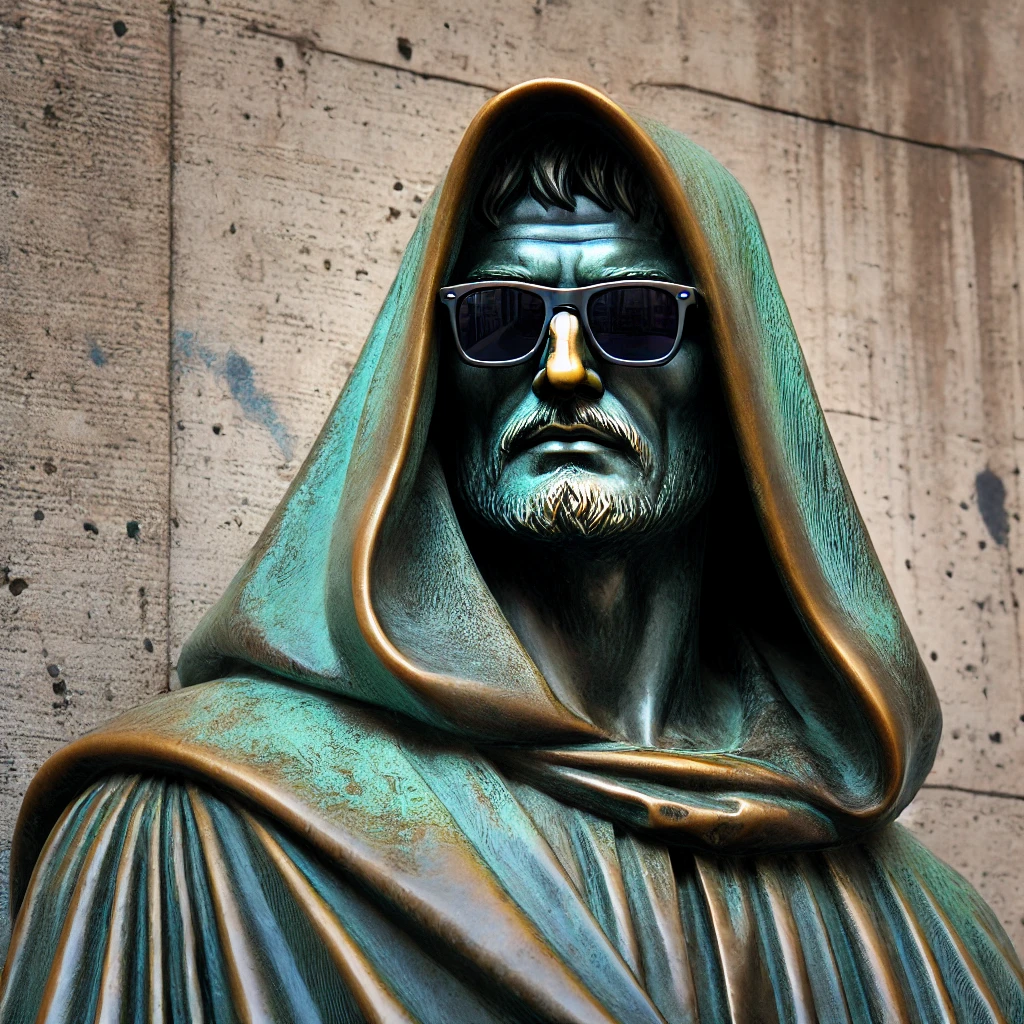
Giordano Bruno was an Italian philosopher, astronomer, and mathematician whose radical ideas about the universe and his defiance of religious dogma made him one of the most controversial figures of the Renaissance. Bruno’s advocacy for an infinite universe, populated by countless stars and possibly inhabited worlds, challenged the dominant geocentric worldview of his time. His unyielding commitment to his beliefs ultimately led to his execution by the Roman Catholic Church, making him a martyr for free thought and scientific inquiry.
The Intellectual Journey of a Heretic
Born in 1548 in Nola, near Naples, Giordano Bruno entered the Dominican Order at a young age, where he adopted the name “Giordano” from his birth name, Filippo. Despite his monastic life, Bruno’s inquisitive mind soon led him into conflict with the orthodox teachings of the Church. He was particularly influenced by the works of Copernicus, whose heliocentric model of the solar system was just beginning to gain traction.
Bruno’s intellectual journey took him across Europe, where he lectured and engaged with other thinkers in France, England, and Germany. His studies led him to embrace a form of Neoplatonism, infused with ideas from ancient Greek philosophers like Pythagoras and Heraclitus. But Bruno went beyond merely accepting Copernicus’s heliocentrism; he proposed that the universe was infinite, with no center, and that the stars were distant suns surrounded by their own planets. This was a radical departure from the Aristotelian and Ptolemaic models that dominated medieval thought.
Challenging the Dogmas of the Church
Bruno’s ideas were revolutionary not only because they challenged the scientific understanding of his time but also because they undermined the theological foundations of the Church. By suggesting that the universe was infinite and filled with countless worlds, Bruno implied that humanity and Earth were not the center of God’s creation—a direct affront to the geocentric view that had been enshrined in Christian doctrine for centuries.
Moreover, Bruno’s philosophy extended into the realm of religion itself. He believed in the existence of a divine, infinite spirit that pervaded all of nature, a concept that aligned more closely with pantheism than with orthodox Christianity. He rejected the idea of an eternal damnation and the Trinity, among other core Catholic teachings. His vision of the cosmos was one where divinity was not confined to a particular location or form but was instead an intrinsic aspect of the entire universe.
Opposition and Martyrdom
Bruno’s refusal to recant his ideas and his outspoken criticism of the Church eventually led to his arrest by the Roman Inquisition in 1592. After years of imprisonment and a lengthy trial, during which he steadfastly defended his beliefs, Bruno was declared a heretic. In 1600, he was burned at the stake in Rome’s Campo de’ Fiori, a tragic end that highlighted the Church’s intolerance for dissenting views, particularly those that threatened its doctrinal authority.
Bruno’s death was not just a result of his cosmological theories but also his broader philosophical and theological challenges to the Church. His execution is often seen as a pivotal moment in the history of free thought, symbolizing the conflict between emerging scientific ideas and religious dogma.
Legacy and Modern Relevance
Giordano Bruno’s ideas, though condemned in his time, have since gained recognition for their boldness and prescience. His vision of an infinite universe anticipated later developments in astronomy and cosmology, particularly the work of Galileo and, centuries later, the discovery of the vast expanse of space filled with galaxies and stars.
Today, Bruno is celebrated as a pioneer of the scientific revolution and a martyr for intellectual freedom. His commitment to the pursuit of knowledge, even in the face of persecution, has made him an enduring symbol of the fight against censorship and dogmatism. His ideas also resonate with modern cosmology, which continues to explore the vastness and complexity of the universe he once imagined.
Critical Analysis
Giordano Bruno’s life and work provoke reflection on the dangers of dogmatism and the value of intellectual courage. His ideas about an infinite universe, while speculative at the time, opened new avenues of thought that challenged the narrow worldview of his era. However, some critics argue that Bruno was as much a mystic as a scientist, blending his cosmological theories with metaphysical and religious speculations that were often ungrounded in empirical evidence.
Bruno’s execution serves as a reminder of the high cost of free thought in an era dominated by religious authority. His story underscores the importance of protecting intellectual freedom and supporting the pursuit of knowledge, even when it challenges deeply held beliefs.
Further Reading
- “Giordano Bruno and the Hermetic Tradition” by Frances A. Yates
- “Giordano Bruno: Philosopher/Heretic” by Ingrid D. Rowland
- “The Ash Wednesday Supper” by Giordano Bruno, translated by Edward A. Gosselin
- Stanford Encyclopedia of Philosophy entry on Giordano Bruno
- Internet Encyclopedia of Philosophy Giordano Bruno article
Giordano Bruno’s life is a powerful testament to the enduring struggle between reason and faith, freedom and dogma. His vision of the universe reminds us of the boundless potential of human imagination and the dangers of silencing those who dare to think differently.