

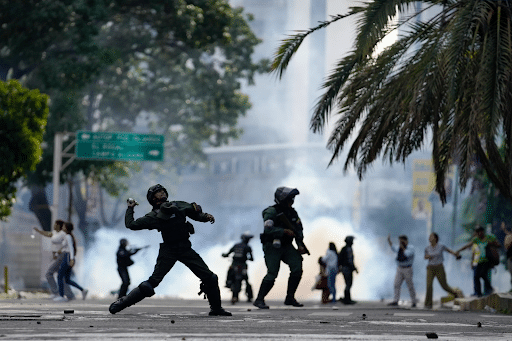
The situation in Venezuela is a sobering reminder of how authoritarianism and a disregard for fundamental human rights can dismantle the very fabric of a society. Following the controversial re-election and January 10, 2025, inauguration of Nicolás Maduro, Venezuela finds itself in the throes of an escalating human rights crisis and a deepening humanitarian catastrophe. This crisis demands more than passive observation; it calls for freethinkers, secularists, and advocates for global justice to engage in critical conversations about power, accountability, and the role of international solidarity.
Democracy Undermined: A Sham Election?
The July 28 elections were marred by allegations of widespread irregularities. While Maduro was declared the winner, independent observers, including the Carter Center and the UN Panel of Electoral Experts, suggest that opposition candidate Edmundo González likely garnered the majority of votes. Yet the government refused to release crucial voting records, fueling suspicions of fraud. This brazen disregard for democratic norms has ignited significant unrest.
In a society that claims to value the will of the people, how do we respond when those in power manipulate the very mechanisms meant to ensure justice? For freethinkers, this raises a pivotal question: Is democracy a universal truth, or is it perpetually vulnerable to exploitation? If even the semblance of free elections can be hijacked, what hope is there for nations teetering on the edge of authoritarianism?
The Cost of Repression
The Venezuelan government’s response to dissent has been brutal. In the aftermath of the elections, protests erupted across the country. Security forces suppressed these demonstrations with violent force, resulting in at least 25 deaths and the arbitrary detention of thousands. Such repression is not only a tragedy but a stark warning about the dangers of unchecked power.
For secularists who champion human rights as a moral foundation independent of divine command, Venezuela poses an unsettling dilemma. How do we reconcile the call for non-intervention with the ethical imperative to oppose oppression? If secularism is rooted in reason and empathy, can it tolerate the suffering of millions for the sake of respecting national sovereignty?
A Nation in Humanitarian Ruin
Beyond the political turmoil, Venezuela’s humanitarian crisis continues to escalate. Over 20 million people—nearly two-thirds of the population—live in multidimensional poverty. Essential goods such as food and medicine are scarce, and the UN’s humanitarian response plan remains woefully underfunded.
This raises another question for freethinkers: Where does the responsibility of the global community begin and end? Is it enough to offer aid, or should intervention extend to direct confrontation with regimes that perpetuate such suffering? Critics argue that meddling risks perpetuating neo-colonialism, while others insist that inaction is tantamount to complicity.
Accountability and the International Community
Organizations such as the Inter-American Commission on Human Rights (IACHR) have called for transparency and accountability, urging investigations into human rights abuses and electoral fraud. But their calls often fall on deaf ears. Without decisive action from the international community, Venezuela’s plight is likely to worsen.
For secularists and freethinkers, this situation underscores a larger philosophical debate: Can morality exist in a vacuum of power? If international bodies like the UN fail to enforce their own principles, what alternative mechanisms can ensure justice? Should global governance evolve beyond outdated paradigms to address the complexities of modern crises?
A Call to Action—And Reflection
Venezuela’s crisis is not just a political or humanitarian issue; it is a test of our collective humanity. It challenges freethinkers to question the very principles they hold dear: democracy, human rights, and the balance between intervention and sovereignty. It asks secularists to confront the moral ambiguity of global politics and to envision solutions that prioritize people over power.
What happens in Venezuela will reverberate far beyond its borders. It is a reminder that the fight for justice is never confined to a single nation. The global community must decide whether to remain passive or to engage in meaningful action that reflects the ideals we claim to cherish.
For freethinkers, this is a moment to lead the conversation, to demand accountability, and to envision a future where human rights are not just an aspiration but a reality. How we respond to Venezuela will define not only their fate but also our own capacity for empathy and reason in the face of injustice.
Let the debate begin.






