

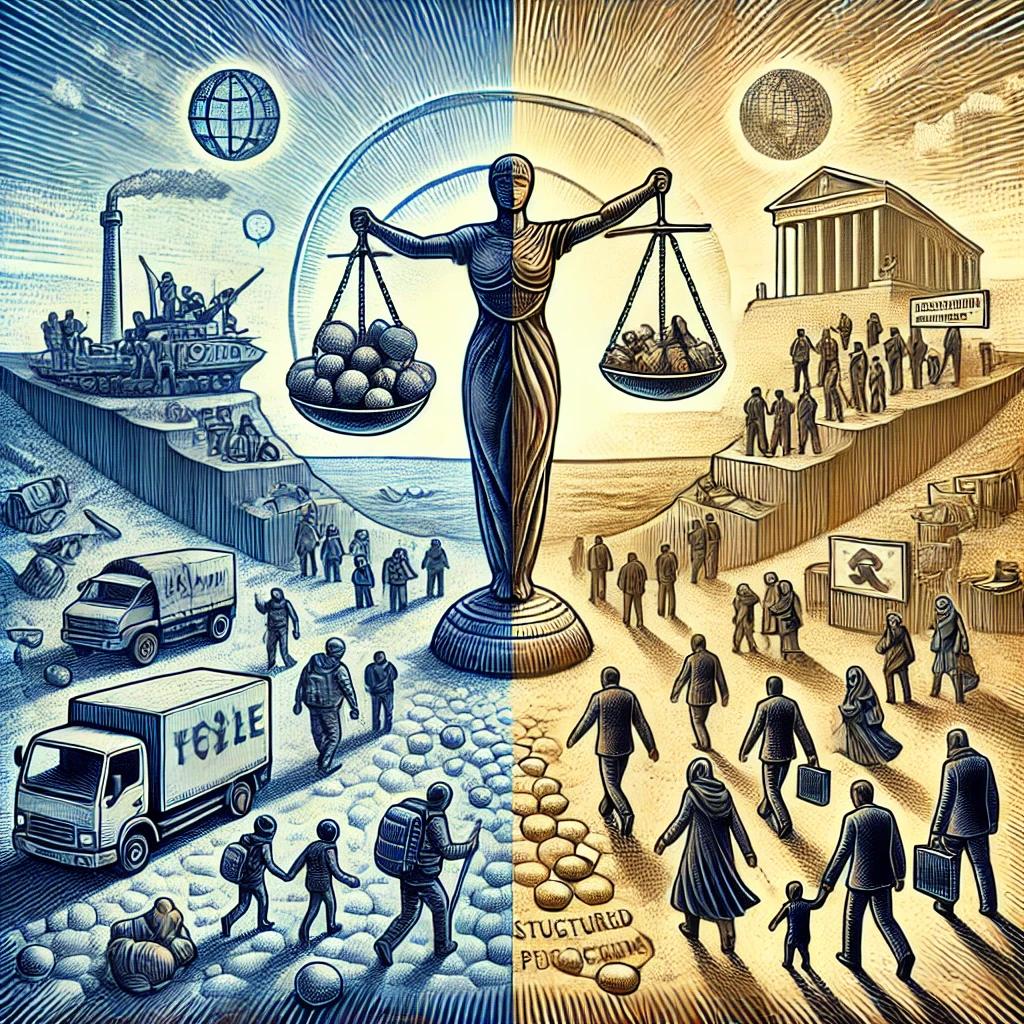
The global refugee crisis is one of the most pressing humanitarian issues of our time. Millions of people flee war, persecution, and economic devastation, seeking safety in more stable countries. The humanist perspective values empathy, dignity, and universal human rights, making it a natural advocate for supporting refugees. However, humanism is also rooted in reason and evidence-based policies, which means acknowledging the realities of migration.
Some refugees should be accepted. Others should not. A purely open-door policy, without proper screening, leads to social tensions, crime, and economic strain. The influx of refugees is not solely an organic phenomenon. Global financial elites have played a role in creating chaos in developing nations, fostering migration waves that weaken national sovereignty and create a nationless masses prone to manipulation. Whether intentional or not, the effect is clear: mass migration benefits powerful global interests while ordinary people—both in host countries and among refugees themselves—bear the consequences.
The super-rich elites desire to divert attention from their obvious crimes, manipulating enormously vulnerable people during one of the worst times in their lives.
I live in a country that is completely against any immigration. It is a racist, racially-hateful and xenophobic land. A rational, humanist approach must balance humanitarian responsibility with long-term societal stability. It should focus on integration, rejecting individuals who pose a threat to social cohesion while supporting those who contribute positively. This article examines the causes of the refugee crisis, humanist principles, challenges, and policies that can create a sustainable and ethical response.
Causes of the refugee crisis
The refugee crisis stems from multiple interconnected causes:
-
War and conflict: Ongoing wars in Syria, Afghanistan, Ukraine, Sudan, and Yemen have displaced millions. Many refugees genuinely need protection.
-
Political persecution: Authoritarian regimes in North Korea, Iran, Myanmar, and elsewhere force political dissidents to flee.
-
Economic hardship and climate change: Droughts, food shortages, and economic collapse have led to large-scale migrations, especially from Africa and parts of South Asia.
-
Global financial elites and manufactured instability:
-
Western interventions have destabilized developing nations, fueling wars and economic disasters that push people to flee.
-
Debt slavery and neocolonial economic policies have stripped nations of their self-sufficiency, making mass migration inevitable.
-
The financial elite benefits from open borders, as large-scale migration dilutes national identity, weakens labor rights, and increases social fragmentation.
- A population without national ties is easier to manipulate, keeping political and economic power in the hands of the few.
-
Humanist principles and migration
Humanism supports universal human rights, including the right to seek asylum. However, it also values reason, evidence-based decision-making, and long-term societal health. A humanist response to migration must:
-
Reject xenophobia and blind nationalism but recognize the importance of cultural and social stability.
-
Uphold secular, evidence-based policies rather than emotional, ideological, or corporate-driven decisions.
-
Ensure integration, not just arrival—a refugee must adapt to the host society, not the other way around.
-
Acknowledge that not all refugees are equal—some can integrate and contribute, while others bring crime, ideological extremism, and long-term social instability.
- Clarify priorities: It is not about preserving Europe as white, black, or yellow. It is about preserving intelligence, talents, creativity, morality, and social harmony.
Some must be accepted, some must be rejected
A functional refugee policy cannot accept everyone. The distinction must be made based on:
- Ability to integrate:
-
Willingness to adopt the culture and values of the host country.
-
Acceptance of secularism, democracy, and human rights.
-
Basic level of education, skills, or professional qualifications.
-
- Criminal and ideological background:
-
Individuals with violent or criminal records should be immediately rejected.
-
Those holding radical religious or political beliefs incompatible with democratic societies should not be admitted.
-
- Humanitarian priority:
-
Women, children, and families escaping genuine war zones must be prioritized.
-
Political dissidents and persecuted minorities (e.g., Yazidis, Christians, LGBTQ individuals in oppressive regimes) deserve asylum.
-
Case studies: Humanist responses in action
Germany (2015-2016 Open-Door Policy)
Germany accepted over 1 million refugees, mostly from Syria, Afghanistan, and North Africa. While many integrated successfully, a significant portion failed to assimilate, leading to social tensions and crime. The mass influx led to a rise in sexual assaults, violent crime, and terror attacks. Despite government efforts, many refugees remain unemployed and dependent on welfare.
Sweden: A Cautionary tale
Sweden, once a beacon of humanitarianism, has struggled with integration. Certain refugee communities have disproportionately high crime rates, particularly involving violent assaults and gang activity. The country has witnessed a rise in parallel societies, where migrant populations refuse to integrate, creating religious enclaves with anti-secular values.
Canada: Selective and structured refugee programs
Canada’s private sponsorship program has been relatively successful because it allows communities to sponsor specific refugees. The program focuses on families, skilled individuals, and persecuted minorities, minimizing the acceptance of refugees with criminal or extremist backgrounds.
Challenges to a humanist response
-
Right-wing backlash: Public resentment grows when governments ignore legitimate concerns.
-
Religious vs. secular conflict: Some migrant communities resist secular values, leading to cultural friction.
-
Crime and safety issues: Some refugees commit violent crimes, leading to political unrest and loss of public trust in migration policies.
-
The long-term impact on intelligence and social order:
-
Uncontrolled migration can lead to a decline in average national IQ if too many non-intelligent, uneducated, unskilled individuals are accepted.
-
Cultural erosion—migrants who reject Western values weaken societal cohesion.
- Elites benefit from the erosion of national identity, using mass migration to weaken resistance against their economic control.
-
Policy recommendations
- Stronger vetting systems:
-
Refugees must be screened for criminal backgrounds, ideological extremism, and ability to integrate.
-
- Humanitarian prioritization:
-
Focus on war refugees, political dissidents, and persecuted minorities.
-
Limit the intake of economic migrants seeking benefits without contributing.
-
- Mandatory integration programs:
-
Language, education, and employment training must be compulsory.
-
Deportation policies for those who refuse to integrate.
-
- Reject open borders, But avoid mass deportations:
-
Open-border policies are detrimental to social stability.
- However, mass deportations would increase suffering and cause instability. A balanced, selective approach is necessary.
-
Western soft power and the refugee crisis
The West once championed human rights, free speech, and democracy. However, its credibility has eroded due to contradictory policies:
-
Intervening militarily in foreign nations, then refusing to accept the refugees those wars create.
-
Pushing for diversity while ignoring real social problems linked to migration.
- Failing to acknowledge that mass migration primarily benefits financial elites, not ordinary citizens.
Prognosis: What will happen next?
-
Short-term (5–10 years): Countries will continue struggling with migration crises, with populist movements rising in response.
-
Medium-term (10–20 years): Europe will either reform its migration policies or face increasing social instability.
- Long-term (20+ years): The refugee crisis will worsen due to climate change and economic instability, requiring a global restructuring of migration policies.
Conclusion
A humanist response to the refugee crisis must be rational, ethical, and sustainable. Accepting refugees is a moral duty, but indiscriminate open-door policies are a disaster. Some refugees should be accepted. Others should not. It is a masterpiece by the elites because they have diverted attention from their obvious crimes. The focus – regarding every single immigrant – must be on IQ, intelligence in a broader sense, or generalizable way, skills, morality, and ability to integrate, ensuring that migration strengthens society rather than weakens it.


