

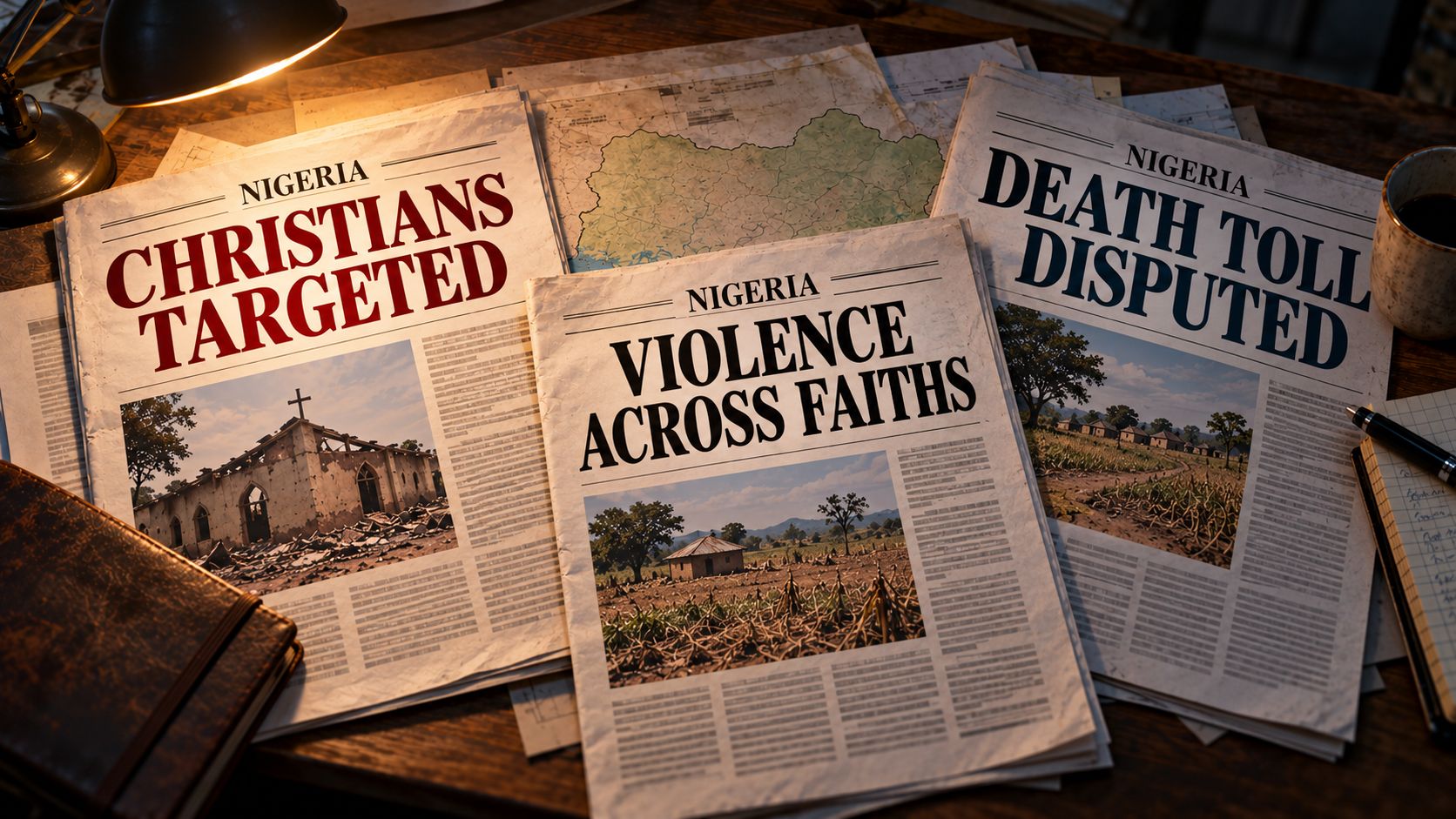
Editorial note: This article reviews selected published reporting and research consulted on 28 October 2026, not an independent investigation on the ground. Most detailed examples concern 2025 or earlier; it is not a comprehensive account of incidents during 2026. Access to affected communities is uneven, and casualty figures, perpetrators and motives may be misreported or remain unknown. We may be wrong about particular figures, individual attacks or the relative importance of different causes. Better evidence could show that religious targeting is more extensive—or less extensive in some settings—than this assessment suggests. We should correct errors and revise conclusions when credible evidence warrants it.
Christians in Nigeria have been murdered, abducted, displaced and attacked while worshipping. Some have faced explicit demands to abandon their faith. These are serious human-rights violations, and uncertainty about the wider conflict must never become an excuse to dismiss them.
Some advocates describe the violence against Christians as genocide. Assessing that claim requires identifying the perpetrators, the communities targeted and the evidence of an intention to destroy a protected group. Nigeria’s overlapping conflicts cannot be treated as a single campaign without demonstrating the connections between them. Nigeria faces overlapping insurgencies, criminal economies, communal conflicts and failures of government protection. Religious identity can determine who is targeted, but it also intersects with ethnicity, land ownership, political exclusion and the ability to pay ransom.
A responsible account must take Christian persecution seriously while examining the claims made about its scale, perpetrators and causes. It must also acknowledge Muslim victims without using their suffering to erase attacks on Christians.
What we can say with confidence
There is credible evidence that Christians are deliberately targeted in some Nigerian attacks. This is not merely an allegation circulating among foreign politicians or religious campaigners.
In reporting published in November 2025, Associated Press interviewed survivors of a November 2024 abduction at a Baptist church in Ligari, Kaduna state. Former hostages described ransom demands, deprivation and pressure to renounce Christianity. Their accounts illustrate how financial extortion and religious persecution can operate together.
A kidnapping does not cease to be religious persecution because the perpetrators also want money. Conversely, the kidnapping of a Christian does not automatically establish a religious motive. The circumstances matter: what the attackers said, whom they selected, how captives were treated, and whether particular communities were repeatedly targeted.
Churches and Christian organizations can provide essential evidence because they remain present where outside reporters have little access. Their testimony deserves investigation rather than automatic acceptance or dismissal.
Nigeria is experiencing several forms of violence
In the northeast, Boko Haram and Islamic State West Africa Province have pursued explicitly Islamist projects. Their violence includes attacks on Christians, but also extensive violence against Muslims, state institutions and people accused of opposing their authority.
In the northwest, armed gangs conduct kidnappings, village raids, extortion and cattle theft. Religious identity may influence particular attacks, but a large part of this violence operates through criminal markets and struggles for territorial control.
Across the Middle Belt, including parts of Plateau and Benue states, violence frequently involves predominantly Christian farming communities and predominantly Muslim Fulani herding communities. Disputes over land, grazing, political power and local belonging overlap with religious and ethnic divisions.
These categories are useful, but their boundaries are porous. Criminal groups can cooperate with insurgents. Communal militias can adopt religious language. Local disputes can become campaigns of collective punishment.
The phrase “farmer-herder conflict” can itself obscure more than it explains. It may suggest a spontaneous confrontation between armed rivals when a particular incident involved a planned massacre of civilians. Each attack needs its own examination.
Religion and resources are not competing explanations
Public debate often presents a false choice: either Christians are being persecuted, or the violence concerns land and resources.
An armed group can seek farmland while selecting a Christian community for expulsion. Religious hostility can help justify dispossession. Economic grievances can be mobilized through ethnic identities, while a history of massacres turns a local dispute into an opportunity for revenge.
Environmental pressure, changing land use and weakening dispute-resolution mechanisms can help explain why conflicts intensify. They do not explain every decision to attack a village, and they do not diminish the responsibility of those who murder its inhabitants.
Equally, religious slogans or the identities of the victims do not, by themselves, explain an entire conflict. Evidence of religious hostility should be examined alongside evidence about organization, financing, territorial objectives and previous attacks.
Understanding these connections matters because different causes require different responses. Protecting a threatened church, dismantling a kidnapping network and resolving discriminatory access to land are related tasks, but they are not interchangeable.
The numbers require particular caution
Large death tolls dominate international arguments about Nigeria. They can also conceal basic disagreements about what is being counted.
“Christians killed in violence” is not the same category as “Christians killed because they were Christian.” Neither is identical to “deaths in incidents where reporting explicitly identified religious targeting.”
The reporting period matters too. A six-year estimate cannot be compared directly with an annual figure. Civilian deaths cannot be treated as equivalent to totals that also include combatants and security personnel.
Open Doors reported that 3,490 Christians were killed in Nigeria for faith-related reasons during its World Watch List 2026 reporting period, from 1 October 2024 to 30 September 2025. This is the organization’s classification and estimate, not an independently verified national total.
The Observatory for Religious Freedom in Africa, or ORFA, offers a different dataset. Its June 2026 fact sheet reports 42,033 civilian deaths within its dataset for October 2019–September 2025: 22,835 Christians, 10,519 Muslims, 184 adherents of African traditional religions and 8,495 people whose religious identity was unknown. We have checked these figures against ORFA’s publication but have not independently audited its incident records or religious classifications.
ORFA also presents higher religious-group totals after allocating the unknown cases among categories. Those adjusted figures must not be described as if investigators had established the religion of every additional victim. Allocation is an analytical step, not newly discovered identification.
None of these cautions implies that the suffering is exaggerated. They mean that numbers need explanations before they can support conclusions.
Advocacy organizations have strengths—and limits
Christian advocacy groups often maintain networks in communities that receive little sustained international attention. They may record attacks overlooked elsewhere and recognize patterns that broad conflict databases miss.
Their religious commitments do not invalidate their work. But their mission does shape the questions they investigate, the populations they monitor and the language they use.
Readers should ask how an organization establishes a victim’s religion, distinguishes civilians from fighters, identifies perpetrators and determines motive. Does it publish incident-level evidence? Does it explain uncertainty? Can other researchers audit its conclusions without exposing vulnerable witnesses?
The European Union Agency for Asylum, for example, reported an Intersociety estimate of more than 7,000 Christians killed during part of 2025, while explicitly noting that the figures could not be corroborated by other sources. That qualification is essential and should travel with the claim whenever it is repeated.
An impressive-looking total is not a substitute for transparent methods. Nor is the absence of a comprehensive public dataset proof that a local organization is wrong.
Conflict databases are not complete censuses
ACLED is valuable because it applies a structured approach to recording political violence. But it explicitly warns that fatality estimates are among the least reliable components of conflict reporting and may be revised as new information emerges.
A database dependent on available reporting cannot record every unreported killing. Nor can it reliably assign religious identities or motives that its sources never establish.
This creates an important trap. A relatively small count of incidents explicitly coded as targeting Christians cannot establish that only a small number of Christians were killed. It measures a narrower category.
The reverse error is equally serious: counting every Christian death as proof of anti-Christian intent.
The sensible response is to compare the underlying definitions and incidents, rather than choosing whichever total best supports a preferred argument. Different datasets may disagree because one is incomplete, because their methods differ, or because they are answering different questions.
Repetition is not independent confirmation
ORFA states that its research combines local partners’ information with ACLED data. The International Institute for Religious Freedom has endorsed ORFA’s work, and ORFA contributes to that institute’s violence database.
These relationships do not discredit the findings. They do mean that readers should not mistake several organizations repeating a number for several independent investigations reaching the same result.
The same problem occurs in journalism. Ten reports may all trace back to one police statement, one community leader or one preliminary list of victims.
The same caution applies to international news organizations, human-rights groups and government research agencies. HRW’s Nigeria chapter cites media reports for several incidents, while EUAA compiles material from other organizations. Their inclusion of a claim does not necessarily mean they independently investigated the event.
Even the scale of a single massacre can remain disputed. For the June 2025 Yelewata attack, Human Rights Watch reported a state-government toll of 59 while noting that residents supplied a list of more than 100 alleged victims. Amnesty International reported more than 100 deaths; Open Doors reported more than 200.
Differences may reflect reporting dates, geographic coverage, definitions or difficulties identifying the dead, as well as possible errors. Before treating figures as directly contradictory, those differences must be checked. We have not established a final reconciled toll.
Those discrepancies require further investigation. They cannot responsibly be resolved by simply selecting the highest figure, accepting the official figure, or averaging them.
Muslim victims do not cancel Christian persecution
Muslim communities have also suffered massacres, abductions, displacement and attacks on places of worship. Human Rights Watch’s account of 2025 includes a deadly attack on worshippers at a mosque in Katsina state.
Recognizing those victims does not weaken the case for protecting Christians. It establishes that the wider emergency cannot be understood through Christian victimhood alone.
Several things can be true simultaneously: Christians can face targeted persecution in particular places; Muslims can be killed in large numbers elsewhere; and both communities can suffer from armed groups whose motives combine ideology, profit and control.
National totals cannot settle every local question. Even if one religious community suffered more deaths across a broad region, that would not disprove a campaign against another community in a particular district.
Human rights are not a competition in which acknowledging one group’s suffering reduces the importance of another’s.
Fulani identity is not evidence of guilt
Where credible evidence identifies particular Fulani armed groups as perpetrators, that evidence should be reported. But “Fulani,” “herder,” “Muslim” and “jihadist” are not interchangeable categories.
Fulani civilians can themselves be victims of extortion, displacement and retaliatory attacks. Treating a broad ethnic population as a unified military organization risks encouraging precisely the collective punishment that civilian protection is supposed to prevent.
A description such as “suspected herder-allied attackers” also leaves important questions unanswered. Which organization was involved? Who commanded it? What evidence identifies its members? Was the attribution independently checked?
Careful language protects the investigation from prejudice. It also helps distinguish perpetrators from people who happen to share their ethnicity or religion.
What about the claim of genocide?
Genocide is a specific legal category, not simply another word for an exceptionally large massacre. It requires prohibited acts committed with the intention of destroying a protected group, wholly or in substantial part, as such.
Religious groups are protected under that definition. A genocide assessment therefore cannot be dismissed merely because Christians remain numerous in Nigeria, or because Muslims are also being killed. The relevant inquiry can concern a particular group of perpetrators and a geographically limited population.
But the victims’ Christianity, a high death toll and repeated attacks do not automatically establish the required intent. Investigators need to examine patterns of conduct, statements, targeting, organization and the circumstances surrounding the violence.
On the evidence reviewed for this article, we cannot responsibly present a single nationwide genocide against Christians as an established fact. That is not a finding that genocidal acts or intent are absent from every local campaign. It is a recognition of what this review can and cannot establish.
Protection must not wait for agreement over terminology. Mass murder, persecution and forced displacement demand action regardless of the eventual legal classification.
Government assurances deserve scrutiny too
The Nigerian government has an interest in resisting claims that it has failed to protect religious communities. Its explanations should therefore receive the same critical attention as those offered by advocacy groups.
Calling violence “banditry” does not establish that religion played no role. Announcing arrests does not demonstrate that suspects were properly investigated or successfully prosecuted. Failure to protect civilians also requires examination even where official complicity has not been established.
At the same time, security operations are not automatically protective. Rights organizations have documented civilian deaths caused by Nigerian military airstrikes. More force without better intelligence, civilian safeguards and accountability can deepen the emergency.
The relevant tests are practical: were warnings acted upon, threatened communities protected, crimes investigated and displaced people able to return safely? Were officials and security personnel held accountable when they committed abuses?
A secular response should defend every threatened community
Freethought provides no reason to minimize the killing of Christians. Freedom of conscience includes the right to practise Christianity without intimidation, just as it includes the right to practise Islam, change religion or reject religion altogether.
Our response should support protection based on risk, impartial criminal investigations, assistance for displaced people and accountability for both armed groups and state forces. It should also resist religious and ethnic collective blame.
Christian victims deserve more than being recruited into somebody else’s political narrative. They deserve to be heard accurately, protected effectively and remembered as people.






