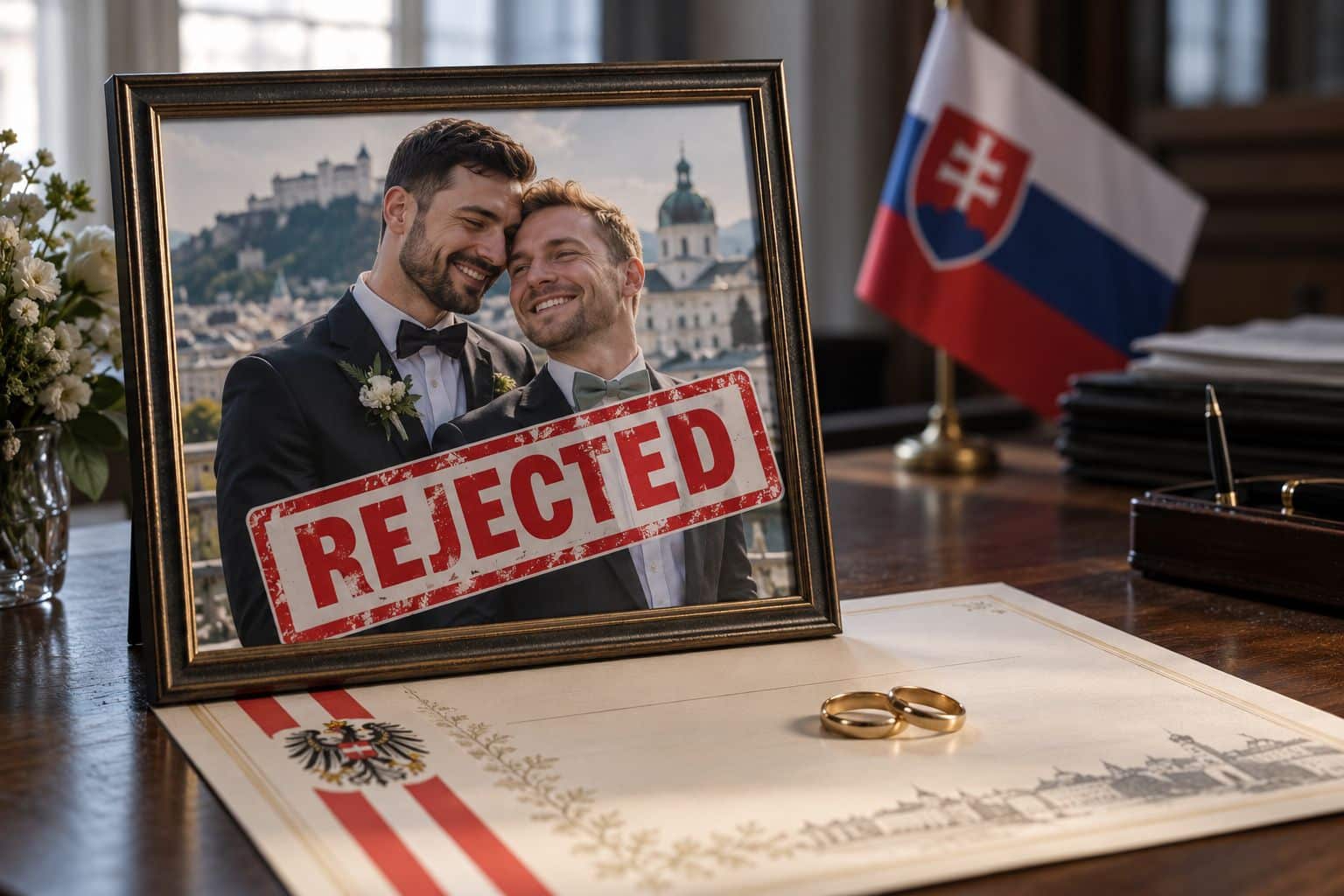
Ivan Novotný and Metod Špaček married in Austria in 2020. Six years later, Slovakia still refuses to register their marriage. The two former Slovak diplomats have taken the Interior Ministry to court, challenging a state that accepts their citizenship but refuses to acknowledge their marriage at home.
Their lawsuit, filed in September, concerns the registration of an existing Austrian marriage certificate. Špaček previously headed President Zuzana Čaputová’s office. Now, he and his husband must pursue legal action against the country they once represented abroad.
A marriage that encounters a border
The dispute exposes a serious weakness in Europe’s promise of free movement. Citizens can build a family in one member state, then face authorities in another that refuse to recognize the legal relationship they established. Crossing a border should not mean surrendering the security attached to that relationship.
Slovakia does not allow same-sex couples to marry domestically or enter registered partnerships. Its constitution defines marriage as a union between a man and a woman. Interior Minister Matúš Šutaj Eštok has relied on the country’s legal framework to defend the refusal to register the couple’s Austrian marriage.
However, citing a domestic restriction does not settle the European legal question. The dispute concerns how Slovakia treats citizens who have exercised rights that come with EU membership.
What the European court actually ruled
On November 25, 2025, the Court of Justice of the European Union ruled on a similar dispute involving two Polish men who married in Germany. It found that a member state cannot refuse recognition simply because its domestic law prohibits same-sex marriage when the couple married while exercising their freedom to move and reside in another member state, where they created or strengthened their family life.
The judgment does not require every EU country to introduce same-sex weddings domestically. It does, however, require recognition in the circumstances covered by the ruling. Where registration of a foreign marriage certificate is the country’s only recognition procedure, authorities must apply that procedure without discrimination.
That distinction matters. Presenting the judgment as a universal order to introduce marriage equality would overstate it. Treating domestic opposition to same-sex marriage as sufficient grounds to disregard it would miss its central point.
Slovakia’s ministry argues that recognition for free-movement purposes does not require marriage registration. That distinction is central to the dispute.
Whose family needs protection?
The political language surrounding these disputes often invokes the protection of marriage. Yet recognizing two men’s existing marriage takes nothing away from a heterosexual couple. Their vows remain intact, their household remains theirs, and their freedom to follow religious teachings remains untouched.
Meanwhile, the excluded couple must spend time and resources seeking recognition that others can take for granted. A government defending this unequal treatment should explain what concrete harm recognition would cause. Invoking tradition merely restates the preference behind the exclusion.
Religious communities can maintain their own understanding of marriage. Civil authorities, however, serve citizens with different beliefs and sexual orientations. Equal treatment should not depend on whether a relationship satisfies the theology of the majority.
Rights need to survive the journey home
The Slovak proceedings will test how the European ruling applies to this refusal. A judgment on paper only becomes meaningful when public authorities implement the rights it protects.
Novotný and Špaček already married. The question facing Slovakia is whether it will acknowledge their legal relationship—or continue making them fight for recognition of a family that already exists.