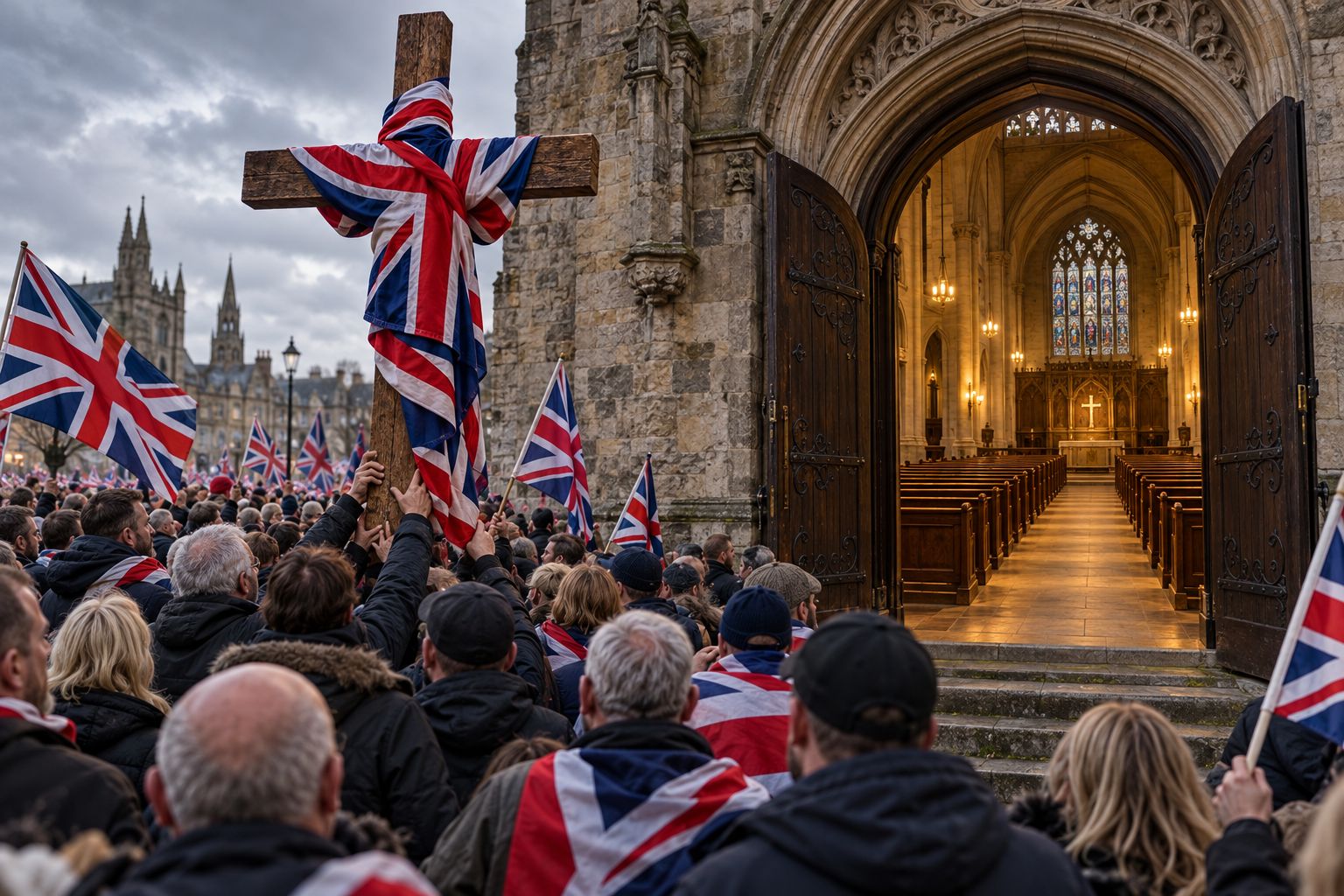
A person can defend a Christian nation without spending much time in church. New research from Theos highlights that distinction in Britain, where religious identity can serve a political purpose quite separate from worship. The findings raise a question for anyone celebrating a supposed Christian revival: are people embracing a faith, or drawing a boundary around who belongs?
Published on October 11, the report examines attitudes toward Christianity and Britishness among 1,765 UK adults. Researchers Nick Spencer and Yinxuan Huang identify five groups, reflecting different combinations of religious belief, cultural attachment, and national identity. Their analysis challenges the assumption that everyone who wants a more Christian Britain wants the same thing.
Defending Christianity without practicing it
The group most closely associated with Christian nationalism represents 11% of respondents. Although 81% identify as Christian, only 13% attend church weekly. That gap suggests that a Christian label can carry considerable importance without corresponding religious participation.
Theos calls this group “Identity Integrationists.” Its members regard Christianity as fundamental to Britishness and seek to defend Christian heritage against influences they perceive as threatening. Another group, “Belief Integrationists,” places greater emphasis on promoting the Christian faith itself.
This distinction matters politically. A faith asks what someone believes and how they should live. A national identity can instead ask where someone comes from and whether they fit a preferred cultural image. When politicians merge the two, Christianity can become a test that other citizens never agreed to take.
Low church attendance does not prove that someone’s beliefs are insincere. Neither does regular attendance guarantee tolerance. Nevertheless, defending a religious identity and practicing a religion are different activities. Public debate should stop treating them as interchangeable.
Heritage does not confer ownership
Christianity has influenced Britain’s institutions, culture, and historical development. However, acknowledging that influence does not establish that Christians possess a stronger claim to the country than anyone else. Historical importance cannot justify unequal citizenship.
An atheist does not need to adopt Christian beliefs to belong. A Muslim should not have to conceal religious convictions to receive equal treatment. Likewise, a Christian should remain free to worship without the state recruiting that faith into a nationalist project.
People can value old churches, music, and local traditions without demanding religious conformity. The political problem begins when affection for a shared past becomes a claim that some neighbors are less authentically British. At that point, heritage becomes an instrument of exclusion.
Britain is not united behind a religious test
The report also provides an important corrective to sweeping claims about the country. Eight percent of respondents strongly agree that someone must be Christian to be truly British, while another 9% slightly agree. Only 1% identify Christianity as the most important factor in being truly British.
Consequently, loud expressions of Christian nationalism should not stand in for the population as a whole. A movement can attract attention without representing a majority. Nor should its preferred account of national identity become the default description of Britain.
The research also identifies people who reject Christianity as a component of Britishness while remaining hostile to other religious or immigrant identities. That finding complicates any comforting division between intolerant believers and tolerant nonbelievers.
Secularism requires more than abandoning religious belief. Someone who rejects Christianity but denies equal standing to Muslims has not established a consistent commitment to freedom. The relevant principle is whether everyone receives the same rights.
Criticize beliefs, protect people
Religious ideas deserve scrutiny. Christianity, Islam, and every other belief system should remain open to criticism, ridicule, and rejection. Protecting people from discrimination must never become a demand to protect doctrines from disagreement.
However, criticism of religion does not justify treating its followers as permanent outsiders. Opposing religious control over public policy differs from claiming that a religious minority cannot belong to the nation. Freethought loses its consistency when it defends freedom for one group while accepting collective suspicion of another.
The same standard applies to Christian nationalism. Its claims deserve examination because they concern political power and citizenship. Calling those claims religious should grant them neither immunity from criticism nor automatic authority.
Equal citizenship needs no religious qualification
This survey describes patterns of attitudes. By itself, it cannot establish that Christian nationalism is growing, explain every participant’s motives, or prove that churchgoing causes greater tolerance. Its value lies in revealing differences that political slogans tend to conceal.
Those differences should sharpen the debate. When someone demands a Christian Britain, we should ask what that means in practice. Does it mean freedom to worship, an attachment to historical buildings, preferential treatment for a church, or reduced standing for people outside the faith?
A democratic society can accommodate religious belief and cultural attachment without ranking its citizens by either. Nobody should need a baptism certificate, a preferred ancestry, or permission from a nationalist movement to belong.