Nigeria votes in fewer than 100 days.
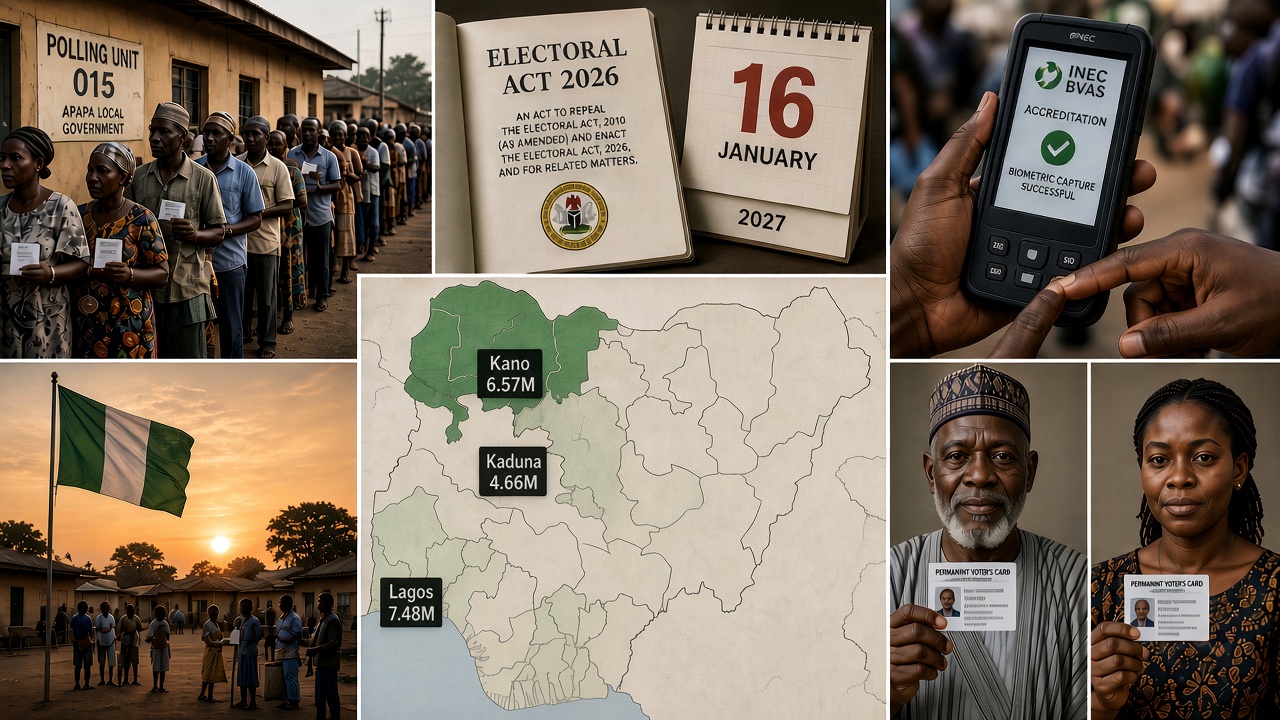
On Saturday, 16 January 2027, eligible voters will head to the polls to elect a president and members of the National Assembly. Three weeks later, on 6 February, they will return to choose state governors and state houses of assembly.
This timetable arrived earlier than most Nigerians anticipated. Under initial projections, the presidential poll was slated for late February. A sweeping legislative overhaul altered that trajectory.
This analysis does not advocate for any candidate or political formation. Instead, it examines what the certified data shows, how the enduring cleavages of ethnicity and religion intersect with demographic realities, and the immediate statutory procedures available to citizens this week.
103,428,715
That is the total number of registered voters across Nigeria, according to INEC Chairman Prof. Joash Amupitan, SAN, who disclosed the certified figures at a national stakeholders’ consultative assembly in Abuja on 6 October.
The roll expanded by 10,772,421 new registrants following a three-phase Continuous Voter Registration (CVR) exercise and subsequent automated biometric deduplication. Prof. Amupitan characterised the country as maintaining the largest active democratic register on the African continent.
INEC also confirmed that 232,658 persons on the register are persons with disabilities (PWDs), constituting approximately 0.23 percent of the national electorate.
Eighteen political parties have validly sponsored presidential candidates: sixteen men and two women.
Where the voters are
The spatial distribution of the national electorate remains heavily concentrated.
Lagos State holds the largest single share of registered voters at 7,488,633, followed closely by Kano with 6,570,276. Kaduna ranks third with 4,662,640, while Katsina places fourth with 3,876,051.
Zonally, the North-West constitutes the single largest voting bloc with 25,083,411 registered voters—roughly one-quarter of the national total. The South-West records 19,614,274, while the North-Central accounts for 16,965,787.
Bauchi State, where I reside, ranks tenth nationally with 3,012,547 voters.
Historically and demographically, the northern states command an immense proportion of the aggregate vote. Whatever electoral dynamics unfold in January, these regional tallies will remain mathematically decisive.
Why January
Throughout Nigeria’s Fourth Republic, general elections have conventionally taken place in February or March. The 2023 general election took place in late February.
The timeline shifted following the enactment of the Electoral Act 2026, which repealed the 2022 statute. Signed into law by President Bola Tinubu on 18 February 2026, the updated legislation compressed statutory administrative deadlines for pre-election activities and reset the commission’s operational calendar. Consequently, INEC adjusted the presidential and federal legislative elections to 16 January 2027, moving the governorship and state assembly polls to 6 February.
Policy analysts have noted that this adjustment marks the first January presidential ballot since the return to civil rule in 1999.
While political observers debate whether the legislative compressed timeline reflects procedural modernisation or tactical calculation, the primary reality for the citizen is fixed: polling day is imminent.
This week
Two time-sensitive statutory processes are underway nationwide, both bound by strict deadlines.
The public display of the voter register. Under Section 19(1) of the Electoral Act 2026, INEC must display the national voters’ roll for public scrutiny not less than 90 days before polling day. The Commission commenced the physical and electronic display on 9 October, running through 15 October at the Registration Area (Ward) level, after which the exercise transitions to local government offices for the hearing of claims and objections. This statutory window is the primary avenue for voters to correct typographical errors, verify polling unit allocations, or challenge improper entries.
Permanent Voter Card (PVC) collection. Nationwide distribution of newly printed PVCs commenced simultaneously on 9 October. To accelerate distribution and mitigate historic logistics bottlenecks, INEC integrated on-demand card printing modules at designated electoral cluster centres. Voters who defer collection until the final weeks before January inevitably risk procedural congestion.
Election day, step by step
Under operational guidelines issued by the electoral management body:
Accreditation and voting proceed concurrently from 8:30 am to 2:30 pm. Every prospective voter must present a valid PVC for biometric authentication via the Bimodal Voter Accreditation System (BVAS).
INEC reports the procurement of 57,000 new BVAS devices alongside infrastructure upgrades to its electronic results transmission architecture. Commission leadership indicated that strengthening existing digital protocols was preferred over introducing untried technical frameworks late in the electoral cycle.
Whether these upgrades ensure real-time transmission and eliminate latency remains to be tested on election day under the scrutiny of domestic and international observers.
Under the law, all open political campaigning must cease strictly 24 hours prior to polling day.
The ticket nobody can agree on
A single-faith presidential ticket is neither unprecedented nor uncontested in Nigerian political history.
In the aborted 1993 presidential election, the Social Democratic Party (SDP) fielded Moshood Abiola, a southern Muslim from Ogun State, alongside Babagana Kingibe, a northern Muslim from Borno State. In 2023, the ruling All Progressives Congress (APC) paired Bola Tinubu, a southern Muslim, with Kashim Shettima, a northern Muslim. That ticket prevailed in a fractured four-way race against the Peoples Democratic Party (PDP), Labour Party (LP), and New Nigeria Peoples Party (NNPP).
The 1999 Constitution contains no prohibition against single-faith candidacies. The convention of pairing Christian and Muslim candidates remains an informal political consensus developed to maintain confessional stability across a pluralistic federation.
The arguments advanced by proponents. Party leadership maintains that the 2023 outcome demonstrated that administrative capacity, competence, and broad coalition-building should supersede religious labels, contending that governance outcomes have disproven earlier narratives of confessional exclusion.
The arguments advanced by critics. Regional and civic coalitions—including the Northern Christian Elders Forum, the Middle Belt Forum, and opposition leaders—argue that an exclusively single-faith executive is tone-deaf to the demographic realities of a religiously divided society. Opposition figure Atiku Abubakar has consistently reiterated his objection to same-faith configurations, framing multi-faith balance as indispensable to national cohesion.
Structural dynamics. Empirical analysis reveals that presidential tickets in Nigeria are strategically assembled at the intersection of geography, ethnicity, and faith. Where demographic density is concentrated among specific religious communities in the northern zones, southern candidates frequently calculate that confessional alignment with the regional majority is necessary to secure high voter turnout.
For the critical voter, the public record provides concrete metrics that transcend political speeches:
Has public infrastructure, municipal funding, and security deployment since 2023 differed based on the religious composition of local communities?
Does fiscal allocation demonstrate sectarian preference, or do geographic and political alignments drive resource distribution?
When political or religious figures introduce confessional rhetoric during campaigns, is that discourse accompanied by programmatic public policy proposals?
Regional realities: 89 percent in the South-East, 40 percent in the North-West
Voting behaviour in Nigeria remains heavily shaped by geopolitical and ethnic geography, as demonstrated by the 2023 certified returns.
Analysis by StatiSense shows that Peter Obi secured 89.42 percent of the aggregate vote in the South-East. Bola Tinubu achieved 55.77 percent across the South-West. Atiku Abubakar garnered 51.71 percent in the North-East. In the high-density North-West, the electorate divided into competitive shares: Tinubu (40.08 percent), Abubakar (35.35 percent), and Rabiu Kwankwaso (19.25 percent).
Nationally, the aggregate vote stood at 36.61 percent for Tinubu, 29.07 percent for Abubakar, 25.40 percent for Obi, and 6.23 percent for Kwankwaso.
Three factors complicate simplistic ethnic narratives:
First, the northern electorate did not vote as a monolithic bloc. In Bauchi State, the returns split between Abubakar (49.98 percent), Tinubu (37.10 percent), and Kwankwaso (8.45 percent). Tinubu secured more cumulative votes from the North-West than from his home South-West geopolitical zone, while Abubakar won four of the seven North-West states.
Second, intra-state demographics drive sharp internal competition. In Lagos State, extensive urban cosmopolitanism and significant non-indigene populations resulted in an exceptionally narrow margin between the top two contenders, separating them by less than one percentage point.
Third, the constitutional framework was purposefully engineered to deter purely regional candidates. Under Section 134(2) of the 1999 Constitution, securing a first-round victory requires the highest national vote tally alongside at least one-quarter of the votes cast in at least two-thirds of the 36 states and the Federal Capital Territory. Following the 2023 legal challenges, the Supreme Court definitively affirmed that the FCT is treated on equal footing with the states, requiring candidates to hit the 25 percent threshold across at least 25 of Nigeria’s 37 administrative jurisdictions, rather than treating the federal capital as a separate mandatory hurdle.
Additionally, Section 14(3) sets out the Federal Character principle, mandating that the composition of public institutions reflect national diversity to prevent ethnic or regional predominance.
Here again, critical evaluation demands objective inquiry:
When identity politics are deployed on the campaign trail, does the candidate present actionable governance blueprints to address structural poverty, health, and economic stagnation?
Does a candidate’s legislative and administrative record stand up to objective scrutiny once ethnic appeals are removed from consideration?
What concrete policy commitments have candidates made to jurisdictions outside their primary regional bases?
The voter’s statutory rights and protections
Under Sections 77(2), 117(2), and 132(5) of the 1999 Constitution, the franchise is extended to every Nigerian citizen who has attained the age of eighteen and is duly registered on the national voter roll.
Under Section 10, the state is barred from establishing a religious monopoly, while Section 42 guarantees freedom from discrimination on grounds of ethnic origin, sex, religion, or political opinion.
Critically, electoral corruption remains explicitly criminalised under the law. Section 121 of the Electoral Act prescribes that any person who directly or indirectly offers, gives, receives, or solicits financial or material inducement to procure a vote commits the offence of bribery, punishable upon conviction by a fine of up to ₦500,000, imprisonment for up to twelve months, or both.
Ninety-nine days
There are 103 million registered citizens, 18 accredited candidates, and a fixed Saturday in January.
Ethnic allegiances and confessional rhetoric will feature prominently throughout the campaign cycle—as they have in every democratic transition since the 1959 pre-independence elections.
For the democratic citizen, however, the immediate imperative is civic due diligence: verifying personal data on the published register, collecting voter credentials, understanding electoral safeguards, and evaluating prospective leadership on empirical records rather than manufactured sentiment.