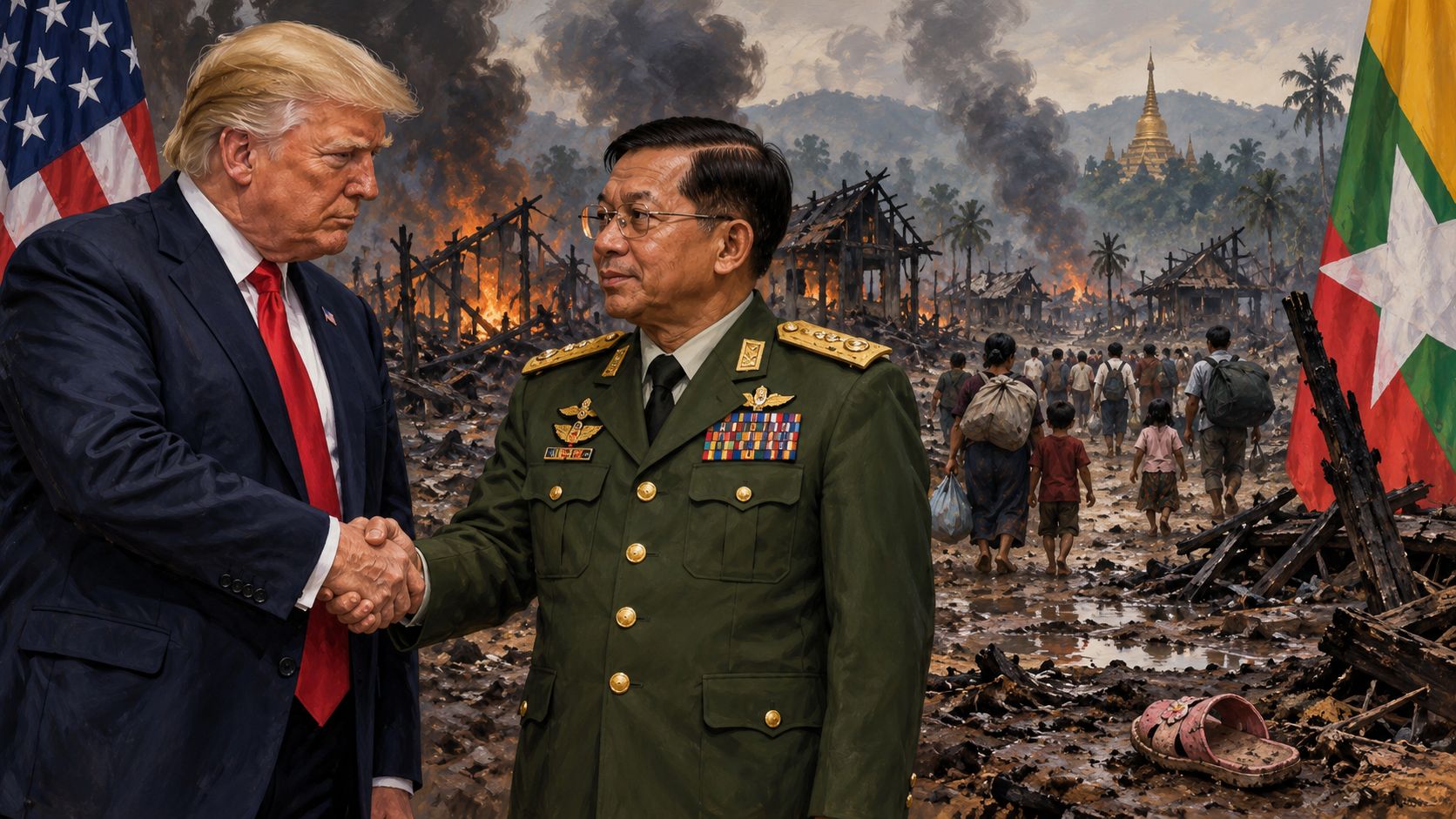
Mass killings, rape, torture, and villages burned to the ground marked Myanmar’s military campaign against the Rohingya in 2017. Security forces killed thousands of civilians and drove more than 700,000 people into Bangladesh within two months. United Nations investigators documented systematic atrocities and called for military commanders to face prosecution for genocide, crimes against humanity, and war crimes. These are the forces whose leadership the Trump administration is now approaching.
The violence extended beyond the Rohingya. UN investigators documented the military’s use of sexual violence to terrorize ethnic communities in Kachin and Shan states. They identified the severity of sexual violence against the Rohingya as evidence of genocidal intent. For the people subjected to these campaigns, military authority meant the threat of displacement, assault, and death.
Then, on February 1, 2021, the military overthrew Myanmar’s elected civilian government. Its crackdown on resistance included killings, torture, arbitrary detention, and attacks on peaceful demonstrators. The coup helped plunge the country into a widening armed conflict, while the generals continued to use lethal force against the population they claimed to govern.
Atrocities that continue
The military’s record of abuse belongs to the present as well as the past. A recent UN investigation found escalating airstrikes against civilians. The Independent Investigative Mechanism for Myanmar has gathered evidence for potential prosecutions and is also investigating serious alleged crimes by armed groups opposed to the military. Accountability must cover perpetrators across the conflict.
That continuing violence should define the context of any diplomatic engagement. Myanmar’s military leadership has not earned rehabilitation through a demonstrated commitment to protecting civilians or accepting responsibility for past crimes. Access to foreign officials cannot substitute for either.
Nevertheless, Reuters reported on October 8 that the Trump administration had opened direct talks with the military-installed government. U.S. official Michael Vance met Min Aung Hlaing in September. The outreach initially concerned detained American businessman Adam Castillo, while broader interests include scam operations and rare-earth resources. Min Aung Hlaing remains under U.S. sanctions; Washington has also contacted opposition and ethnic groups.
The price of diplomatic access
Negotiating to free a detainee can be necessary. Governments sometimes have to speak to abusive authorities because those authorities control a person’s freedom. Such contact needs a clear purpose and limits. A negotiation over an individual case should not become an opening for the political rehabilitation of leaders implicated in mass atrocities.
The danger grows when strategic resources enter the discussion. Rare-earth minerals may matter to industrial policy and national security, but the people living above those deposits have rights of their own. Their safety and political freedom should not become secondary considerations in a competition for access.
Direct talks do not automatically establish that Washington has abandoned accountability. However, they create opportunities for the military leadership to portray itself as an accepted international partner. The administration must therefore answer a basic question: what protections for Myanmar’s people accompany this outreach?
Without clear conditions, engagement can reward the people who seized power while weakening those who resisted them. Diplomatic visibility carries value, even before sanctions change or commercial agreements emerge. A meeting can help a regime claim that its international isolation is ending.
Victims must remain central
UN investigators previously urged governments to cut financial and other support to Myanmar’s military. Their reasoning was concrete: commanders implicated in grave crimes needed isolation and credible judicial scrutiny. Commercial engagement that strengthens military institutions could undermine that objective.
Any broader U.S. engagement should therefore include demands to end attacks on civilians, permit humanitarian access, release people imprisoned for peaceful opposition, and cooperate with investigations. Officials should explain how they will measure progress and what consequences will follow further abuses. Vague assurances offer little protection to communities facing armed force.
Myanmar’s democratic and ethnic communities also deserve a meaningful role in decisions affecting their future. The generals’ control of state institutions does not give them an exclusive right to speak for the country. A policy that treats military power as sufficient political legitimacy would repeat the central injustice of the coup.
The Rohingya who fled burned villages, the families of murdered protesters, and the civilians living under airstrikes deserve more than expressions of concern attached to a resource negotiation. Their suffering should shape the conditions of engagement from the beginning. If Washington pursues access while allowing accountability to fade, it will send the generals a devastating message: atrocities can become negotiable once the perpetrators have something valuable to offer.