

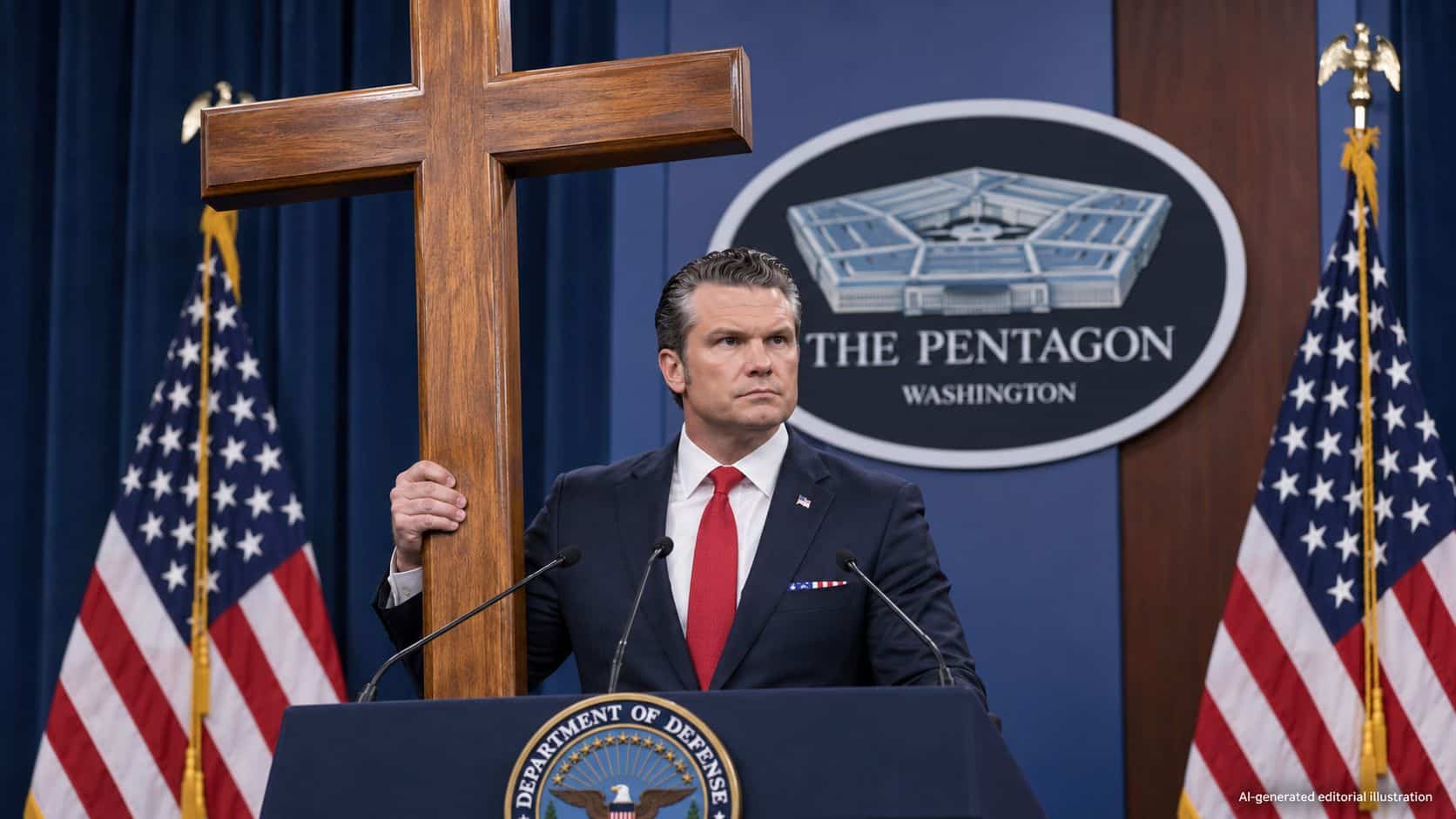
Defense Secretary Pete Hegseth has announced a new Office of Religious Affairs at the Pentagon. The office will report directly to him, giving religious support a powerful advocate at the top of the military establishment. He unveiled the initiative at Marine Corps Base Quantico on September 30, 2026.
The Pentagon says the office will protect voluntary religious practice and respect personnel of every faith and none. However, secular organizations warn that Hegseth’s rhetoric points toward Christian favoritism. Religious leaders have also raised questions about its authority and place within the military’s command structure.
Religion gains a direct line to the secretary
Hegseth presented the office as a solution to neglected religious services and excessive bureaucracy. He promised that it would defend funding, improve facilities, and strengthen support for military chaplains. Its direct access to his office would help it overcome administrative obstacles, he said.
Yet his announcement went beyond administrative reform. Hegseth described the military as “putting on the full armor of God” and declared that “the real battle is spiritual.” Those biblical references framed a government initiative through an explicitly Christian understanding of warfare.
That framing matters because the military serves a religiously diverse population. When its civilian leader presents military service through Christian language, personnel may question whether everyone enjoys equal standing. The Pentagon’s promise of neutrality therefore needs clear rules and consistent implementation.
What will the new office do?
According to its founding memorandum, the office will oversee religious policy, resources, and programs across the armed forces. Its responsibilities include support for religious facilities, chaplain-led activities, faith-based homeschooling, and religious initiatives connected to suicide prevention. It will also oversee the Armed Forces Chaplains Board.
Another responsibility deserves particular scrutiny. The memorandum calls for research and analytical tools to assess personnel’s spiritual fitness, readiness, and resilience. However, the Freedom From Religion Foundation says the document leaves important questions unanswered. These include how officials would define those qualities and what information they might collect about personal beliefs.
For nonreligious personnel, the practical concern is straightforward. Courage, purpose, and resilience do not require belief in a deity. Any assessment must accommodate people who build those qualities through secular values, relationships, and personal commitments.
Christian leaders also question the structure
The criticism extends beyond atheist and secular organizations. Episcopal Bishop Ann Ritonia told Religion News Service that stronger funding could help struggling chaplaincy programs. Nevertheless, she questioned whether the office could disrupt existing command relationships or give particular religious groups disproportionate access to decision-makers.
Evangelist Franklin Graham welcomed the initiative and emphasized chaplains’ importance to military personnel. These contrasting responses show that religious Americans also disagree about how the government should organize spiritual support. Supporting chaplains does not settle questions about oversight, fairness, or institutional power.
Atheists already face changes to military records
The announcement follows another controversial change. The Pentagon reduced its recognized religious affiliation categories from more than 200 to 31. Categories identifying atheists, humanists, and several minority traditions disappeared from the revised system.
The Air Force subsequently instructed personnel to update their affiliation records. Active-duty members have until October 16, while reservists and Air National Guard members have until November 9. FFRF argues that removing these identities undermines recognition of the military’s religious and nonreligious diversity.
These changes do not ban atheists from serving. However, they provide relevant context for assessing the new office. Promises to respect nonbelief become harder to trust when administrative systems stop recognizing it explicitly.
Watchdogs demand transparency
Americans United for Separation of Church and State condemned the office as another step toward Christian nationalism within the military. Its president, Rachel Laser, argued that Hegseth’s policies elevate Christianity at the expense of the diverse personnel he serves.
Meanwhile, FFRF announced plans to seek public records about the office’s funding, outside religious contacts, and proposed assessments. The organization also urged Congress to scrutinize its authority. These requests could clarify how the Pentagon intends to turn broad assurances into enforceable protections.
Military personnel should have access to religious support when they want it. They should also have equal access to secular support and the freedom to decline religious participation. The new office’s credibility will depend on whether it protects those choices equally, including for people whose convictions differ from Hegseth’s.






