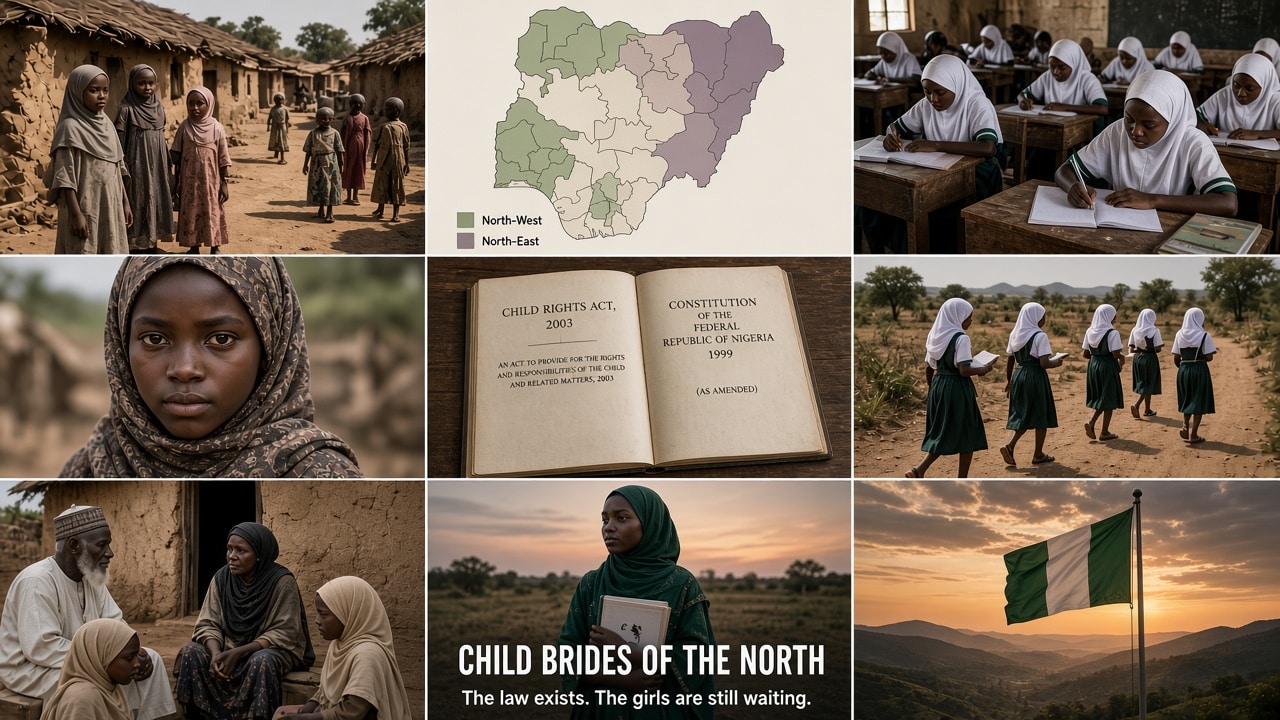
In Jigawa State, 63 percent of girls are married before they turn 18.
In Zamfara, 63 percent. In Sokoto, 61 percent. In Katsina, 61 percent.
These are not figures from a century ago. They are from 2024.
Nigeria has one of the world’s largest populations of child brides. In 2018, 44 percent of Nigerian women aged 20–49 had been married before age 18, representing about 22 million women. Nigeria had the world’s third-highest absolute number of child brides, although its prevalence rate was lower than that ranking suggests. Child marriage is disproportionately concentrated in Northern Nigeria, particularly in the North-West and North-East.
This is not a secret. It has been documented by UNICEF, the UN Committee on the Rights of the Child, the CEDAW Committee, the Human Rights Council, and the African Union. The prevalence of child marriage in Nigeria has been documented by UNICEF and other international and regional human-rights bodies, which have repeatedly called for stronger legal protection, enforcement and measures to address its underlying causes.
It has not stopped. In some states, it has barely slowed.
The law already exists
This is the part that most people do not know.
Nigeria passed the Child Rights Act in 2003. Section 21 provides that a person under the age of 18 is not capable of contracting a valid marriage, and any marriage contracted in violation of the provision is null and void. and that a marriage contracted in violation of the provision is null and void. Section 23 also provides criminal penalties for people who marry, betroth, promote, or facilitate the marriage of a child.
The law exists. It has existed for over two decades.
Although child-rights legislation is now in place across all 36 states, implementation and enforcement remain uneven, particularly in parts of Northern Nigeria. The challenge is therefore not simply whether the law exists, but whether girls can effectively access the protection it provides.
This is where the legal paradox lives.
The Nigerian Constitution guarantees freedom of thought, conscience and religion under Section 38. At the same time, the constitutional framework recognises different systems of personal law, including Islamic and customary law. This has created a legal tension with the Child Rights Act, which sets 18 as the minimum age for a valid marriage. The tension is further complicated by Section 29(4)(b) of the Constitution, which provides that a married woman is deemed to be of full age for the purposes of that section.
In parts of Northern Nigeria, the interaction between Islamic, customary and statutory law has historically created significant gaps between the Child Rights Act’s 18-year minimum and the way some marriages involving girls below that age are recognised or enforced in practice. These legal and enforcement gaps have contributed to the persistence of child marriage.
A girl who reaches puberty is still a child under the Child Rights Act.
What happens to her body
In the North-East and North-West, 48 percent of girls marry by the age of 15 and 78 percent by the age of 18.
A girl who marries at twelve or thirteen does not stop being a child because she has a husband. Pregnancy during adolescence carries higher risks of complications for both the mother and child, while early marriage can also interrupt education and expose girls to social and economic pressures for which they may be unprepared. The Nigerian medical system is not equipped to protect her when things go wrong and they go wrong at rates that do not apply to adult women.
Vesico-vaginal fistula (VVF) is a serious obstetric injury that can result from prolonged or obstructed labour. It can cause continuous leakage of urine and can have severe physical, social and psychological consequences for affected women and girls. Adolescent pregnancy is among the factors associated with increased risk of obstetric complications. VVF is largely preventable through delaying pregnancy, access to skilled maternal healthcare, and timely treatment when complications occur.
Nigeria has specialist facilities that provide VVF treatment and repair, but access to timely care remains a challenge in many affected communities.
What happens to her future
Child marriage is more common among girls from poorer households, rural communities, and those with limited access to education. Poverty, social and gender norms, and barriers to schooling can reinforce one another, making it harder for girls to remain in school and build independent economic opportunities. UNICEF notes that child marriage can interrupt education, limit future employment opportunities and increase the risk of social isolation and domestic violence.
This can create an intergenerational cycle: when girls leave school early and marry young, they may have fewer opportunities to acquire education, skills and income. Their children can then grow up in the same conditions of poverty and limited educational access. Breaking that cycle therefore requires more than preventing early marriage; it also requires keeping girls in school, reducing household economic pressures and expanding opportunities for young women.
Recent data suggests that child marriage has declined nationally, but progress remains slow and uneven. The latest available data show that about one in three young women in Nigeria were married before age 18, while the burden remains substantially higher among girls from poorer households, rural communities and those with little or no education.
Child marriage is strongly associated with poverty, rural residence and limited access to education. In Nigeria, girls from poorer households and rural communities are substantially more likely to marry before age 18, while girls with little or no schooling face a much higher risk than those who reach secondary education. These overlapping disadvantages help explain why child marriage remains particularly widespread in parts of Northern Nigeria.
The constitutional argument the states are making
The nine northern states that have not domesticated the Child Rights Act are not simply ignoring the law. They are making a legal argument — one that has never been definitively resolved by the Supreme Court.
The legal debate concerns how the Child Rights Act interacts with constitutional protections for freedom of religion and the recognition of Islamic and customary personal law. Questions about the scope and application of these different legal provisions have contributed to continuing uncertainty over the protection of girls from child marriage.
The constitutional position is more complicated than this argument suggests.
The constitutional position is more complicated. Section 38 protects freedom of thought, conscience and religion, while the Constitution also recognises the jurisdiction of Sharia Courts over questions of Islamic personal law, including marriage. At the same time, Section 21 of the Child Rights Act prohibits marriage involving a person under 18, creating a legal tension where the Act applies. Section 29(4)(b) of the Constitution adds another complication by providing that a married woman is deemed to be of full age for the purposes of that section.
The result is a complex interaction between constitutional provisions, state child-rights legislation and Islamic and customary personal law. Human-rights bodies and legal scholars have raised concerns about these inconsistencies and their implications for the protection of girls from child marriage.
Section 34 of the Nigerian Constitution protects the dignity of every person, while Section 42 prohibits discrimination on specified grounds, including sex, religion and circumstances of birth. These provisions raise an important constitutional question when girls face marriage-related restrictions or risks that do not apply in the same way to boys. How those protections interact with religious and personal-law rights remains an important part of the wider legal debate over child marriage in Nigeria.
The interaction between these constitutional provisions and the Child Rights Act remains an important and contested legal question. Until the relevant legal questions are authoritatively settled and child-protection laws are consistently implemented and enforced, girls in communities where child marriage remains common may continue to face significant gaps between their rights on paper and their protection in practice.
What the evidence says works
There is evidence of progress: child marriage has declined nationally, although the decline has been uneven and the prevalence remains high in parts of Northern Nigeria.
Evidence suggests that girls’ education is an important factor in reducing child marriage, alongside household economic support, changes in social norms, legal protection and effective enforcement. Recent evidence from Northern Nigeria shows that girls who complete secondary school marry considerably later than those with little or no education.
Education is strongly associated with later marriage. In Northern Nigeria, recent evidence found that the median age at first marriage was 16.6 years among girls with no education, compared with 21.7 years among those who completed secondary school. Keeping girls in school can therefore play an important role in delaying marriage and expanding their future educational and economic opportunities.
This evidence is not new. The Girls’ Education Project Phase 3 (GEP3), implemented across six northern states from 2012 to 2022, brought an additional 1.5 million girls into school. An independent evaluation found that modest unconditional cash transfers of about $45 to poor households, combined with community mobilisation, enrolment drives and improvements in schools and learning, helped increase girls’ enrolment from 1.76 million to 2.87 million — a 64 percent increase.
Keeping girls in school does not eliminate child marriage on its own, but evidence shows that staying in education is strongly associated with marrying later and having greater educational and economic opportunities.
There is no single solution to child marriage in Northern Nigeria. Evidence points to a combination of measures: keeping girls in school, reducing household poverty, expanding economic opportunities, changing harmful social norms, and strengthening the implementation and enforcement of child-protection laws. These measures are most effective when they work together to address both the immediate risks facing girls and the conditions that make early marriage more likely.
The challenge now is not simply whether states have domesticated child-rights legislation, but whether those laws are effectively implemented and enforced. Recent assessments indicate that all 36 states have now domesticated child-rights legislation, yet significant gaps remain in implementation, accountability and access to child-friendly justice. Strengthening those systems is therefore essential to turning legal protection on paper into effective protection for girls at risk of child marriage.
The girl in Jigawa
Consider a hypothetical twelve-year-old girl in Northern Nigeria whose family is arranging her marriage. Under the Child Rights Act, a person under 18 is not capable of contracting a valid marriage. Yet the protection available to a girl in practice can depend on how child-rights legislation is implemented and enforced in her state and community.
She may have a legal right on paper, but knowing that right, accessing legal assistance, reaching a child-friendly court and obtaining effective protection are separate challenges. This gap between legal protection and practical enforcement is one of the central problems Nigeria faces in protecting girls from child marriage.
The law exists. The challenge is turning that legal protection into effective protection in practice. Where implementation, enforcement and access to justice remain weak, the gap between a girl’s rights on paper and her lived reality can remain wide.
For a twelve-year-old girl facing marriage, that gap is not an abstract legal problem. It can determine whether the rights guaranteed to her by law are actually available when she needs them.