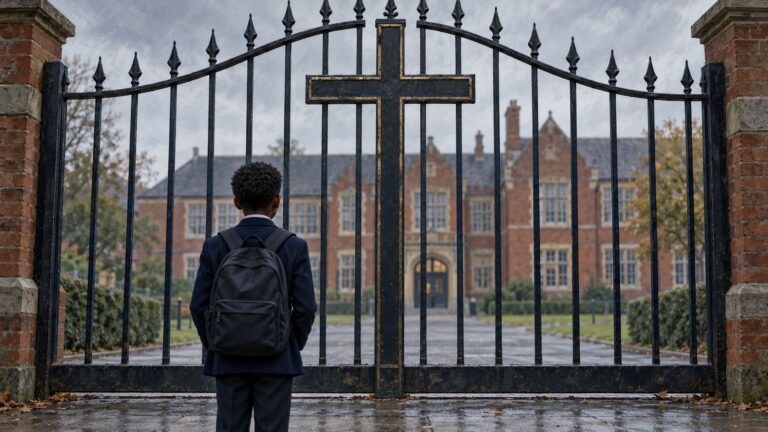
For more than two centuries, the United States has wrestled with where government ends and religion begins. Now an Oklahoma court case could redraw part of that boundary.
On September 24, 2026, U.S. District Judge David L. Russell granted a preliminary injunction to the National Ben Gamla Jewish Charter School Foundation. The ruling temporarily prevents Oklahoma from enforcing a law that requires charter schools to remain nonsectarian.
If Ben Gamla ultimately opens as planned, it could become the first openly religious public charter school in the United States. The proposed virtual school would combine regular academic instruction with Jewish religion, culture, values, texts, holidays and practices. It reportedly plans to begin operating in the 2027–28 school year.
However, the legal battle is far from over. The September decision is a preliminary injunction, not a final ruling on the constitutionality of religious charter schools.
Oklahoma had rejected the school
The Oklahoma Statewide Charter School Board unanimously rejected Ben Gamla’s original application in February 2026.
The board pointed to a 2024 Oklahoma Supreme Court decision involving a different religious charter school. That case concerned St. Isidore of Seville Catholic Virtual School, which Catholic organizations had hoped to operate with public charter-school funding.
Oklahoma’s highest court blocked St. Isidore. It concluded that establishing the Catholic charter school would violate state law and provisions of the Oklahoma Constitution.
The dispute eventually reached the U.S. Supreme Court.
In May 2025, the justices divided 4–4. Justice Amy Coney Barrett did not participate. Because the court tied, it simply affirmed the Oklahoma Supreme Court’s judgment without establishing a nationwide Supreme Court precedent on whether religious organizations have a constitutional right to operate public charter schools.
That unresolved constitutional question returned with Ben Gamla.
The school argues that excluding religion is discrimination
Ben Gamla sued after Oklahoma rejected its application.
Its argument centers on the First Amendment’s Free Exercise Clause. The foundation contends that once Oklahoma creates a charter-school program open to private organizations, the state cannot exclude an otherwise eligible organization simply because it is religious.
Judge Russell found that argument sufficiently strong to justify temporary protection while the lawsuit continues.
He concluded that Oklahoma’s requirement that charter schools remain nonsectarian appears to discriminate against religious applicants because of their religious character. The injunction therefore prevents the state charter board from enforcing that requirement against Ben Gamla while the litigation proceeds.
Supporters of the school describe the dispute as a religious-equality issue.
Daniel Chen of the Becket Fund for Religious Liberty, which represents Ben Gamla, argued that the state should not operate a charter system that accepts many educational approaches while categorically excluding religious organizations.
That reasoning follows a broader line of recent Supreme Court cases involving government benefits and religious institutions.
In Espinoza v. Montana Department of Revenue in 2020 and Carson v. Makin in 2022, the Supreme Court ruled against state policies that excluded religious schools from certain publicly funded education programs available to private secular schools. Supporters of religious charter schools argue that the same principle should apply here.
Opponents say charter schools are fundamentally different
The opposing argument starts with one crucial distinction: charter schools are not simply private schools receiving a government benefit.
They are public schools.
Oklahoma law has traditionally treated charter schools as part of its public education system. They receive public money, operate under government authorization and provide education on behalf of the state.
For opponents, that changes the constitutional equation.
Groups including Americans United for Separation of Church and State, the American Civil Liberties Union and the Freedom From Religion Foundation have intervened in the litigation. They argue that allowing a public charter school to teach and promote a particular religion would cross the boundary between government support for private religious choice and government-sponsored religious education.
The National Alliance for Public Charter Schools has also expressed concern about the decision. It emphasizes that charter schools have historically remained public, tuition-free and nonsectarian even when independent organizations operate them. The organization warned that redefining religious charter schools as constitutionally private actors could have consequences for funding, employment rules and other parts of the charter-school system.
That disagreement reaches the heart of the case.
Is a charter school essentially a private organization participating in a government-funded program?
Or is it an arm of the public school system performing a government function?
Different answers produce very different First Amendment consequences.
Ben Gamla would openly incorporate religion
This is not simply a school founded by religious people while teaching a secular curriculum.
Court documents describe Ben Gamla’s proposed school as combining conventional academic education with instruction in Jewish religion, culture, values, rituals, texts, holidays and practices. The foundation states that passing Jewish religious beliefs and practices to children forms a core part of its religious mission.
That makes the case considerably different from disputes over whether religious organizations can receive grants, scholarships or other generally available public benefits.
The government would not merely provide money that parents independently chose to spend at a private religious school. Oklahoma’s charter system would formally authorize and fund the institution as a charter school.
Supporters say excluding such a school solely because it is religious violates free exercise.
Opponents say allowing it transforms public education into a vehicle for religious instruction.
A previous attempt already reached the Supreme Court
The unusual history of the St. Isidore case makes the Ben Gamla dispute even more significant.
Oklahoma’s charter board approved St. Isidore in 2023. The proposed Catholic virtual school intended to incorporate Catholic teaching throughout its educational program.
The Oklahoma Supreme Court blocked it the following year. The U.S. Supreme Court’s 4–4 split then left that judgment intact without answering the constitutional question for the rest of the country.
Ben Gamla now presents federal courts with another route toward answering essentially the same question.
However, Judge Russell’s September 24 decision does not settle it.
The ruling only grants temporary relief while the lawsuit proceeds. Oklahoma and intervening parties can continue litigating the case and may appeal the injunction to the U.S. Court of Appeals for the 10th Circuit.
The consequences could extend far beyond Oklahoma
The dispute ultimately concerns much more than one Jewish virtual school.
If courts conclude that states operating charter programs must admit religious schools on equal terms, similar applications could appear elsewhere. Religious organizations representing many faiths could seek public charter status.
If higher courts instead conclude that charter schools act as government institutions, states could retain the traditional requirement that public charter schools remain secular.
The First Amendment protects both religious exercise and limits on government establishment of religion. The Ben Gamla case places those two principles unusually close together.
For now, one factual distinction matters most.
The United States does not yet have an operating religious public charter school. A federal judge has cleared a major legal obstacle that could allow Ben Gamla to become the first.
Whether it actually does so — and whether the ruling survives further litigation — remains unresolved.