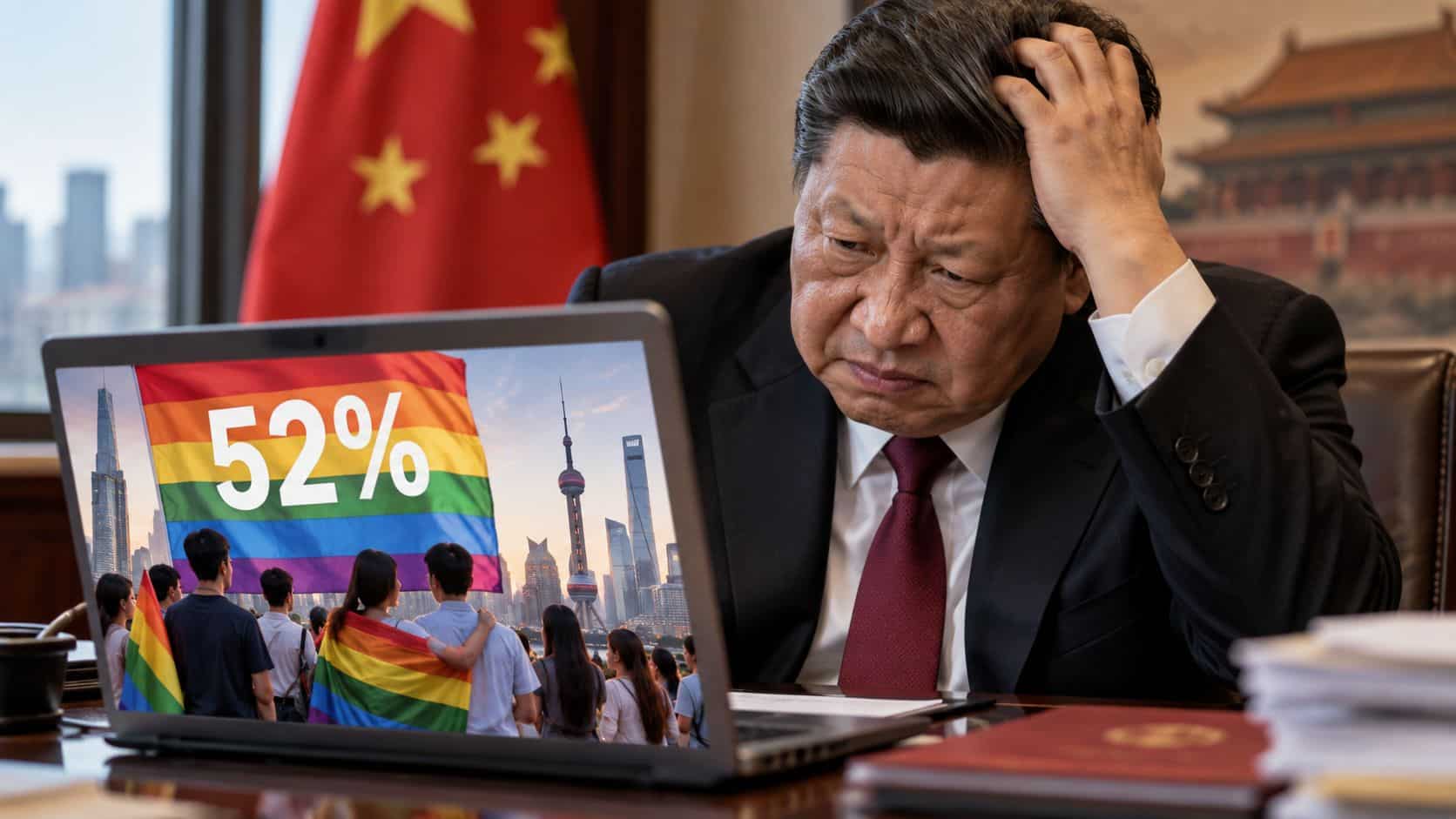
A large survey of adults in mainland China has found surprisingly high levels of support for LGBTQ people and several LGBTQ rights. More than half of respondents supported same-sex marriage. Even larger majorities backed fair treatment at work and protection from bullying in schools.
Those findings are important. However, they need one major qualification: the survey was not nationally representative.
Researchers surveyed 2,926 adults in mainland China between October 31 and November 17, 2023. The Williams Institute at UCLA School of Law published the findings in 2024. PinkNews brought renewed attention to the study in August 2025.
Support was substantial among respondents
The results were striking.
Fifty-three percent of respondents agreed that LGBTQ people should be accepted by society. Another 38% somewhat agreed. Only a small minority expressed outright disagreement.
Marriage equality also received considerable support. Fifty-two percent agreed that same-sex couples should have the same right to marry as opposite-sex couples. Another 37% somewhat agreed. Meanwhile, 48% agreed that same-sex couples could be capable parents, and 46% said they would be willing to attend a same-sex wedding.
Support was even stronger when the questions focused on protection from discrimination.
Sixty-two percent agreed that LGBTQ people should receive fair treatment at work. Another 34% somewhat agreed. Meanwhile, 68% agreed that LGBTQ students should be protected from bullying and violence in schools, with another 30% somewhat agreeing.
At first glance, the numbers suggest very broad support for LGBTQ equality in mainland China.
But that interpretation goes too far.
The people surveyed were not typical of China as a whole
The most important part of the study may be its limitations section.
Researchers recruited participants through Dynata, an international online survey company. Participants came from an online panel and volunteered to take part. Researchers used quotas for age, region, and gender, but this was still a non-probability sample rather than a random national sample.
The demographic differences were enormous.
The average respondent was 34.2 years old. Only 3% of the sample was 55 or older. Eighty-nine percent had at least a college-level education. Seventy-one percent reported monthly income of at least 7,000 yuan.
The researchers themselves compared those figures with the broader Chinese population. They noted that around 15% of Chinese adults had a college education, compared with 89% of their respondents. They also reported that most respondents earned more than 7,000 yuan per month, while the national average monthly income figure they cited was 3,268 yuan.
Geography created another major imbalance.
Beijing accounted for 17.5% of respondents, although the researchers cited it as containing only about 1.6% of China’s population. Shanghai represented 16.8% of respondents compared with about 1.8% nationally. Guangdong accounted for 19.3% of the sample compared with 8.9% of the population.
In other words, the survey disproportionately captured the views of younger, wealthier, highly educated and urban Chinese adults.
That matters because those characteristics were often associated with more favorable attitudes toward LGBTQ people.
The sampling problem affects the headline
The researchers found that younger respondents, women, people with more education, and people who personally knew LGBTQ individuals generally expressed more favorable attitudes. Higher income was also associated with more favorable responses on several questions, including marriage equality
This creates an obvious problem when turning the survey into a headline.
“52% of respondents support same-sex marriage” is accurate.
“52% of Chinese people support same-sex marriage” is not established by this study.
The researchers explicitly acknowledged this. They wrote that because the sample was not nationally representative, they could not determine whether respondents held more favorable views than the Chinese population as a whole. They also warned that overrepresenting younger people could make overall attitudes appear more positive than they really are nationally.
That distinction is crucial.
PinkNews reported the study under the headline “More than half of Chinese citizens support LGBTQ+ rights, poll suggests.” The article accurately reproduced many of the survey figures, but the headline is broader than the evidence allows.
The Williams Institute itself used more careful language. Its own summary said that more than half of “Chinese people surveyed” supported acceptance of LGBTQ people. Lead researcher Ilan Meyer described the findings as evidence of high approval among an “influential segment” of the Chinese population.
That is a much more defensible description.
The findings are still significant
The limitations do not make the study useless. Far from it.
A non-representative survey can still tell us something important about the people who participated. In this case, it shows that substantial support for LGBTQ equality exists among a large group of mainland Chinese adults.
It also provides evidence against the simplistic idea that Chinese society is uniformly hostile to LGBTQ people.
Among the surveyed population, support went beyond vague tolerance. Large proportions backed workplace equality, protection from bullying, same-sex parenting and marriage equality. Those are concrete social and legal issues.
The results also reveal an interesting generational and social pattern. Younger and more educated respondents tended to show greater acceptance. People who knew LGBTQ individuals also tended to report more favorable attitudes.
That does not tell us exactly where China as a whole stands today. However, it does show that attitudes within parts of Chinese society may be considerably more supportive than outside observers sometimes assume.
One number should not become the whole story
The temptation is obvious.
A figure such as 52% is simple, memorable and perfect for a headline. But survey numbers only mean something when we know whom researchers actually surveyed.
This study did not prove that a majority of China supports same-sex marriage.
It found that 52% of 2,926 respondents in a heavily educated, relatively young, comparatively affluent and strongly urban online sample agreed that same-sex couples should have the same right to marry as opposite-sex couples.
That is still a noteworthy finding.
It just is not the same finding.