In the early 2000s, Muhammadu Buhari was reported to have urged Muslims to support candidates who would uphold Islamic and traditional values. During the 2003 presidential campaign, reports also attributed a more specific call to him to vote only for Muslim candidates. Buhari disputed that interpretation, saying that his remarks had been misrepresented. The controversy nevertheless became part of the wider debate over religion and electoral politics in Nigeria.
Eight years later, Buhari selected Pastor Tunde Bakare, a Christian cleric from the South-West, as his running mate in the 2011 presidential election. In 2015, he again chose a Christian running mate, Professor Yemi Osinbajo, and won the presidency.
The contrast illustrates how religious identity and political strategy have interacted in Nigeria’s elections over time.
This article examines how religion became part of political mobilisation in Nigeria, how that relationship developed after independence, and what it has meant for voters and democratic politics.
The first republic and the pattern that never changed
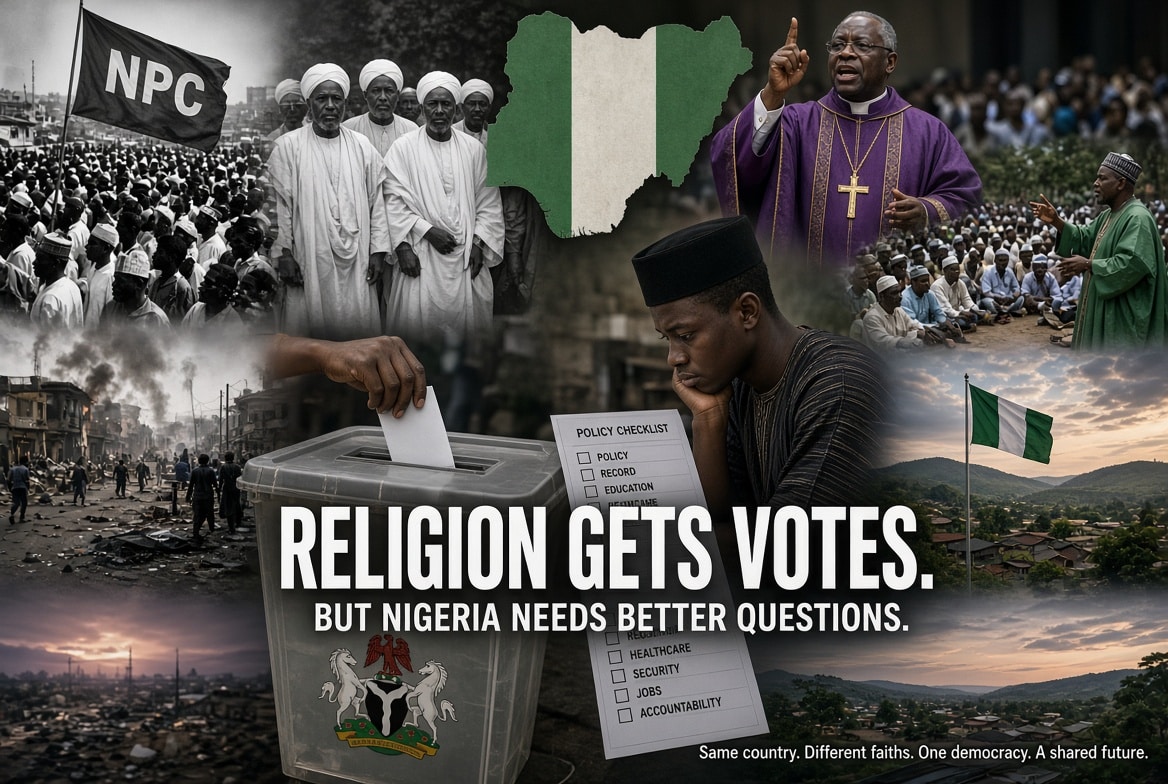
Nigeria’s first federal election was held in December 1959, shortly before independence. The election was shaped strongly by regional politics, with the Northern People’s Congress (NPC) becoming the dominant political force in Northern Nigeria. The North’s larger population also translated into greater representation in the federal legislature under the electoral arrangements of the period.
The NPC was not formally a religious organisation, but it operated within a political environment in which Islam, traditional authority, and regional identity were closely connected. The British system of indirect rule had strengthened the political position of traditional rulers in Northern Nigeria, particularly the emirs, and these institutions remained influential as Nigeria moved towards independence.
Religion was therefore one of several identities through which political support could be organised. Political parties also relied on regional, ethnic, traditional, and community networks. In Northern Nigeria, these networks included traditional rulers and Muslim religious figures, while political mobilisation in other parts of the country developed through different combinations of regional, ethnic, religious, and party structures.
This became an important feature of Nigerian politics after independence: political competition was rarely based on policy alone. Regional identity, ethnicity, religion, and established networks of influence often shaped how parties organised and sought electoral support.
Since independence in 1960, religion has remained an important factor in Nigerian politics. Political parties and candidates have at different times appealed to religious identity when seeking electoral support, particularly in elections where religious and regional divisions were politically significant.
This was not unique to the North. In the South, Christian churches and Christian identity played equivalent roles in political mobilisation. But the mechanisms differed. In the South, politicians competed for the endorsement of church leaders. In Northern Nigeria, traditional rulers and Muslim religious figures could play an important role in political mobilisation, although their influence varied across communities and political periods.
What Sharia 1999 actually was
When Governor Ahmed Sani Yerima of Zamfara announced the implementation of Sharia-based criminal law in October 1999, it marked a major development in Nigeria’s post-independence political history. Zamfara became the first state to introduce an expanded Sharia legal framework after the return to civilian rule in 1999.
The move came amid widespread dissatisfaction with the country’s political and legal institutions after years of military rule. Supporters of Sharia presented it as a way of promoting justice, social order, and accountability, while critics raised concerns about its implementation, constitutional questions, and its potential impact on women and religious minorities.
The policy quickly spread beyond Zamfara. Eleven other northern states subsequently introduced or expanded Sharia-based criminal codes, making Sharia an important issue in political and legal debates across Northern Nigeria.
The development also exposed a continuing tension within Nigeria’s constitutional system: the country recognises freedom of religion while maintaining a federal legal system that must apply constitutional rights and protections across all states. The implementation of Sharia therefore became not only a religious issue, but also a question of law, governance, and the relationship between state institutions and religious authority.
More than two decades later, the legacy of the Sharia experiment remains contested. Supporters point to its symbolic and moral importance, while critics have questioned aspects of its implementation and its effects on vulnerable groups. The experience demonstrates how religious ideas can become closely connected to electoral politics, public expectations, and legal institutions in Nigeria.
The Muslim-Muslim ticket
The 2023 presidential election brought religious identity back to the centre of Nigeria’s political debate. Bola Tinubu, the presidential candidate of the All Progressives Congress (APC), selected Kashim Shettima, a Muslim from Borno State, as his running mate, creating a Muslim-Muslim presidential ticket.
The decision was controversial because Nigeria’s major parties had often used religious balancing as part of their strategy for managing the country’s religious and regional diversity. Although the Constitution does not require presidential candidates and their running mates to belong to different religions, political parties have frequently considered religious balance when selecting their tickets.
Tinubu and the APC defended the choice on political and merit-based grounds, while critics argued that the ticket did not adequately reflect Nigeria’s religious diversity. The controversy became an important part of the 2023 campaign and generated debate about whether religious identity should influence the choice of political candidates.
Tinubu ultimately won the election, while the Muslim-Muslim ticket remained one of the most discussed features of the campaign. The episode showed how religious identity continues to influence political competition in Nigeria, even though religion is not a constitutional qualification for holding the offices of president or vice-president.
A 2006 Pew Forum survey found that 76 percent of Christians and 91 percent of Muslims in Nigeria prioritised religion over national identity.
The survey provides evidence that religion had a strong influence on how many Nigerians viewed their identity and political life at the time. It also helps explain why religious identity could become an important factor in electoral mobilisation. However, the findings do not show that politicians alone created these attitudes, and religious identity was only one of several factors that influenced political behaviour.
The prophets for hire
Religious leaders have also played a visible role in Nigerian electoral politics. During election campaigns, politicians have sought the support of prominent Christian and Muslim figures, while some religious leaders have openly expressed support for particular candidates.
One prominent example came during the 2015 presidential election, when Catholic priest Father Ejike Mbaka delivered a widely discussed sermon that was interpreted by many observers as criticism of President Goodluck Jonathan and support for Muhammadu Buhari. The sermon generated strong reactions within Christian communities and became part of the wider political debate surrounding the election.
Similar forms of religious political mobilisation have occurred in Northern Nigeria, where Muslim clerics and traditional religious authorities have sometimes used sermons, public statements, and community networks to discuss political candidates and elections.
The involvement of religious leaders raises an important question for Nigerian democracy: where does legitimate political participation by religious citizens end, and where does religious authority become a tool for electoral mobilisation? The answer is not always straightforward. Religious leaders, like other citizens, have political rights, but their influence can be particularly significant in communities where religious authority carries considerable social weight.
For voters, the practical issue is therefore not simply whether a religious leader supports a candidate, but whether voters have enough independent information to assess that candidate’s record, policies, and qualifications for themselves.
What it costs ordinary people
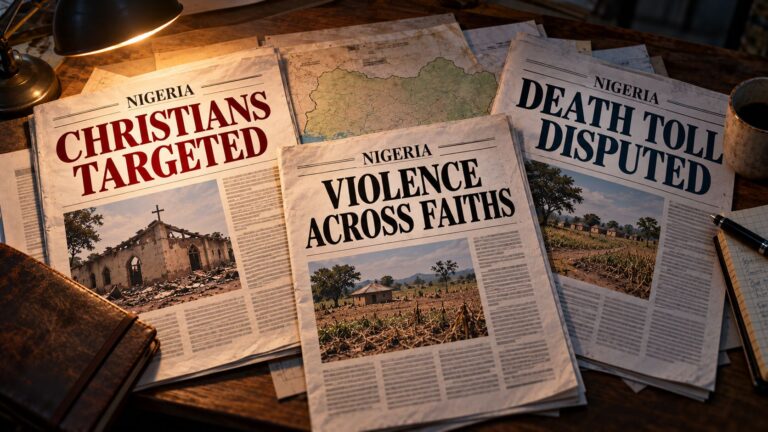
The political use of religious and ethnic identities has had consequences beyond election campaigns. Researchers have linked identity-based political mobilisation to increased social division, mistrust, and, in some periods, communal conflict in Nigeria.
The 2000 Kaduna crisis, which followed intense controversy over the introduction of Sharia criminal law, resulted in large-scale violence and loss of life. The crisis demonstrated how political and religious disagreements could quickly become communal conflicts in a society already divided along religious and regional lines.
Religious identity has also featured in conflicts in Plateau State and other parts of Nigeria, although the causes of these conflicts are complex and can include land disputes, political competition, ethnicity, access to resources, and insecurity alongside religion.
The consequences are not limited to those directly involved in violence. Prolonged conflict can disrupt businesses, displace families, damage infrastructure, interrupt education, and weaken trust between communities.
For ordinary voters, the practical consequence is that political competition based heavily on religious or ethnic identity can make it harder to evaluate candidates on issues such as public services, security, education, healthcare, employment, and accountability.
This is why understanding how religious identity has been used in Nigerian politics matters beyond the election season. It helps voters distinguish between a candidate’s religious identity and the policies, record, qualifications, and actions that can actually be examined.
What the pattern has produced
More than two decades after the return to civilian rule, the political legacy of religious mobilisation remains visible in different parts of Nigeria. Zamfara’s introduction of Sharia in 1999 was followed by similar reforms in several other northern states, while Kano developed an extensive Hisbah system. Kaduna, meanwhile, experienced severe communal violence in 2000 following intense controversy over the introduction of Sharia.
These developments did not produce the same political or social outcomes across the states involved. Northern Nigeria has continued to face a range of challenges, including insecurity, poverty, limited access to education and healthcare, and disputes over land and political power. These problems have multiple causes and cannot be attributed to religion alone.
What the history does show is that religious identity has remained an important part of political mobilisation. Candidates and political parties have continued to operate in an environment where voters may consider religion alongside ethnicity, region, party affiliation, personal reputation, government performance, and other factors.
For voters, this history provides an important lesson: religious identity can tell us something about a candidate’s background, but it does not by itself tell us how that candidate will govern. A more useful assessment requires looking at the candidate’s previous record, public policies, qualifications, spending priorities, and performance in office.
Nigeria’s 2027 general election campaign period officially began in August 2026, bringing political parties and candidates into another electoral cycle. Religion is likely to remain one of several identities considered during political mobilisation, alongside region, ethnicity, party affiliation, and candidates’ records in office. The history since independence shows that these factors have repeatedly shaped political competition in Nigeria.
What remains clear from Nigeria’s political history is that religious identity continues to be one of several factors that can influence political mobilisation. Surveys and election research also show that Nigerians consider religion alongside other identities and political interests. How these factors will shape the 2027
Election will depend on the candidates, parties, campaigns, and voters themselves.