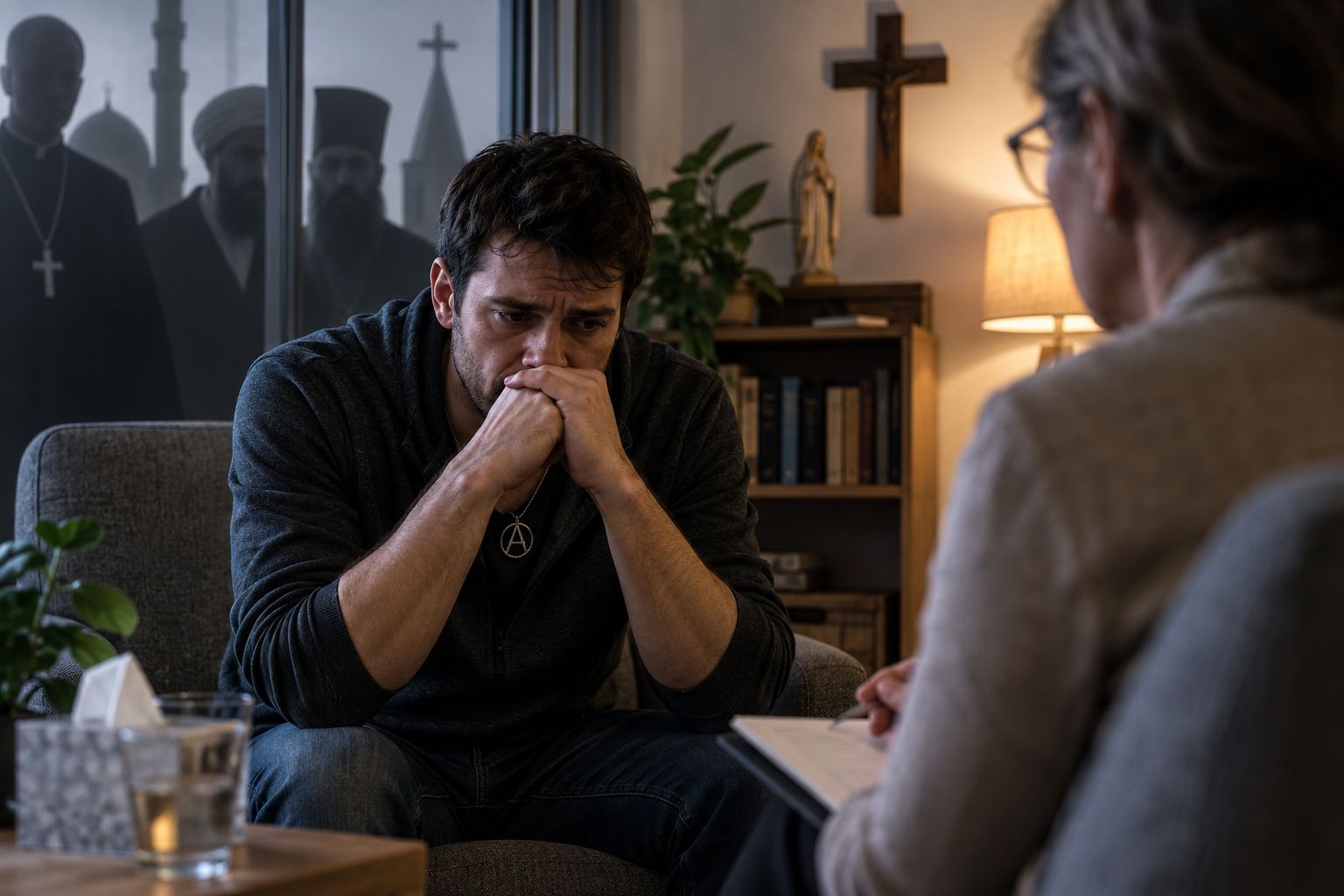
Imagine being threatened because you do not believe in God. Your family rejects you. Your government may consider your words blasphemous. You fear that someone will expose your identity. Eventually, the pressure becomes overwhelming and you decide you need psychological help.
Then another problem appears: can you safely tell your therapist that you are an atheist?
For some humanists, atheists and other nonreligious human-rights defenders, even seeking mental-health care can become another source of fear.
That is the disturbing picture Humanists International has presented to the United Nations.
The organization submitted evidence to the UN Special Rapporteur on the situation of human rights defenders, warning that nonreligious activists can face severe psychological pressure while having remarkably few places where they can safely seek help.
Persecution can begin before activism does
You do not necessarily need to organize demonstrations, publish articles or campaign against blasphemy laws to encounter trouble.
Sometimes simply becoming known as an atheist is enough.
Humanists International says nonreligious people can experience rejection by their families, ostracism from their communities, discrimination and persecution by both governments and private individuals.
For those who later become human-rights defenders, the pressure can intensify.
Blasphemy and apostasy laws remain an obvious danger. But governments can also use vaguely defined laws concerning morality, public order or religious harmony against people who challenge dominant religious beliefs.
Cybercrime legislation can add another layer of danger. What someone posts online can become evidence in a criminal case.
The consequences may extend far beyond receiving an angry comment on social media. Humanists International describes defenders facing death threats, hiding or relocation, restrictions on their movement and, in some cases, exposure of personal information by state authorities.
Living under those conditions can have predictable psychological consequences.
Then try finding a therapist
Normally, telling someone experiencing severe stress to seek professional help sounds sensible.
For a persecuted atheist, it may not be that simple.
In some countries, counseling and mental-health services are heavily connected to religious institutions. Individual practitioners may also be closely tied to the same religious communities from which a nonbeliever fears persecution.
That creates an extraordinary dilemma.
To receive effective therapy, a patient normally needs to discuss what is actually causing the distress. But what if the source of that distress is persecution for abandoning religion?
Explaining the problem means revealing the very information the person has been trying to keep secret.
The patient must then ask uncomfortable questions. Will the therapist respect confidentiality? Will the therapist understand atheism as a legitimate worldview? Could information somehow reach the family, religious community or authorities?
When apostasy or blasphemy can have serious legal or social consequences, those are not necessarily irrational fears.
Humanists International warns that the absence of confidential secular or nonreligious mental-health services can deter some defenders from seeking help altogether.
The people most in need of psychological support may therefore be among those most frightened to ask for it.
Psychiatry can become part of the problem
The submission contains an even darker allegation.
Humanists International says mental-health systems themselves can sometimes be used against humanists and nonreligious people, including through involuntary psychiatric detention connected to a person’s religion, beliefs or nonreligious identity.
That turns medicine on its head.
Psychiatric care should exist to help people experiencing mental illness or severe psychological distress. It should never become a mechanism for treating disbelief as pathology.
Not believing in God is not a psychiatric disorder.
Humanists International is therefore asking governments to prohibit involuntary psychiatric detention linked to religion, belief or nonreligious identity and to provide effective remedies where such abuses occur.
The punishment does not always end when people escape
Getting away from immediate danger does not automatically repair the psychological damage.
Human-rights defenders seeking assistance may repeatedly have to explain traumatic experiences to governments, organizations, asylum authorities or protection programs. Each application can require them to describe threats, persecution and abuse again.
Then there is the possibility of rejection.
Humanists International warns that complicated protection systems, unsuccessful applications and repeated retelling of traumatic events can deepen exhaustion and hopelessness.
Nonreligious activists can encounter another problem as well: people may fail to recognize them as human-rights defenders in the first place.
An atheist campaigning against a blasphemy law is not merely someone arguing about religion. He or she may be defending freedom of thought, conscience, religion and belief — rights that international human-rights law protects for believers and nonbelievers alike.
Freedom of religion also includes freedom from religion.
Humanists take their case to the UN
The Humanists International submission was made in response to a UN request for evidence concerning the mental health and psychosocial well-being of human-rights defenders.
The material is intended to contribute to a thematic report for the 64th session of the UN Human Rights Council.
Humanists International based its submission on its casework, its annual Freedom of Thought Report and its experience working with humanist defenders around the world.
Its recommendations go well beyond simply telling activists to seek counseling.
The organization wants states to repeal blasphemy and apostasy laws and to address vague restrictions based on concepts such as morality, religious harmony and public order when they are used against nonreligious people.
It also wants publicly funded health systems to provide confidential nonreligious mental-health options.
That recommendation may sound mundane compared with abolishing blasphemy laws. In practice, it can matter enormously.
A therapist is not much help if you are afraid of telling them why you need therapy.
Atheists have human rights too
Religious persecution is widely recognized as a human-rights issue. Christians persecuted for Christianity deserve protection. Muslims persecuted for Islam deserve protection. Jews, Hindus, Buddhists and members of minority religions deserve the same.
So do people who believe none of it.
Freedom of religion or belief is not supposed to mean freedom to choose between approved religions. It protects the ability to have a religion, change religion or reject religion entirely.
Yet atheists and humanists can still disappear from the discussion.
Humanists International is asking the UN and human-rights institutions to explicitly recognize nonreligious defenders and record belief identity when documenting defenders at risk.
That matters because an invisible problem is remarkably easy to ignore.
There are places where saying “I don’t believe in God” can destroy relationships, endanger a career, trigger prosecution or place a person in physical danger.
And in the most disturbing circumstances, the person enduring that pressure may not even feel safe telling a therapist why they are suffering.
Nobody should need courage simply to say they are an atheist.
And nobody should have to hide their worldview from the person who is supposed to help them survive the consequences of persecution.