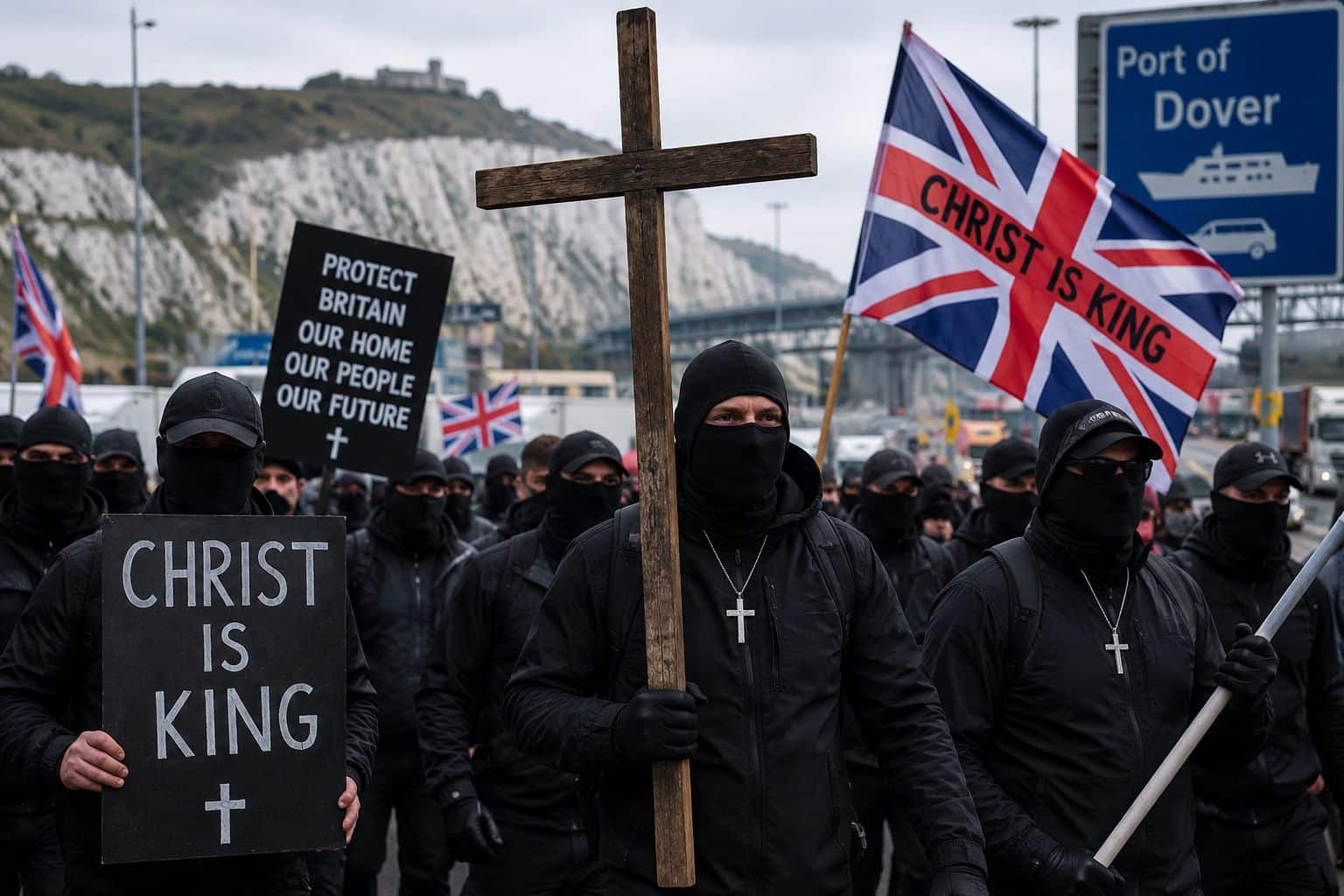
Hundreds of men dressed in black. Balaclavas covering their faces. Roads blocked. Traffic brought to a standstill. And above the noise came a chant that would normally belong inside a church: “Christ is King.”
Britain has seen plenty of anti-immigration protests. But the scenes in Dover and Portsmouth in early September looked different.
Behind them was Patriot Platform, a relatively new anti-migrant movement led by Daniel “Danny Tommo” Thomas. Thomas describes himself as a Christian and has spoken openly about building what he calls a “Christian patriotic army.”
Christianity and militant-looking nationalism had suddenly become very difficult to separate.
Black clothes, balaclavas and crosses
On September 5, hundreds of protesters descended on Dover, one of Britain’s most important ports. Many were dressed entirely in black and wore balaclavas. Some wore crosses around their necks.
They occupied roads and roundabouts leading toward the port, producing miles of traffic disruption. Protesters chanted “Stop the boats” and “Christ is King.”
A day later, similar scenes unfolded in Portsmouth after asylum seekers were brought ashore.
The Portsmouth demonstration became more confrontational. Police and coastguard vehicles were damaged, several officers suffered minor injuries from objects thrown toward them, and police eventually used dispersal powers to clear the area.
The British government condemned what it called “thuggish and intimidating behaviour.”
But Patriot Platform says it is building something much larger than a weekend protest.
A “Christian patriotic army”
Thomas has repeatedly wrapped the movement in Christian language.
“We’re growing a Christian patriotic army,” he said in August, describing a movement intended to exert enormous pressure on the British government.
That language has alarmed secular campaigners.
Humanists UK says Christianity is increasingly being used to give nationalist politics a religious identity. Its chief executive, Andrew Copson, warned that religious identity was being used to divide people and give nationalist intimidation “a claim to moral authority.”
The concern is not simply that some anti-immigration protesters happen to be Christians. Millions of British Christians hold completely different political views.
The issue is the deliberate combination of Christianity, nationalism and political mobilization.
Patriot Platform describes itself in explicitly Christian and patriotic terms. Thomas has talked about restoring Christian values and mobilizing men around a common national cause.
He has also denied that he is building a violent movement and has said violence would destroy what his organization is trying to achieve.
Even Christian leaders are sounding the alarm
Some of the sharpest criticism has come not from atheists, but from Christians themselves.
Arun Arora, the Church of England’s bishop of Kirkstall, condemned what he described as the “twisted theology” surrounding the demonstrations and warned about nationalism using Christian imagery and language.
That distinction matters.
“Christ is King” is, by itself, an ordinary expression of Christian belief. Christians have used variations of it for centuries.
A religious declaration changes meaning, however, when it is shouted by groups of masked political activists blocking roads while campaigning against migrants.
The problem is not the sentence alone. It is the political movement surrounding it.
Christianity becomes a political uniform
This is the danger of Christian nationalism.
Religion stops being merely a private belief about God, Jesus, salvation or morality. It becomes a marker separating the people who supposedly belong to the nation from those who supposedly do not.
Christianity becomes part of national identity.
A cross can then become more than a religious symbol. It can become a political badge.
And “Christ is King” can become more than a profession of faith. In the context of an anti-migrant demonstration, it can communicate a political vision of what Britain is supposed to be and who is supposed to belong there.
Britain is not a Christian club. It is home to Christians, Muslims, Hindus, Jews, atheists, humanists and millions of people whose relationship with religion is considerably more complicated.
Citizenship does not depend on accepting Jesus Christ.
An American influence?
There is another striking element to the story: the United States.
Thomas has previously claimed that an American think tank transferred £30,000 to him to help fund an earlier demonstration in Downing Street. More recently, Patriot Platform has raised money through an American Christian crowdfunding platform.
Those claims have intensified concerns that elements of American-style Christian nationalism may be finding an audience in Britain.
The exact organizational and financial relationships deserve continued scrutiny. But the ideological resemblance is difficult to miss: Christianity presented not simply as a faith, but as something intertwined with national identity, immigration and political power.
Britain has seen this combination before
Political movements have always understood the power of religion.
Religion provides symbols. It provides moral certainty. It provides an identity larger than the individual. And, perhaps most importantly, it can transform an ordinary political disagreement into something that feels sacred.
Once God supposedly enters politics, compromise becomes much harder.
An opponent is no longer merely wrong about immigration policy. He can be portrayed as standing against the nation, civilization or even God.
That is precisely why secular democracy matters.
People must remain free to proclaim that Christ is King. They must also remain free to say that Christ was merely a man, that another religion is true, or that no gods exist at all.
But government belongs equally to all of them.
Keep God out of the border war
Britain has every right to debate immigration. People can demand lower immigration, higher immigration, tougher border enforcement or a completely different asylum system.
Those arguments belong in democratic politics.
What should worry a secular society is the attempt to turn one religion into the identity of the nation itself.
Masked men dressed uniformly in black, blocking roads and chanting “Christ is King,” while their organizer talks about creating a “Christian patriotic army,” should therefore attract scrutiny far beyond the immigration debate.
Britain does not need a Christian army.
It needs citizens who can disagree about immigration, religion and almost everything else without deciding that God belongs exclusively on one side.