

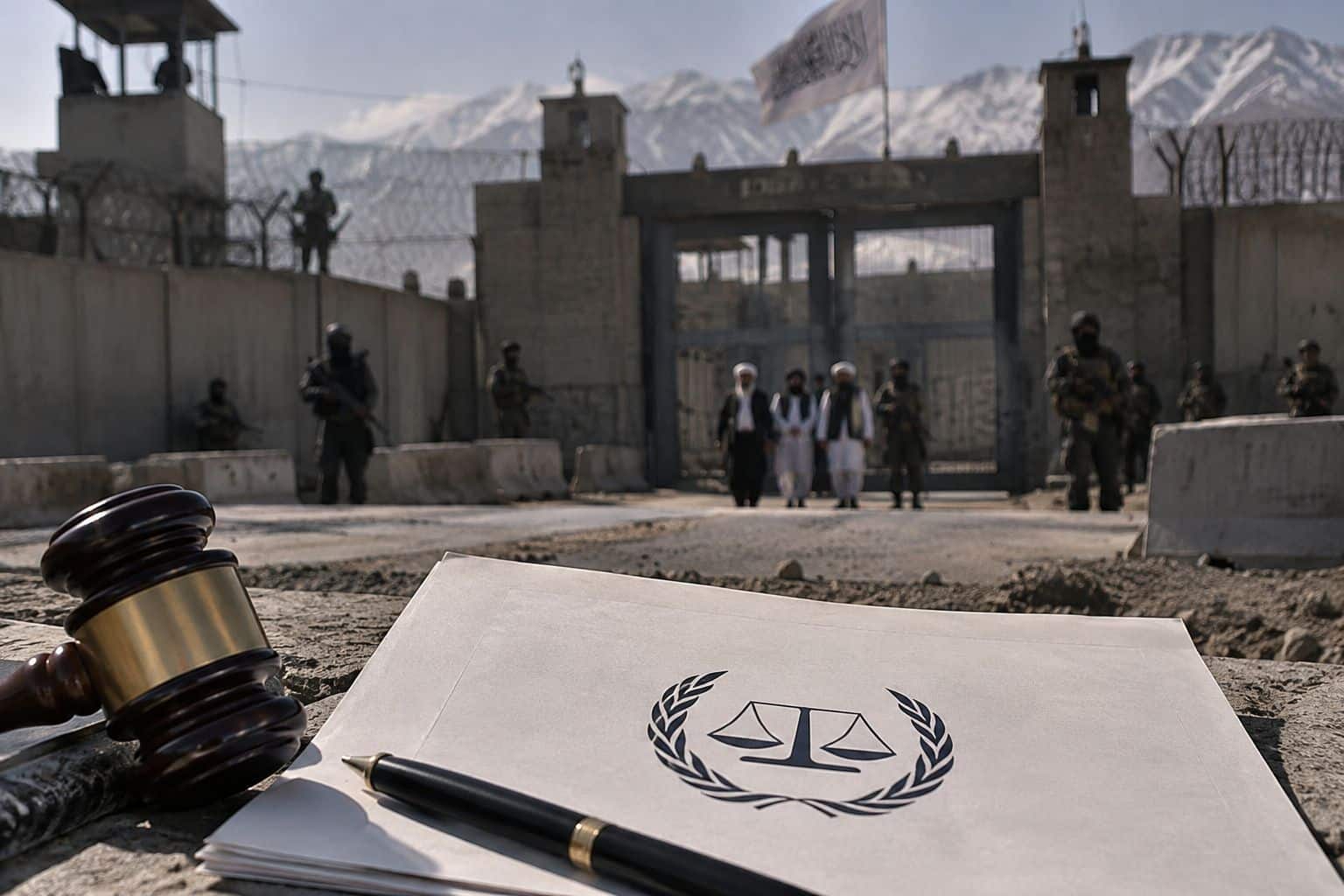
Malala Yousafzai is once again demanding accountability for what the Taliban has done to Afghanistan’s women and girls. The demand is difficult to dispute. The much harder question is what “accountability” actually means when the people accused of the crimes control the country, its police, its courts and its armed forces.
Speaking in New York this week, Yousafzai argued that international law provides too little protection when perpetrators cannot actually be held responsible. She pointed directly to the Taliban, which has spent five years systematically restricting the lives of Afghan women and girls.
Girls remain barred from secondary education and university. Women have been pushed out of much of public life and employment. Restrictions extend to movement, dress and access to public spaces. In 2026, Taliban rules further weakened protections for women and girls, including protections involving domestic violence and marriage.
Calling for justice is therefore easy to understand.
Delivering it is another matter.
There are already arrest warrants
The international community has actually gone considerably further than issuing condemnations.
In July 2025, the International Criminal Court issued arrest warrants for Taliban supreme leader Haibatullah Akhundzada and Taliban chief justice Abdul Hakim Haqqani. The ICC found reasonable grounds to believe that they were responsible for the crime against humanity of persecution on gender grounds.
That is significant.
It means the treatment of Afghan women and girls is not merely being discussed as an unfortunate domestic policy or cultural dispute. An international court has opened a legal pathway toward individual criminal responsibility.
But an arrest warrant is not an arrest.
And that exposes the central weakness of international criminal justice.
The ICC has no police
The International Criminal Court cannot send its own officers into Afghanistan to arrest Taliban leaders.
It has no police force.
The ICC explicitly states that it depends on states to arrest suspects and surrender them to the Court. Enforcement is therefore ultimately performed by governments, not by judges sitting in The Hague.
That distinction matters enormously.
A court can investigate. It can collect evidence. It can determine that the legal requirements for issuing an arrest warrant have been satisfied. It can ask states to cooperate.
But somebody with actual coercive power eventually has to put the accused person under arrest.
In Afghanistan, that power belongs to the very regime whose senior leaders are being pursued.
The Taliban is hardly going to arrest its own supreme leader and deliver him to The Hague.
International law meets political reality
This is the uncomfortable gap between international law and international politics.
Domestic criminal law normally has an enforcement mechanism behind it. If a court issues an arrest warrant, the state has police officers capable of executing it.
International criminal law works differently.
There is no world police force waiting outside the ICC. The Court depends heavily on cooperation from sovereign states. That system can work when a suspect travels to a country willing and legally obliged to arrest them. It becomes considerably more difficult when suspects remain protected by a government that rejects the Court’s authority or refuses to cooperate.
The Taliban therefore does not have to defeat the ICC legally.
Its leaders may simply remain beyond its physical reach.
The warrants are not meaningless
That does not make the ICC warrants worthless.
They can restrict the international movement of suspects. They establish a formal judicial record of allegations that have passed a legal threshold. They can preserve the possibility of prosecution if political circumstances change.
Regimes do not necessarily last forever.
Governments collapse. Leaders lose power. Former rulers travel abroad. Political alliances change. People who once appeared untouchable can suddenly become vulnerable to arrest.
International criminal investigations can therefore operate on a much longer timescale than ordinary politics.
The important distinction is between legal accountability and immediate enforcement.
The first is already developing.
The second remains extraordinarily difficult.
The UN is collecting evidence too
Another accountability mechanism is now being developed.
In October 2025, the UN Human Rights Council created an Independent Investigative Mechanism for Afghanistan. Its mandate includes collecting, preserving and analyzing evidence of serious violations and preparing files that could eventually be used in criminal proceedings.¨
Human Rights Watch and other organizations are currently calling for the mechanism to become fully operational and adequately funded.
Again, this matters.
Evidence can disappear. Witnesses can die or become impossible to locate. Documents can be destroyed. Victims’ memories fade. A regime that believes it will eventually face prosecution has every incentive to conceal evidence.
Preserving evidence today could therefore determine whether prosecutions become possible years from now.
But an investigative mechanism has the same fundamental limitation: it can prepare the road to justice, but it cannot march into Kabul and arrest Taliban leaders.
What about “gender apartheid”?
Yousafzai has also been one of the prominent advocates for recognizing what is happening in Afghanistan as gender apartheid.
She argues that the Taliban has created a systematic structure designed to exclude women and girls from public life and that international law should explicitly recognize gender apartheid as a crime. Her advocacy predates her latest comments and has become a central part of the Malala Fund’s campaign on Afghanistan.
The terminology has gained considerable international support. UN experts and human-rights organizations have described the Taliban’s system as gender apartheid, while gender persecution is already recognized as a crime against humanity under the Rome Statute and forms the basis of the existing ICC warrants.
Codifying gender apartheid could strengthen international law and create an additional framework for future accountability.
But once again, a law does not arrest anybody by itself.
Sanctions and diplomatic isolation are different tools
Countries possess other forms of leverage.
They can impose targeted sanctions, restrict travel, freeze assets under their jurisdiction, refuse diplomatic recognition, condition engagement with Taliban authorities and support Afghan civil society.
These measures can impose costs without requiring military intervention.
They are not, however, substitutes for criminal prosecution. Freezing someone’s assets is not the same thing as putting that person on trial for crimes against humanity.
The distinction becomes particularly important when politicians promise to “hold perpetrators accountable.” That phrase can mean anything from issuing a diplomatic statement to actually placing an accused perpetrator before a court.
Those are radically different levels of accountability.
Military intervention is not the answer Malala is asking for
There is another theoretically obvious enforcement mechanism: force.
A sufficiently powerful coalition could attempt to remove the Taliban or capture wanted leaders militarily.
But that would mean another war in Afghanistan, with all the risks to civilians and regional stability that such an intervention would entail. It is also explicitly not what Afghan women represented in Malala’s recent advocacy are asking for. In her March 2026 UN speech, Yousafzai emphasized that Afghan women were seeking recognition in international law rather than military intervention.
After two decades of foreign military involvement in Afghanistan, presenting another invasion as a straightforward human-rights solution would ignore both history and the potentially enormous human cost.
The enforcement problem therefore remains.
So who is actually going to enforce accountability?
For the moment, there is no single institution capable of doing it.
The ICC can prosecute individuals, but it needs states to execute its warrants. The UN can investigate and preserve evidence, but it cannot independently arrest Taliban leaders. Governments can impose diplomatic and economic consequences, but those measures do not constitute a criminal trial.
Real prosecution would most plausibly become possible if a wanted Taliban leader entered the jurisdiction of a cooperating state, if political conditions inside Afghanistan changed, or if a future Afghan government became willing to cooperate with international justice.
None of those outcomes is guaranteed.
That is precisely why Malala’s demand exposes something larger than Afghanistan.
International law is strongest when governments are willing to enforce it. When those controlling a territory are themselves accused of serious international crimes, the distance between declaring something illegal and actually punishing it can become enormous.
Justice without enforcement is unfinished justice
It would be wrong to conclude that international investigations, arrest warrants and evidence gathering are pointless.
They are not.
Without them, there may be no foundation for prosecution if circumstances eventually change. International justice sometimes requires years or decades. Documentation today can become evidence tomorrow.
But we should also resist pretending that issuing another declaration constitutes justice.
Afghan girls cannot attend secondary school while the international community debates terminology. Women living under Taliban rule cannot enforce an ICC warrant themselves. A legal document in The Hague does not automatically change what happens in Kabul.
Malala is right to demand accountability.
The international community has already begun constructing the legal machinery for it.
The unresolved question is brutally simple:
When the accused control the police, the courts and the country, who is going to enforce the law?






