

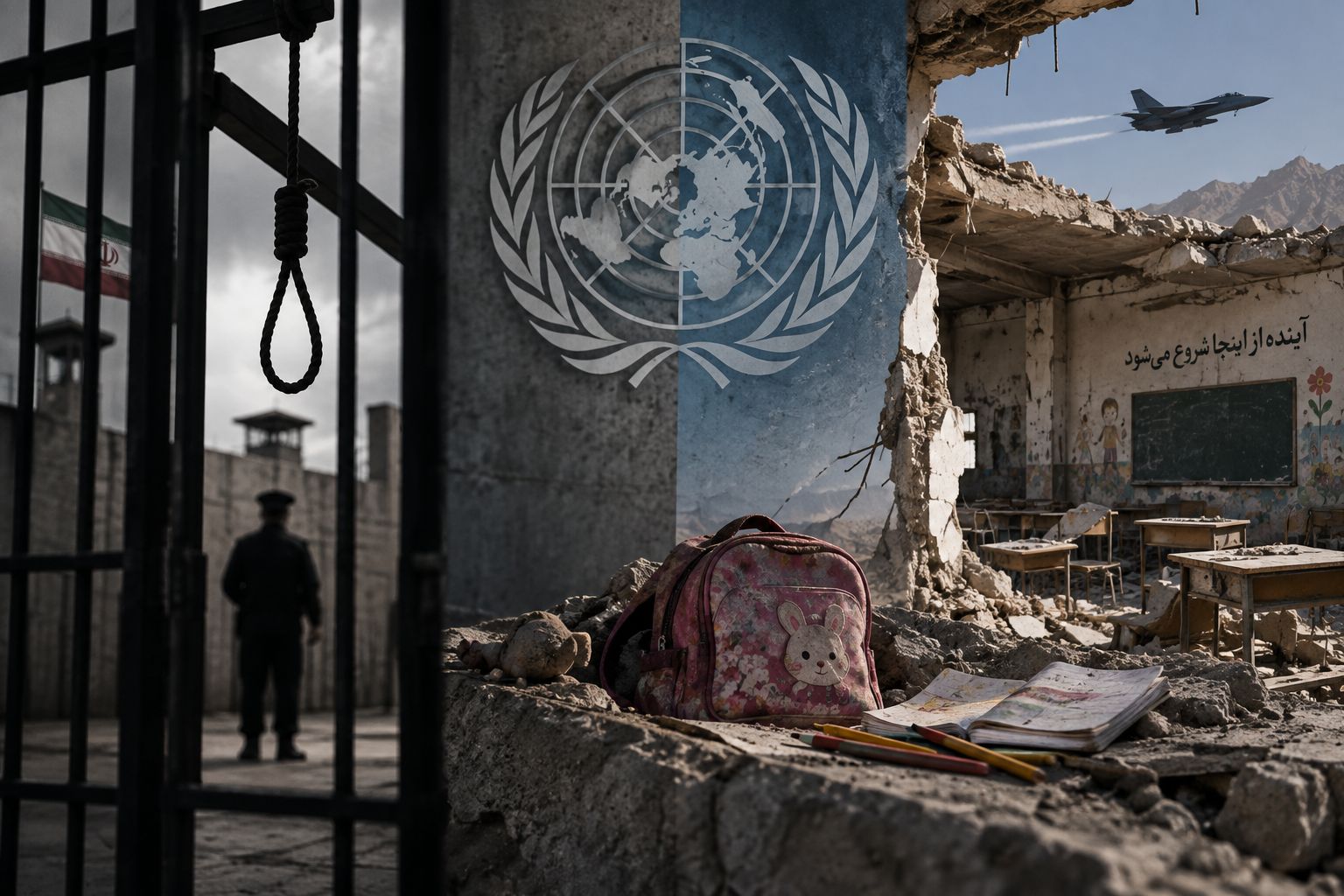
A United Nations investigation has reached grave conclusions about conduct on both sides of the conflict involving Iran and the United States.
The Independent International Fact-Finding Mission on Iran says it has reasonable grounds to believe that two U.S. military strikes inside Iran in February 2026 amounted to war crimes. Separately, investigators concluded that Iranian authorities committed crimes against humanity during their violent suppression of nationwide anti-government protests.
The findings are significant precisely because they do not fit neatly into a narrative in which abuses matter only when committed by one side. International humanitarian and human-rights law applies regardless of whether the alleged perpetrator is a theocratic government suppressing its population or a democratic state conducting military operations abroad.
A primary school was hit
One of the most serious findings concerns the Shajareh Tayyebeh Primary School in Minab, southern Iran.
The school was struck on February 28. According to Iranian officials cited by the UN investigation, more than 150 people were killed, including approximately 120 schoolchildren. UN investigators concluded that the school was a clearly identifiable civilian object and said they found no evidence that it was being used for military purposes.
The school was located next to a naval complex belonging to Iran’s Islamic Revolutionary Guard Corps. According to the fact-finding mission, however, the United States failed to adequately update its targeting information and verify that the building it was striking constituted a military objective. Investigators concluded that this went beyond simple negligence.
The mission said there were reasonable grounds to believe U.S. forces launched an indiscriminate attack resulting in civilian deaths and damage to civilian infrastructure, amounting to a war crime under international law.
President Donald Trump said in June that nobody had intentionally attacked a girls’ school and referred to an investigation into the incident. The Pentagon has conducted its own investigation but, as of September 17, had not released preliminary findings publicly.
A second strike raises similar questions
UN investigators also examined a February 28 strike on a sports center in Lamerd.
According to the report, the attack damaged nearby homes and a school and killed or injured 22 civilians. Investigators again concluded that the strike was indiscriminate and therefore constituted a war crime.
U.S. Central Command previously said that American forces had not carried out strikes inside Lamerd that day. The UN mission nevertheless said it had reasonable grounds to attribute the attack to the United States.
That distinction matters. The UN fact-finding mission is an investigative body, not a criminal court. Its conclusions do not themselves establish individual criminal guilt or result automatically in prosecutions. Evidence gathered by such missions can, however, later be used by national courts or international tribunals.
Iran accused of crimes against humanity
The same investigation reached equally serious conclusions about the Iranian government’s treatment of its own population.
Nationwide protests erupted in late December 2025. The fact-finding mission concluded that Iranian authorities carried out a widespread and systematic attack against civilians involving unlawful killings, torture, arbitrary detention, enforced disappearances and severe restrictions on freedom of expression.
That language has a specific legal significance. Crimes against humanity involve certain serious acts committed as part of a widespread or systematic attack directed against a civilian population.
The mission also pointed to internet shutdowns and Iran’s use of the death penalty during the repression. Investigators described the crackdown as a significant escalation compared with previous patterns of suppressing dissent in the country.
Iran has consistently rejected allegations that it systematically violates human rights. During the protests, authorities blamed violence on what they described as terrorists and rioters supported by foreign opponents, including the United States and Israel.
The real death toll may be considerably higher
Iranian authorities have reported 3,038 deaths and approximately 25,000 injuries connected with the unrest.
The UN mission said it could not independently establish a definitive death toll. However, investigators believe the actual number of people killed and injured is probably considerably higher than the official figures.
Rights organizations have also reported that bystanders were among those killed during the crackdown. The protests developed into one of the most severe episodes of domestic repression Iran has experienced since the establishment of the Islamic Republic in 1979.
Washington rejects the UN conclusion
The U.S. government disputed the findings.
The Pentagon declined substantive comment, saying its own investigation remained underway. White House spokeswoman Anna Kelly attacked the record of the UN Human Rights Council and maintained that Iran was the party committing war crimes in the current conflict. U.S. officials have repeatedly said American military operations comply with the law of armed conflict.
The Iranian mission in Geneva did not immediately respond to Reuters’ request for comment on the new report.
The disagreements mean the UN report should not be described as a court judgment. What investigators have established is that, based on the evidence they examined, they found the threshold of “reasonable grounds to believe” had been reached.
Human rights do not depend on who commits the abuse
The report presents two very different categories of alleged and documented wrongdoing.
In Iran, investigators describe a government using killing, torture, detention, disappearances and restrictions on expression against civilians challenging its authority. In the U.S. case, investigators examined military attacks and concluded that two strikes failed to comply with rules designed to protect civilians during armed conflict.
The legal frameworks differ, but the underlying principle does not: civilian lives do not acquire different value depending on the flag carried by the perpetrator.
Condemning Iran’s repression does not require overlooking civilian deaths caused by U.S. military action. Likewise, scrutiny of American conduct does not erase the Iranian government’s responsibility for abuses against protesters.
The fact-finding mission is expected to present its findings to the UN Human Rights Council in Geneva, where states will formally discuss the report.
For organizations concerned with universal human rights, that may be the most important lesson of the investigation. Human rights lose their meaning if they are defended selectively.






