Children should learn about human rights together, not be divided according to the religion of their parents.
That was the message delivered by Humanists International and Belgium’s Centre d’Action Laïque (CAL) at the 63rd session of the United Nations Human Rights Council on September 17. The organizations argued that education based on equality and universal human dignity is difficult to reconcile with school systems that separate children according to inherited religious affiliation.
Their argument raises a broader question that extends far beyond Belgium: should children automatically be classified by the religious identity of their families, or should public education treat them first and foremost as individuals capable of developing their own beliefs?
Human rights do not depend on religion
The joint statement began with one of the basic principles behind modern human rights: rights belong to human beings because they are human.
The Universal Declaration of Human Rights describes all people as born free and equal in dignity and rights. Humanists International and CAL emphasized that human rights therefore do not originate from divine revelation or membership in a particular religious community.
That distinction matters in education.
The UN Declaration on Human Rights Education and Training, adopted in 2011, says human-rights education should reflect principles including equality, human dignity, inclusion and non-discrimination. Humanists International and CAL argue that dividing pupils according to their parents’ religions sits uneasily alongside those principles.
The issue is not whether children should be allowed to learn about religions. Understanding religion is an important part of understanding history, culture and contemporary society. The question is whether public education should assign children to separate categories of belief before they are old enough to determine those beliefs for themselves.
A child is not automatically a believer
This is where the humanist argument becomes particularly important.
Calling a young child “Catholic,” “Muslim,” “Jewish” or “atheist” can obscure the difference between the beliefs of parents and the developing convictions of the child. Parents naturally influence their children, religiously and otherwise. But freedom of thought, conscience and religion also belongs to children.
A genuinely pluralistic education system should therefore leave room for children to question, compare and eventually accept or reject the ideas with which they were raised.
Humanists International has long argued that children’s freedom of religion or belief can be compromised when schools provide no meaningful alternative to religious instruction or privilege religious education through the state.
Religious freedom should protect the freedom to practice Christianity, Islam, Judaism, Hinduism or any other religion. But the same principle necessarily includes the freedom to change religion, reject religion or have no religion at all.
Belgium illustrates the problem
The organizations specifically pointed to Belgium, where parts of the public education system still separate pupils for religious or non-confessional ethics instruction according to choices made by their parents.
CAL has campaigned for a different model for years.
Following a 2015 Constitutional Court decision and subsequent legislation in the French-speaking education system, philosophy and citizenship education was introduced for all pupils. Students can receive one hour of philosophy and citizenship, with an additional hour available to pupils who opt out of religion or ethics instruction. CAL continues to advocate a common two-hour philosophy and citizenship course.
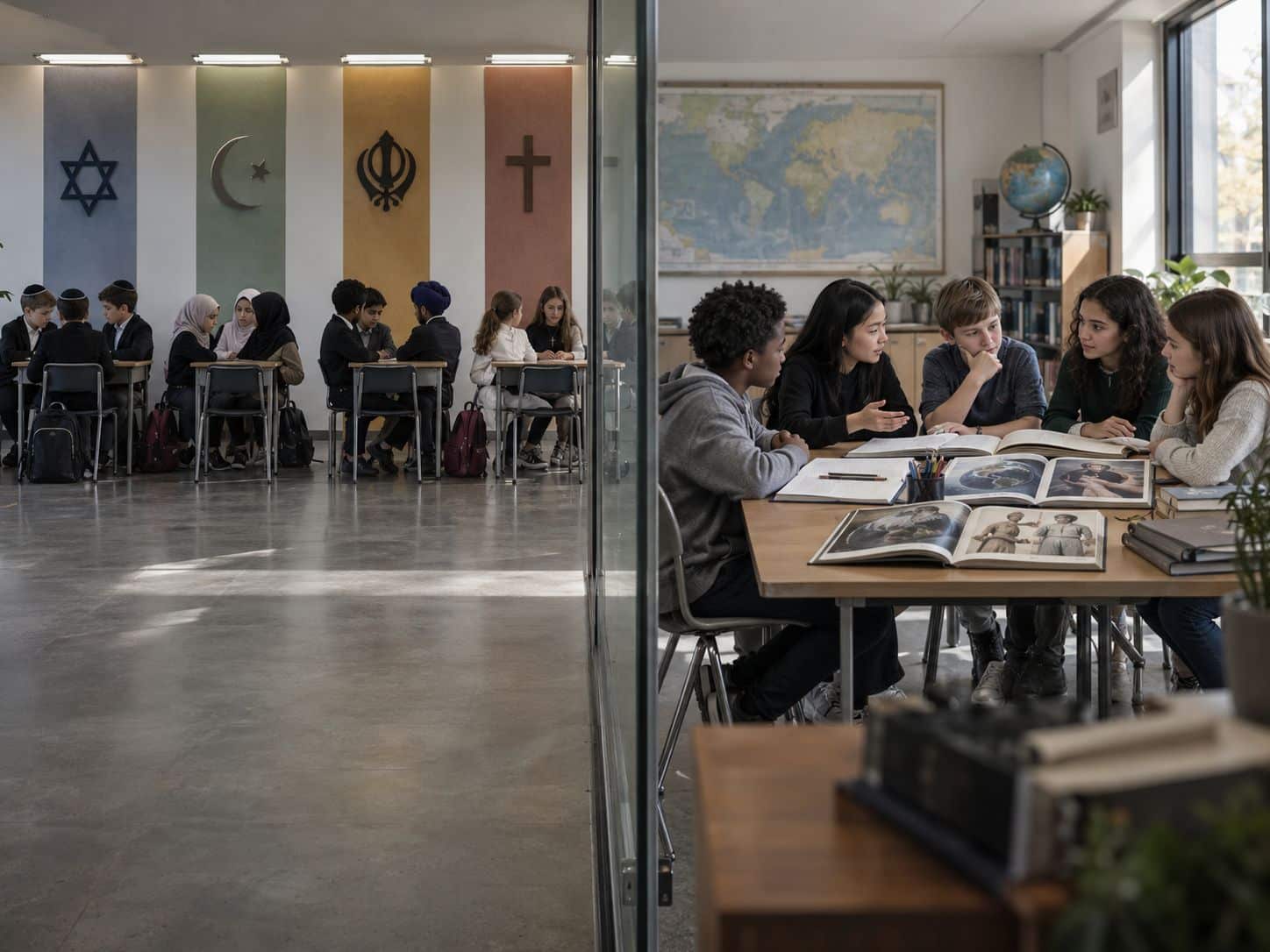
The idea is straightforward: instead of separating children according to inherited religious categories, pupils can meet in the same classroom to examine philosophy, citizenship, democracy and ethical questions together.
That does not require teaching atheism. Nor does it require hostility toward religion.
It requires neutrality.
Teaching children how to think
There is an important distinction between teaching children what they must believe and teaching them how to examine beliefs.
A secular philosophy and citizenship class can introduce pupils to competing ethical traditions, religious ideas, humanism, political philosophy and fundamental rights without declaring one worldview unquestionably true.
Children can learn how arguments work. They can distinguish evidence from assertion. They can encounter people who think differently from their parents. They can learn that disagreement does not necessarily require hostility.
These abilities are especially important in democratic societies.
Human-rights education becomes much more meaningful when pupils encounter human diversity rather than remaining intellectually separated according to categories inherited from previous generations.
The problem goes beyond Belgium
The joint statement also noted that the situation elsewhere can be considerably more restrictive. In some countries, nonreligious pupils have no alternative to religious education at all.
This creates an obvious problem for freedom of conscience.
If the state requires a child to participate in confessional religious instruction without providing a genuine alternative, freedom of religion risks becoming freedom only for people whose beliefs correspond to those recognized by the system.
At the other extreme, secularism should not mean preventing children from learning about religion or treating religious pupils as unwelcome. A neutral education system can accommodate religious diversity while refusing to decide which religious claims are true.
The distinction is fundamental: education about religion is not the same thing as religious instruction.
Children need common ground
Thomas Gillet, president of CAL, delivered the joint statement in French during a high-level UN panel marking the 15th anniversary of the Declaration on Human Rights Education and Training. The organizations presented philosophy and citizenship education as a way of bringing pupils together around democratic values while protecting their individual autonomy.
That principle deserves attention far beyond Belgium.
Schools are among the first places where children encounter people from backgrounds different from their own. Separating them according to religion can reinforce boundaries that education should instead help them understand and cross.
A Christian child, a Muslim child, an atheist child and a child who has no idea what they believe yet all possess the same human rights.
They do not need separate versions of human dignity.
They need an education that gives them the intellectual freedom to decide for themselves what they believe.