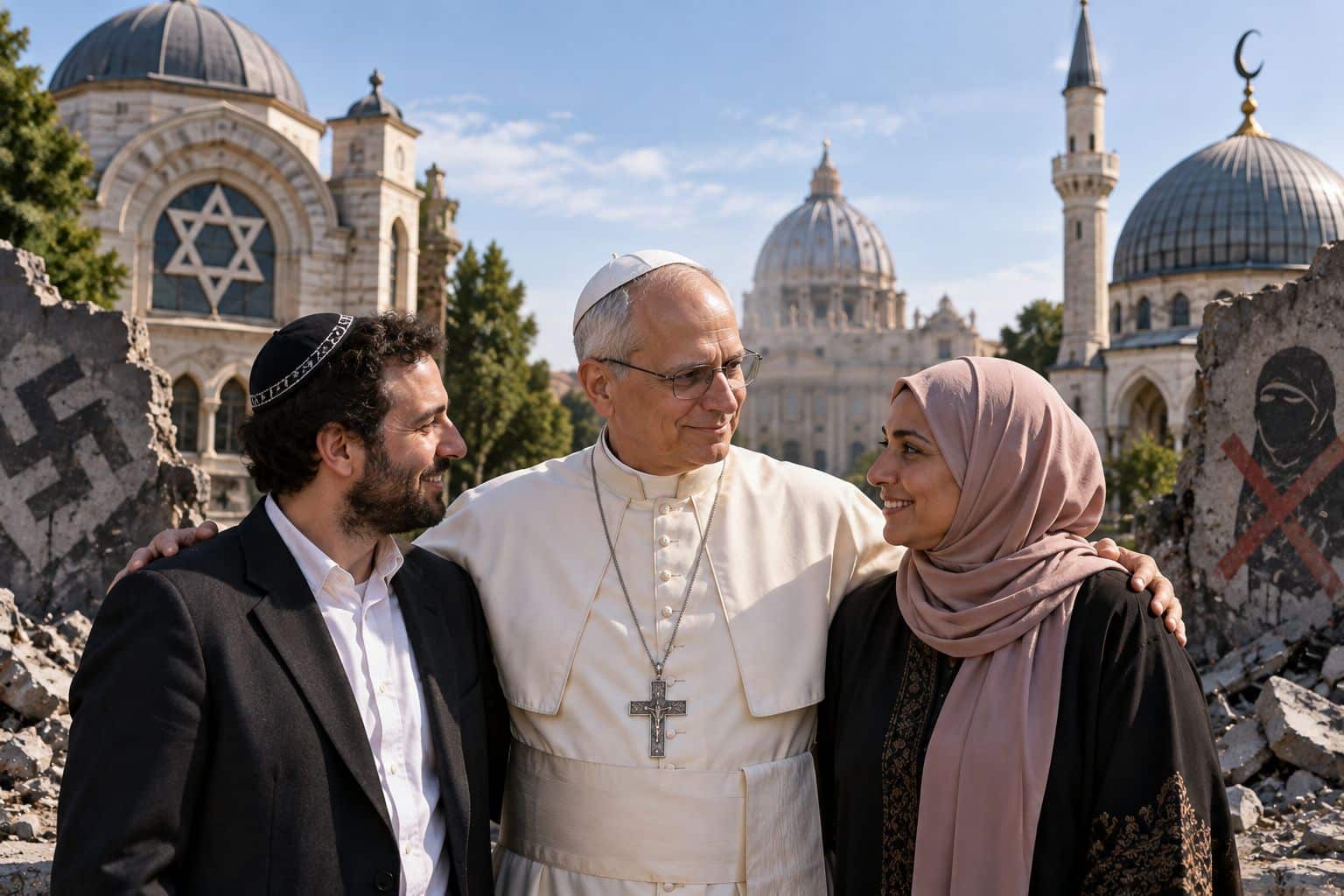
Pope Leo XIV has reaffirmed the Catholic Church’s opposition to both antisemitism and Islamophobia, arguing that religious and political tensions must not become excuses for hostility toward entire groups of people.
The message comes in a new Vatican document, A Journey of Hope, published on September 16 to commemorate 60 years of interreligious dialogue following the Second Vatican Council’s landmark declaration Nostra Aetate. The document was prepared by three Vatican departments, approved by Pope Leo, and ordered by him to be published.
For freethinkers, there is an important distinction here. Religions, religious doctrines and religious institutions are ideas and organizations. They can and should be criticized. Jews and Muslims, however, are human beings. Criticism of Judaism, Islam, Israel, Iran, Saudi Arabia, religious lobbying or clerical power does not justify prejudice against people simply because they are Jewish or Muslim.
Antisemitism remains a shared struggle
The Vatican document reiterates the Catholic Church’s condemnation of antisemitism. It recalls that Nostra Aetate denounced hatred, persecution and antisemitic acts directed against Jews, regardless of who commits them. The new document describes opposition to antisemitism as a “shared struggle” involving Christians and Jews.
This position carries particular historical weight. Relations between Christianity and Judaism were marked for centuries by discrimination, persecution and religious hostility. Nostra Aetate, adopted in 1965, represented a major change in the Catholic Church’s formal relationship with Judaism and explicitly rejected antisemitism.
That distinction remains crucial today. The policies of the Israeli government are legitimate subjects of political and moral criticism. They should not be treated as actions for which Jews around the world bear collective responsibility. Opposition to a government must not become hostility toward an ethnic or religious population.
Islamophobia also comes under criticism
The document is similarly explicit about hostility toward Muslims. It criticizes manifestations of Islamophobia that fail to distinguish between religious fundamentalism and violence on one hand and ordinary Muslims living peaceful lives on the other.
That distinction should not require anyone to soften criticism of Islam. Islamic doctrines concerning apostasy, blasphemy, women’s rights, LGBTQ+ people or the relationship between religion and government can be subjected to the same rigorous criticism as Christian, Jewish, Hindu or any other religious doctrines.
But criticism of Islam is not the same thing as hostility toward Muslims.
A person can strongly oppose Sharia-based criminal laws while defending the civil rights of Muslims. A person can condemn Islamist extremism without regarding ordinary Muslims as extremists. And a person can reject Islamic theology entirely while insisting that Muslims deserve exactly the same human rights as everyone else.
The Middle East has strained Jewish-Christian relations
The Vatican document also acknowledges the effects of recent Middle Eastern conflicts on relations between Jews and Christians. It says disagreements over the violence have strained channels of communication, although decades of interreligious dialogue have prevented those relationships from collapsing altogether. The document does not identify a particular conflict by name.
The issue illustrates why separating individuals from governments, religions and political movements matters.
Jews are not synonymous with Israel. Muslims are not synonymous with Islamism. Israelis are not synonymous with the Israeli government. Palestinians are not synonymous with Hamas. Christians are not synonymous with the Vatican.
Treating millions of individuals as interchangeable representatives of a collective identity makes serious discussion almost impossible.
Criticizing ideas without attacking people
Freethinkers do not have to agree with Pope Leo’s theology—or with religion at all—to recognize the importance of this distinction.
Freedom of thought includes the freedom to criticize Christianity, Islam and Judaism. It includes criticism of religious scriptures, clerics, institutions and political influence. No religion should enjoy immunity from scrutiny merely because criticism makes some believers uncomfortable.
At the same time, freedom of thought is perfectly compatible with rejecting antisemitism, anti-Muslim prejudice and collective blame.
Indeed, those principles reinforce one another. A secular society should protect the right to say that a religion is wrong while equally protecting the person who follows that religion.
Pope Leo’s message therefore contains a principle that extends far beyond Catholic interfaith dialogue: criticize beliefs as fiercely as the evidence warrants, criticize governments for what they actually do, and hold organizations accountable for their actions—but judge human beings as individuals.