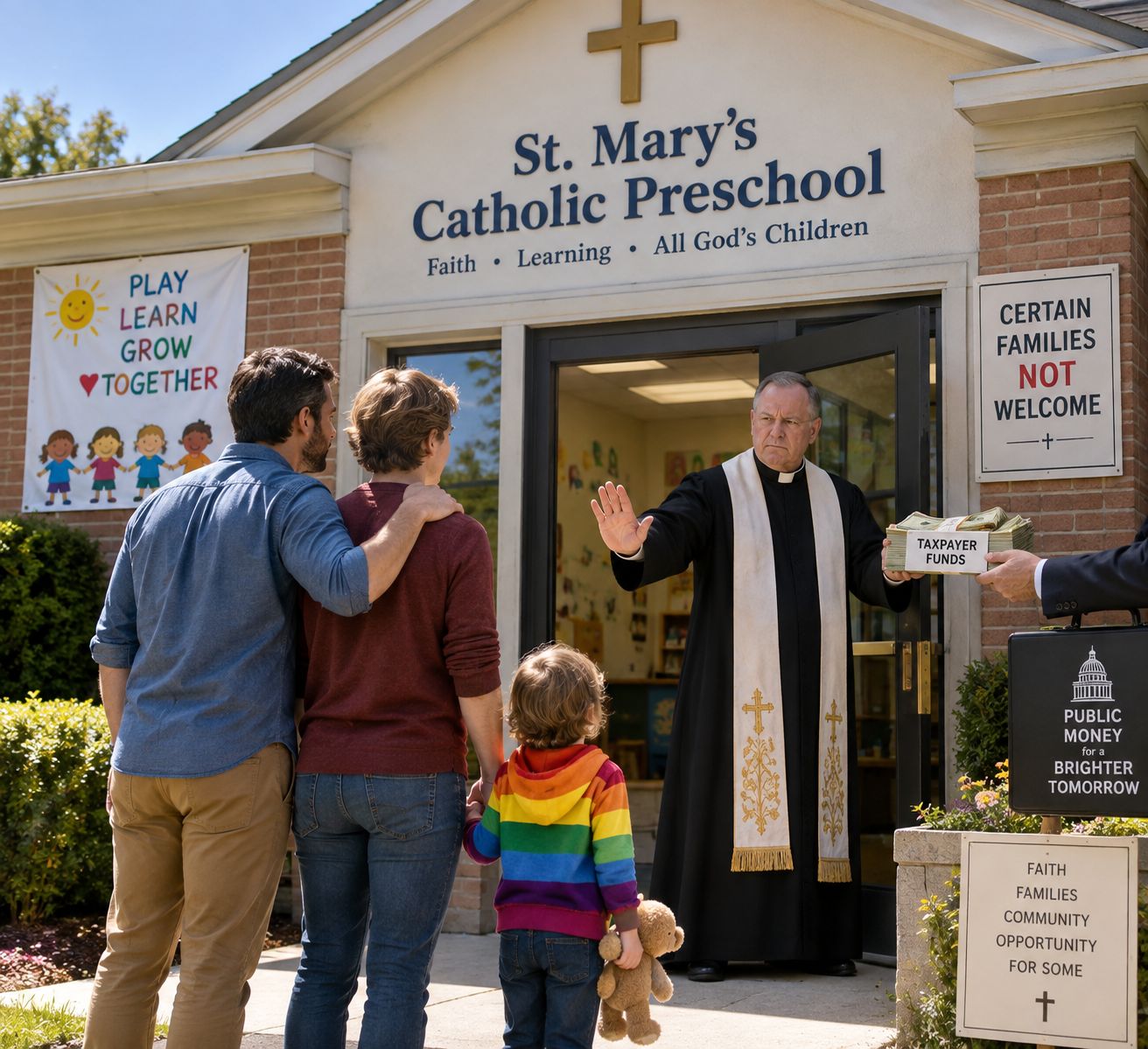
Catholic preschools in Colorado want access to a taxpayer-funded universal preschool program. At the same time, they want the freedom to apply religious enrollment policies that can exclude children because they or their parents are LGBTQ.
That dispute has now reached the U.S. Supreme Court.
The case, St. Mary Catholic Parish v. Roy, presents a question extending far beyond a handful of preschools. When religious organizations voluntarily participate in publicly funded programs, can they demand exemptions from the anti-discrimination rules imposed on everybody else?
For secularists, the answer should be straightforward. Religious freedom protects the right to practice a religion. It should not automatically create a right to receive public money while disregarding the conditions attached to that money.
Colorado created universal preschool
Colorado’s Universal Preschool Program helps families pay for preschool and allows them to choose among participating public and private providers, including religious ones.
But participation comes with conditions. Providers must give families an equal opportunity to enroll regardless of characteristics including race, ethnicity, religious affiliation, sexual orientation, gender identity, income, disability and housing status.
Catholic preschools connected to the Archdiocese of Denver objected to parts of those requirements.
According to filings in the Supreme Court case, the archdiocese concluded that the prohibition on considering LGBTQ status in enrollment decisions conflicted with Catholic teaching. It therefore sought religious exemptions from parts of the program’s requirements. Colorado refused, saying participating providers could not discriminate against children or families in violation of the equal-opportunity requirement.
The schools sued.
They want the money without all the conditions
The Catholic schools argue that Colorado is forcing them to choose between participating in a generally available government benefit and remaining faithful to their religion.
Their Supreme Court petition also attacks the way Colorado administers exemptions and argues that secular exceptions undermine the state’s claim that its rules are generally applicable. The Supreme Court agreed in April to hear two questions concerning those issues.
That deserves to be taken seriously as a constitutional argument. Governments cannot simply design supposedly neutral programs in ways that selectively disadvantage religious institutions.
But there is another principle at stake.
Taxpayer funding is not the same thing as religious liberty.
A Catholic institution has the right to teach Catholic doctrine. A church can preach that marriage exists only between a man and a woman. Catholics can organize their religious communities around those beliefs.
None of that necessarily means taxpayers must finance an institution while allowing it to disregard anti-discrimination conditions attached to a public program.
LGBTQ families are at the center of the case
This is not an abstract disagreement about theology.
Colorado told the Supreme Court that the petitioners sought public funding while retaining the ability to exclude children based on their own or their parents’ sexual orientation, gender identity or religious affiliation.
The Catholic institutions describe the matter differently. They maintain that their admissions practices reflect sincerely held Catholic beliefs and that Colorado has impermissibly burdened their religious exercise.
That distinction will be crucial when the Supreme Court hears the case.
But from the perspective of an excluded family, the practical outcome can be remarkably simple: a government-funded preschool place may be available to other families while theirs is rejected because the school disapproves of who they are.
Religious freedom cannot mean religious privilege
This case illustrates a recurring problem in debates over religious freedom.
Freedom of religion is an essential human right. A government should not tell Catholics what they must believe about marriage. It should not force atheists to profess belief in God. It should not dictate Muslim theology, Jewish theology or anyone else’s theology.
But freedom of religion and entitlement to government funding are different propositions.
Imagine a secular private organization entering a taxpayer-funded education program while announcing that it intends to exclude Catholic families. Few defenders of religious liberty would regard that as an acceptable use of public money.
Changing the identity of the excluded group should not magically transform discrimination into liberty.
Religious institutions deserve the same fundamental freedoms as everyone else. They should not receive a special category of citizenship in which religious motivation automatically overrides rules imposed on other recipients of public funding.
Even Catholics are opposing the schools
The controversy should also not be presented as “Catholics versus LGBTQ people.”
Catholic LGBTQ advocacy organization New Ways Ministry is among the groups opposing the schools’ position. An amicus brief associated with the organization argues that religious freedom does not require the government to subsidize organizations while they violate generally applicable anti-discrimination requirements. Other Catholic voices have similarly supported LGBTQ inclusion.
That matters.
There is no single Catholic position on how civil law should handle LGBTQ equality, even when official church teachings concerning sexuality and marriage remain conservative.
The dispute is therefore better understood as a conflict over the boundaries between religious autonomy, equality and public financing.
The Supreme Court will decide where the boundary lies
The Supreme Court granted review in April 2026, and oral argument is scheduled for November 3.
The eventual ruling could have consequences well beyond Colorado preschool.
If religious organizations can demand public funding while receiving exemptions from conditions that conflict with their doctrines, similar arguments could arise across education and other government-funded services.
There is a legitimate constitutional question about whether Colorado has applied its rules neutrally. The Supreme Court will have to resolve it.
But the broader secular principle should survive regardless of the outcome.
You are free to believe that homosexuality is sinful. You are free to preach it. You are free to establish a religious community around that belief.
What should not follow automatically is another proposition:
The public must pay you to discriminate.