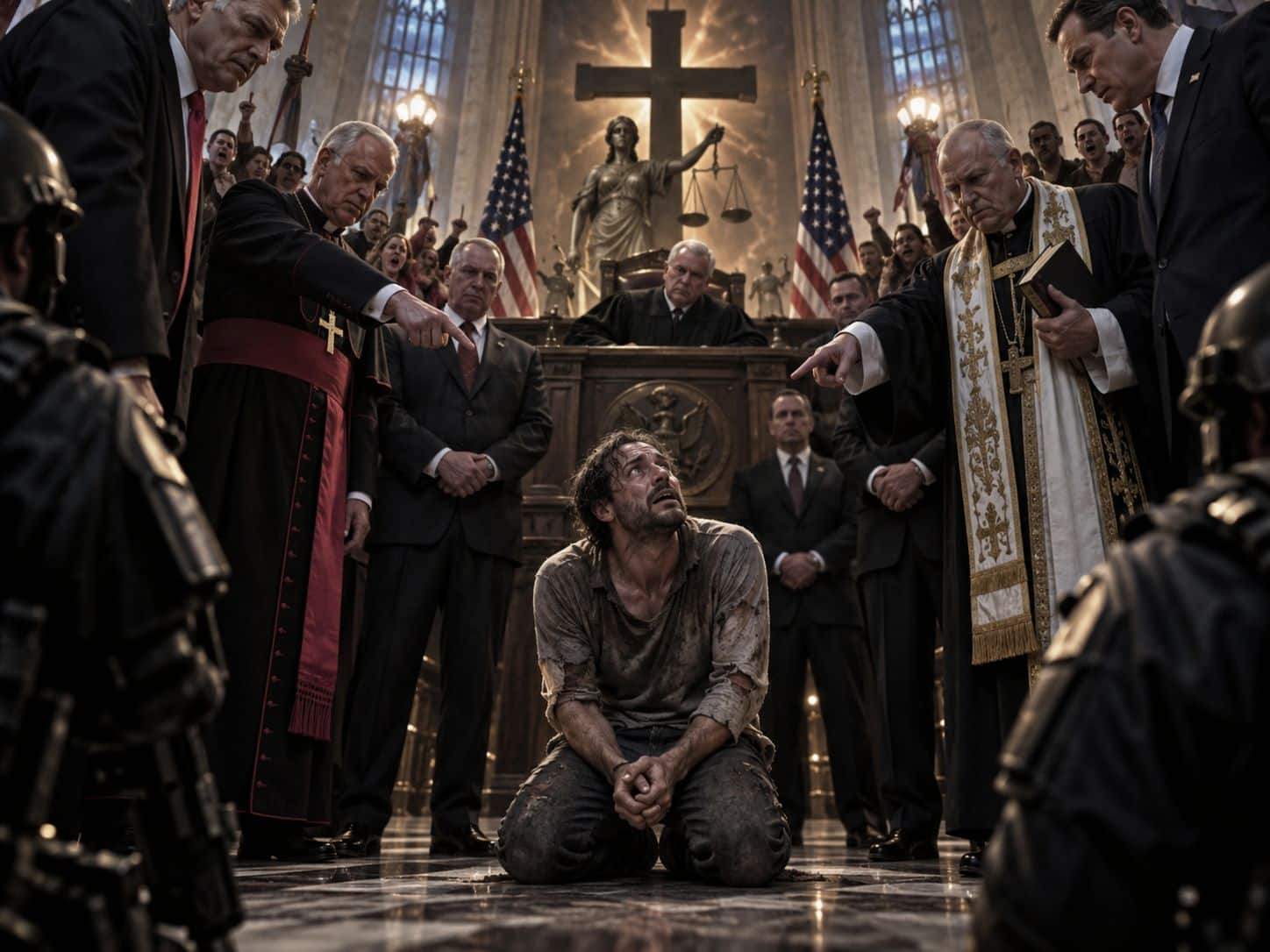
One of America’s most prominent conservative Christian theologians has backed away from an extraordinary proposal: allowing the government to punish blasphemy.
Albert Mohler, longtime president of the Southern Baptist Theological Seminary, now says he was wrong to endorse such an idea. His reversal came after criticism of views he expressed in a recent book on Christian nationalism and during an August discussion in Idaho.
For secularists, however, the controversy raises a question that goes far beyond Mohler himself. How did criminalizing religious dissent become a serious proposal in a modern liberal democracy in the first place?
“I think I blew it”
Mohler’s retreat was unusually explicit. Writing on September 14, he acknowledged his mistake, saying: “I think I blew it.” He added that, as a Baptist, he would never want the state to coerce religious belief. He now says he rejects both blasphemy laws and religious tests for public office and supports the existing American constitutional order.
That is an important correction. It should be welcomed.
But what Mohler previously advocated deserves attention precisely because he is not an obscure internet extremist. He is one of the most influential figures in American evangelical Christianity and has led the Southern Baptist Theological Seminary for decades.
His proposal emerged from a much broader argument about Christian nationalism.
What Mohler originally proposed
Mohler is one of the contributors to the recent book 5 Views on Christian Nationalism. During an August 7 discussion about Christian nationalism, he argued that America’s constitutional order should explicitly acknowledge the country’s Christian foundations. He described the Constitution’s failure to mention God as a serious problem.
The implications went considerably further than symbolic recognition of Christianity.
According to Baptist Press, Mohler’s proposed Christian-nationalist order would criminalize blasphemy. The government, in his formulation, would have the authority to restrict and punish expressions regarded as fundamentally repudiating the foundations of the republic.
At the Idaho discussion, Mohler also argued that blasphemy could undermine the legitimacy of both church and state.
This is where Christian nationalism crosses a particularly dangerous line.
There is an enormous difference between believing that Christianity profoundly influenced American history and giving Christianity privileged legal protection from criticism.
The first is a historical argument. The second concerns state power.
And then there were the atheists
Mohler’s vision also raised troubling questions about the status of nonbelievers.
Baptist Press reported that Mohler wrote that an atheist could live peacefully in the country but “cannot fully contribute to the American order.” His proposed system would also eliminate legal recognition of same-sex marriage.
This exposes one of the fundamental problems with religious nationalism.
Once a state officially identifies itself with one religion, citizens inevitably cease to stand on completely equal ground. Christians become members of the religion acknowledged by the state. Atheists, Muslims, Jews, Hindus and everyone else become people whose worldview stands outside that privileged foundation.
The problem does not disappear simply because minorities are promised tolerance.
A free society should not merely tolerate atheists. It should recognize them as citizens possessing exactly the same political rights and legitimacy as Christians.
Even fellow Baptists objected
Some of the strongest criticism of Mohler came not from atheists or secular organizations but from other conservative Christians.
Richard Land, the former president of the Southern Baptist Convention’s Ethics & Religious Liberty Commission, argued that Mohler’s position appeared to contradict traditional Baptist commitments to religious liberty and separation of church and state. He also questioned whether such a system would effectively create a religious test for political participation.
There is considerable historical irony here.
Baptists themselves benefited enormously from religious liberty precisely because religious majorities were once capable of using government power against religious minorities. Mohler acknowledged this history in his reversal, noting that Baptists had themselves experienced persecution under established churches.
Religious freedom protects Christians too.
Blasphemy laws protect ideas from people
The basic principle should be extremely simple.
People deserve protection. Ideas do not.
A Christian has the right to worship Jesus. A Muslim has the right to worship Allah. An atheist has the right to reject both religions. And all three must remain free to criticize, ridicule or peacefully challenge one another’s beliefs.
The government has no legitimate role in deciding that one citizen’s criticism of another citizen’s god has crossed some theological boundary.
Indeed, blasphemy laws demonstrate precisely why church and state need separation. Before the state can punish blasphemy, somebody must define blasphemy. Then somebody must decide which religion is true enough to deserve protection. Finally, courts and police must enforce that theological judgment.
At that point, religious doctrine is no longer merely a matter of private conviction. It has acquired the coercive machinery of the state.
Mohler’s reversal is welcome — but the original proposal matters
Mohler deserves credit for publicly admitting that he was wrong. Public figures do not always make such unequivocal reversals.
Nevertheless, his original position should not simply disappear down the memory hole.
The controversy demonstrates how quickly arguments about a nation’s “Christian identity” can progress from culture and history to actual restrictions on freedom of expression and equal citizenship.
Mohler initially contemplated a political system in which Christianity would receive explicit state recognition, blasphemy could be punished and atheists would occupy a diminished position in the national order. After substantial criticism, he has now rejected blasphemy laws and religious tests.
Good.
But secular democracy should never have needed this correction.
The right to believe in God means very little unless it includes the equally protected right to say that God does not exist — or even that the entire idea is absurd.