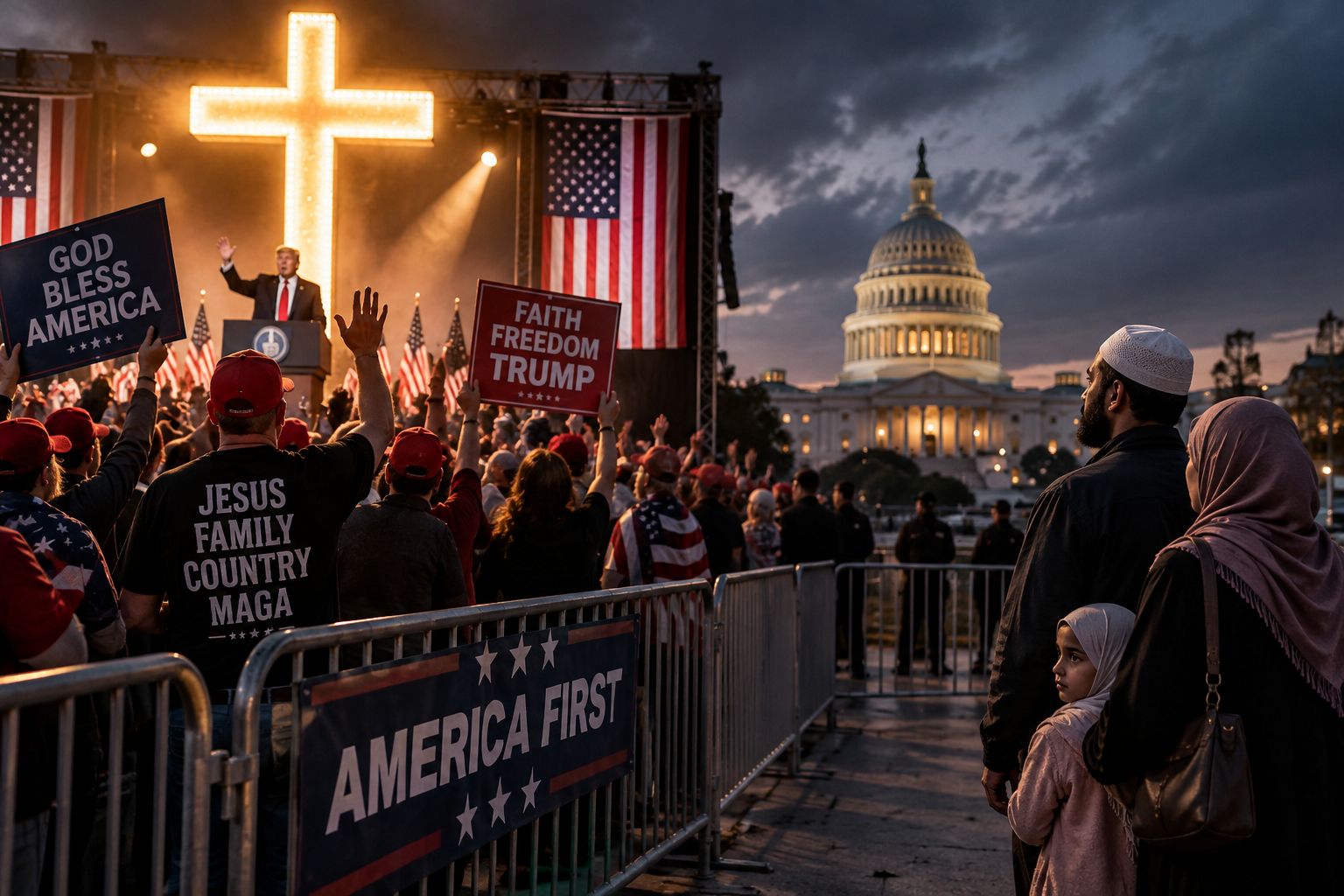
Religion is moving closer to the center of American politics. Three developments surrounding the 2026 midterm elections illustrate the trend: Donald Trump and his allies are using increasingly explicit Christian rhetoric, critics in Washington are warning about the growth of Christian nationalism, and prominent Republicans are turning Islam and Muslim Americans into campaign issues.
These developments are not identical, but together they raise an important question about religious freedom in the United States. If one religion becomes increasingly associated with national identity and political legitimacy, what happens to Americans who belong to another religion—or to no religion at all?
MAGA goes to church
The Republican midterm convention in Dallas offered a striking example of the increasingly religious character of MAGA politics.
Donald Trump made an explicitly religious appeal to Republican voters, while speakers used Christian language throughout the event. Democrats were described as “godless communists,” while Trump was presented by some supporters in language carrying unmistakably religious overtones.
The political message was increasingly difficult to separate from the religious one. Christianity, conservative politics and loyalty to Trump were repeatedly presented as parts of the same struggle over the future of the United States.
This represents something more significant than politicians simply mentioning God. Religious rhetoric has always existed in American politics, including among Democrats. The concern arises when Christianity becomes intertwined with a particular political movement and with ideas about who represents the “real” America.
That distinction matters enormously in a country whose Constitution prohibits religious tests for public office and whose First Amendment restricts government establishment of religion.
Christian nationalism enters the debate
The growing political role of Christianity has already prompted warnings in Washington.
Representative Jared Huffman, a California Democrat and one of the few openly nonreligious members of Congress, has become a prominent critic of Christian nationalism. He argues that the movement threatens the separation between church and state and, ultimately, religious freedom itself.
Huffman has warned that existing constitutional protections are being gradually weakened. He has also criticized members of his own Democratic Party who might respond to Republican religious politics by offering a softer version of the same approach—something he has described as “theocracy light.”
That is an important distinction. Secular government does not require hostility toward Christianity. On the contrary, separation of church and state protects Christians as well as atheists, Muslims, Jews, Hindus and members of every other religious community.
The problem begins when government starts favoring one religious identity.
The Trump administration has provided critics with additional reasons for concern. In 2026, administration officials participated in a government-associated prayer gathering framed around rededicating the United States as “One Nation under God.” Critics, including Huffman, argued that the event blurred the boundary between government and a particular vision of Christianity.
Christian nationalism goes considerably further than an individual politician being Christian. It links national identity with Christianity and can imply that Christian Americans possess a more authentic claim to the country than everyone else.
Muslims become an election issue
At the same time that Christianity is receiving greater prominence within Republican politics, Islam is increasingly being portrayed as something Americans should fear.
Reuters reported in September that several prominent Republicans have made Muslims and Islam campaign issues ahead of the 2026 midterms.
Vice President JD Vance attacked Michigan Democratic Senate candidate Abdul El-Sayed, who is Muslim, calling him “very, very evil” while criticizing comments El-Sayed made after an attack on a Detroit synagogue.
Texas Governor Greg Abbott has targeted a Muslim-led development project in his state while raising allegations involving Islamic law. Concerns about supposed “sharia courts” associated with the project have circulated despite a lack of evidence supporting some of the most alarming claims.
Senator Tommy Tuberville of Alabama has similarly warned about “radical Islam.”
Criticism of Islam, like criticism of Christianity or any other religion, is legitimate in a free society. Religious ideas deserve no immunity from scrutiny. Islamist extremism is also a real phenomenon and should be confronted without hesitation.
But criticizing a religion is fundamentally different from treating ordinary citizens as politically suspect because they belong to that religion.
Muslims make up only a small percentage of the American population. They include conservatives, liberals, secular Muslims, devout believers and people with radically different political opinions. Treating them as a single political threat reproduces precisely the kind of religious tribalism that a secular democracy should resist.
Religious freedom cannot be selective
There is an obvious contradiction in demanding greater political privileges for Christianity while simultaneously portraying another religious community as a threat.
Freedom of religion cannot mean freedom for the majority religion alone.
A genuinely free society must allow Christians to practice Christianity, Muslims to practice Islam, Jews to practice Judaism, and atheists to reject all of them. Government should neither punish religion nor promote it.
This principle becomes especially important when political movements begin defining national identity in religious terms.
An American does not become more American by believing in Jesus Christ. Nor does an American become less American by praying in a mosque, attending a synagogue or believing that no gods exist.
Citizenship is not a theological category.
America faces a choice
The United States has never achieved perfect separation between religion and politics. Presidents invoke God, members of Congress openly discuss their faith, and religious organizations have influenced political movements throughout American history.
But there is a difference between politicians personally expressing religious beliefs and a political movement presenting a particular religion as an essential component of national identity.
The developments surrounding the 2026 midterms suggest that this boundary deserves close attention.
When politicians tell voters that their political struggle is also a religious struggle, democracy can gradually turn political opponents into enemies of the faith. When the same movement singles out a religious minority as culturally dangerous, the implications become more serious still.
America does not need a Christian government, a Muslim government or an atheist government imposing beliefs on its citizens.
It needs a secular government.
That is not an attack on religious freedom. It is one of the strongest protections religious freedom has.