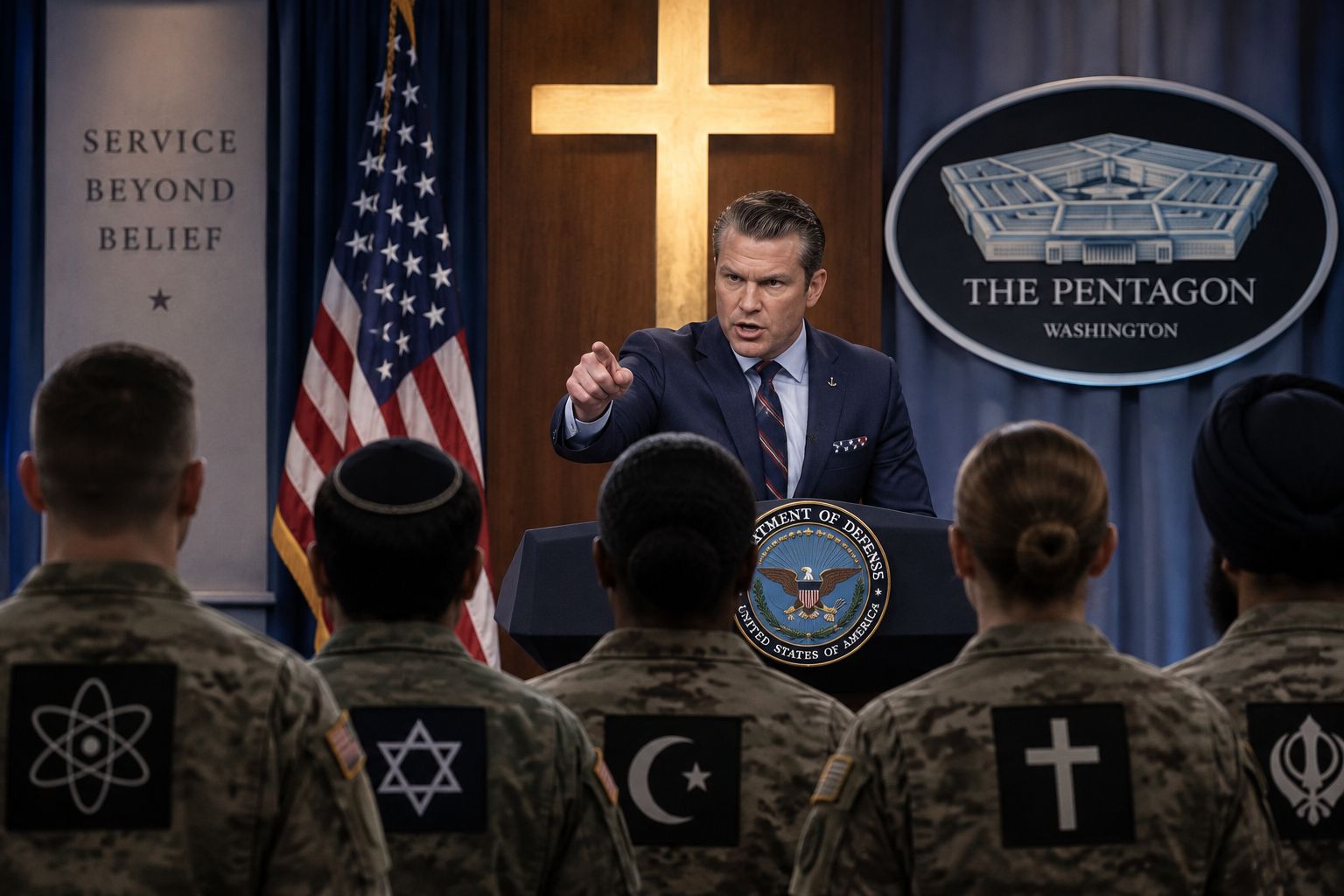
U.S. Defense Secretary Pete Hegseth has come under criticism from secular organizations after attacking a religious-freedom group as “radical anti-Christian” and “pro-atheist” during a dispute over religious messages at a U.S. Air Force base.
The Freedom From Religion Foundation (FFRF) accused Hegseth of scapegoating atheists and non-Christians and of treating Christianity as if it deserved a privileged position within the U.S. military. The controversy raises a much larger question: Should the person leading the armed forces of a religiously diverse country portray atheism as something hostile to the military?
It started with “God bless you”
The controversy began at Kirtland Air Force Base in New Mexico. According to the Military Religious Freedom Foundation (MRFF), service members complained that guards at the base gates were repeatedly greeting personnel with “God bless you.”
One complainant said the greeting had occurred consistently over several days and appeared to be an officially sanctioned practice rather than an occasional personal expression. According to reporting on the dispute, 34 people complained to MRFF, 24 of whom identified as Christians.
That detail matters. The dispute was not simply a battle between atheists and Christians. Christians themselves were reportedly among those objecting to the practice.
The objection was also not that individual service members should be prohibited from being Christians, praying or expressing their faith. The question was whether personnel acting in an official capacity at the entrance to a military installation should repeatedly give visitors an explicitly religious greeting.
MRFF contacted the Air Force over the complaints, and the practice reportedly stopped.
Hegseth responds
Hegseth reacted publicly and aggressively.
He characterized MRFF as a “radical anti-Christian, pro-atheist group” and declared that the Pentagon would “never cave” to it. He also said the Air Force would “confront this.”
That choice of language immediately attracted criticism.
There is an obvious distinction between being anti-Christian and demanding government neutrality toward Christianity. Opposition to government-sponsored religious messaging does not necessarily constitute opposition to Christianity itself.
Likewise, describing an organization as “pro-atheist” as part of an attack carries an uncomfortable implication: that association with atheism is itself evidence against the organization.
Atheism is not an enemy ideology. It is simply the absence of belief in gods. American atheists serve in the military alongside Christians, Jews, Muslims, Hindus, Buddhists and people belonging to many other religious traditions.
FFRF hits back
The Freedom From Religion Foundation responded on September 9, accusing Hegseth of attacking atheists and non-Christians.
FFRF argued that the defense secretary’s response distorted the underlying controversy. It pointed to the Air Force’s own commitment to religious pluralism and argued that military personnel must be able to practice their beliefs without government officials favoring one religion over another.
That distinction is fundamental to secular government.
Religious freedom does not mean suppressing Christianity. Christians in the U.S. military have the same right to their beliefs as everyone else. They can pray, attend religious services, possess Bibles and practice their religion.
But religious freedom also belongs to the atheist who believes there is no God, the Muslim who does not accept Christian theology, the Jew who does not believe Jesus was the Messiah and everyone else whose worldview differs from that of the defense secretary.
Government neutrality protects all of them.
Christianity at the Pentagon
The latest dispute does not exist in isolation. Hegseth has repeatedly attracted criticism over the role of Christianity at the Pentagon.
In 2025, he participated in Christian prayer and worship services at the Pentagon featuring his pastor, Brooks Potteiger. FFRF objected to the events, arguing that officially supported Christian worship inside the Pentagon blurred the constitutional boundary between personal religious exercise and government endorsement of religion.
More recently, FFRF criticized a new history curriculum for schools serving military families. According to the organization, the curriculum gives Christianity preferential treatment while presenting Islam negatively. The Pentagon’s education system serves tens of thousands of children from military families around the world.
These controversies form part of a wider political struggle over the role Christianity should play in American government.
Hegseth and his supporters generally portray their actions as restoring religious liberty and correcting discrimination against Christians. Secular organizations see something fundamentally different: an attempt to transform freedom of religion into governmental preference for Christianity.
Those are not equivalent concepts.
Being secular is not being anti-Christian
This distinction is frequently lost in American culture-war politics.
Secularism does not require the government to oppose religion. It requires the government not to choose among religions — or between religion and nonreligion.
A Christian soldier should not have to become less Christian to serve the United States. An atheist soldier should not have to pretend to believe in God either.
The same principle applies to Muslims, Jews, Hindus and everyone else.
When government officials portray requests for religious neutrality as attacks on Christianity, they turn equality into persecution. When atheism itself is invoked as a negative label, they risk sending another message: Christians belong here, while atheists are somehow suspect.
That is particularly troubling in the armed forces, where commanders and senior officials exercise enormous authority over people beneath them.
The Constitution belongs to atheists too
The United States has never imposed a religious test for federal public office. Article VI of the Constitution explicitly states that “no religious Test” shall be required for public office or trust under the United States.
The First Amendment subsequently prohibited the establishment of religion while protecting its free exercise.
Those principles are complementary. The government cannot tell Christians not to be Christians. But neither should it use government authority to make Christianity the preferred worldview.
Members of the U.S. military swear allegiance to the Constitution, not to Christianity, atheism or any other religious philosophy.
A defense secretary therefore has a particular responsibility to represent service members regardless of what they believe about God.
A dangerous message
Hegseth is entitled to be a Christian. He is entitled to discuss his faith and practice it personally. Religious liberty applies to him as fully as it applies to an atheist.
But his office changes the significance of his words.
When the U.S. defense secretary publicly denounces an organization partly by labeling it “pro-atheist,” atheists have every reason to ask why their worldview is being invoked as an accusation.
The answer to religious diversity in the military is not less religious freedom. It is equal religious freedom.
Christians should be free to be Christians. Muslims should be free to be Muslims. Jews should be free to be Jews. Atheists should be free to reject all religions.
The Pentagon does not need to decide which of them is right.
It needs to defend the freedom of all of them.