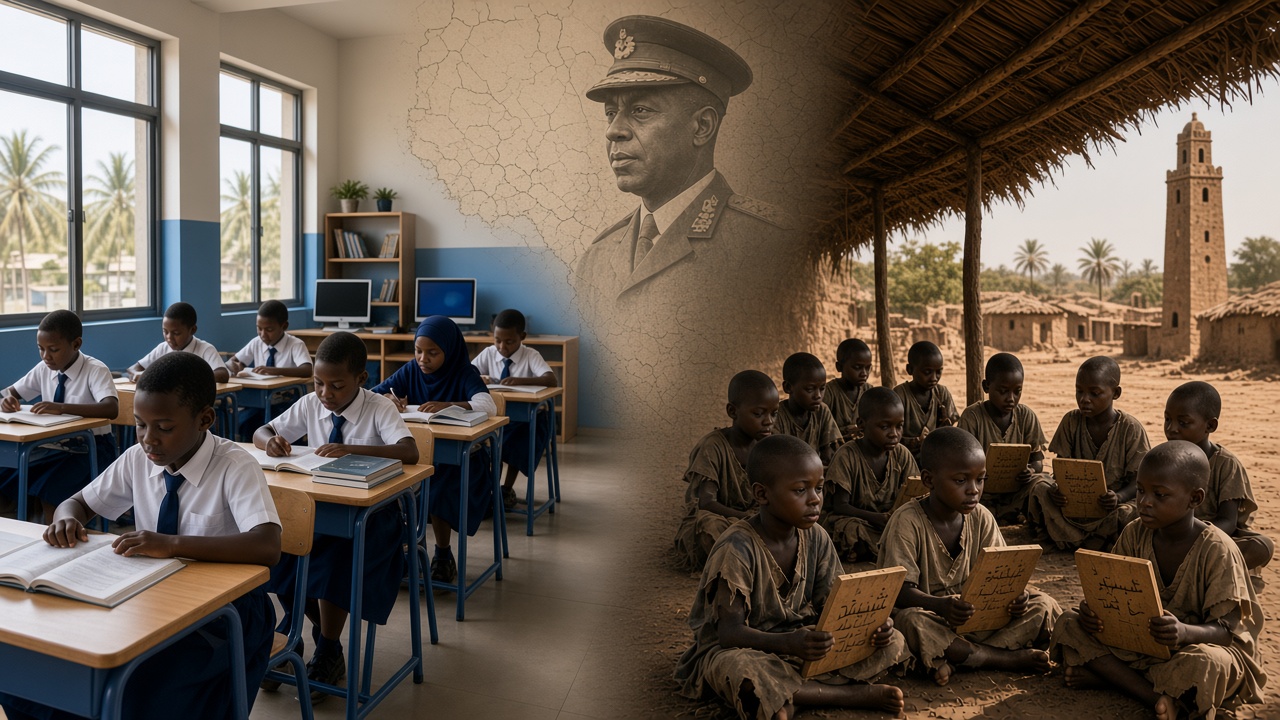
The divisions were already visible in the colonial record.
By the early twentieth century, British rule had produced a widening educational divide between Northern and Southern Nigeria. In his 1922 book, The Dual Mandate in British Tropical Africa, Lord Frederick Lugard wrote extensively about the different social, political and educational conditions across Britain’s Nigerian territories.
Those differences were not simply accidents of geography or culture. They were shaped by colonial policies, including decisions about how education would be introduced, funded and administered in different parts of the country.
Those choices were made over a century ago. Their consequences are visible today in every literacy table, every employment statistic, every healthcare gap, and every out-of-school child count that separates northern Nigeria from the south. The regional divisions visible in Lugard’s colonial Nigeria have not disappeared.
Before the British arrived
Before British colonial rule, Northern Nigeria already had established systems of learning and scholarship, although they differed significantly from the Western-style education later introduced by the colonial state.
Across parts of the region, Islamic scholarship, Qur’anic education and Arabic literacy formed important parts of intellectual and social life. Centres of learning such as Kano and Sokoto produced and preserved manuscripts dealing with subjects including law, theology, history and other areas of knowledge.
This was not a single, uniform educational system, and access to advanced learning was not equally available to everyone. But it was a structured intellectual tradition with its own institutions, methods of instruction and standards of scholarship.
The arrival of British colonial rule introduced a different system of education and, crucially, a different definition of which forms of knowledge and qualifications would be recognised by the state and rewarded within the colonial economy.
The missionary gap
In Southern Nigeria, Christian missionary organisations began establishing Western-style schools from the nineteenth century. The Church Missionary Society, Methodist missions and Roman Catholic missions established schools in places including Lagos, Abeokuta, Onitsha and Calabar. By the early twentieth century, missionary education had helped create pathways into clerical work, teaching and other occupations within the expanding colonial economy.
Northern Nigeria followed a different path. Colonial authorities were cautious about allowing Christian missionary activity in areas under Muslim emirates, partly because indirect rule depended on cooperation with existing political and religious authorities. As a result, missionary expansion in much of the north was more restricted than it was in the south.
The colonial government did establish schools in Northern Nigeria, particularly to train people for administrative and other official roles. But the scale and development of Western-style education did not match the extensive missionary-school networks that had already developed across much of Southern Nigeria.
Meanwhile, Qur’anic education continued as an important system of learning for many communities, but colonial institutions placed greater economic and administrative value on Western-style qualifications. This created a growing gap between the education available to many northern children and the credentials increasingly required for advancement within the colonial system.
The result was a structural imbalance. Decades of more extensive school-building in Southern Nigeria produced greater access to Western literacy and the qualifications recognised by the colonial economy. Many parts of Northern Nigeria entered the twentieth century with far fewer opportunities to access the same educational pathways. By the time the territories were amalgamated in 1914, that disparity had already become deeply embedded.
The 1914 amalgamation and what it locked in
When Lord Lugard amalgamated the Northern and Southern Protectorates in 1914, he brought together regions that had experienced very different patterns of educational development under British influence.
The consequences of the amalgamation are often discussed in political terms — tensions between north and south, competition for resources and representation. Its educational consequences deserve equal attention.
By 1914, access to Western-style education was far more widespread in much of Southern Nigeria than in Northern Nigeria. This gave many southerners greater access to the qualifications increasingly required for clerical work and other positions within the colonial economy. The disparity was not evidence of any difference in intellectual ability. It reflected unequal access to the forms of education and credentials that the colonial system chose to recognise and reward.
The unequal expansion of Western-style education contributed to slower educational and economic development in many parts of the north, while the growing disparity between north and south later contributed to political tensions. development was much slower in the north, and the growing disparity between north and south later caused political tensions.
These tensions did not begin at independence. They were baked in by 1914. Independence simply transferred the management of an unequal system from British hands to Nigerian ones.
What independence did not fix
When Nigeria became independent on October 1, 1960, it inherited deep regional inequalities in access to education and the opportunities that education created.
Successive governments introduced policies intended to address regional disparities, including quota-based admissions and recruitment systems in some federal institutions. These measures were designed, in part, to widen representation and access for historically disadvantaged regions. Their impact, however, has remained contested, and they did not eliminate the underlying gap in educational infrastructure and access.
Nigeria has problems such as inequalities in access to education, an educational gap between the north and south, dwindling financial resources, and inadequate infrastructures. These are not new observations. They appear in virtually every educational policy review Nigeria has conducted since independence.
Nigeria’s educational policies are still influenced by the colonial legacy of educational inequality, with many regions still facing difficulties in ensuring that all citizens receive an equal education.
Sixty-six years of independence have not closed the gap that sixty years of colonial policy created. The gap has narrowed in some places. It has widened in others — particularly where insecurity, poverty, and the out-of-school crisis have concentrated in the north.
Today, the North-West has a literacy rate of 9.5 percent. Lagos has 87 percent. Those two numbers, side by side, describe a country that is still living in Lugard’s two Nigerias.
What the gap actually costs
Educational inequality is not an abstract injustice. Its consequences can compound across generations.
A child who does not learn to read faces greater barriers to accessing written information, including healthcare guidance, legal documents and financial services. Limited access to education is also associated with earlier marriage, poorer health outcomes and fewer economic opportunities. At a community level, low levels of literacy can limit participation in formal employment, access to information and the ability of citizens to engage effectively with public institutions.
Deep social stratification, economic inequality, and cultural estrangement were left behind by British policies. Large segments of the populace, particularly in the rural and northern areas, were often denied access to educational possibilities, leaving many Nigerians without the skills or opportunities required for social mobility.
The Almajiri boy who died eating contaminated fish in Kano last week was not in that situation because his community does not value knowledge. His community has valued knowledge for over a thousand years. His death cannot be explained by colonial history alone. But the educational inequalities that shaped the world around him did not emerge in a vacuum. They reflect a much longer history of unequal investment, compounded by decades of post-independence neglect and failures of child protection.
That is a colonial inheritance. It is also a post-colonial failure because sixty-six years is long enough to have done more.
The two Nigerias are not a metaphor
A child born in Zamfara did not choose where he was born. He deserves the same opportunity to learn and develop as a child born in Lagos. What often differs is the level of investment, infrastructure and support available to them.
That is not fate. That is a budget line.
The colonial administration made choices. Its policies allowed Western-style education to expand far more extensively in much of Southern Nigeria than in Northern Nigeria, where colonial authorities followed a different approach shaped by indirect rule and their relationship with existing emirate institutions. Post-independence governments made choices too. They introduced programmes, policies and reforms, but many failed to close the underlying gap in access, infrastructure and educational opportunity. Each generation of decisions had consequences.
The consequences are visible now: 9.5 percent literacy in the North-West and 87 percent in Lagos. More than eighteen million children are out of school, with the largest share concentrated in northern states. And across the region, children continue to face the consequences of educational systems and child-protection structures that have repeatedly failed to meet their needs.
These are not simply statistics about culture, religion or the supposed backwardness of a people. They reflect the accumulated consequences of unequal investment over generations — first under colonial rule and later through post-independence failures to close the gap. A child in Kebbi deserves the same opportunity to learn and thrive as a child in Enugu.
The good news is that historical inequalities are not permanent. They can be reduced through sustained investment in schools, teachers, child welfare and the communities that have been left furthest behind.
Nigeria does not lack evidence about what helps children stay in school. The harder question is whether those priorities will be reflected consistently in budgets and public policy.
Colonial rule helped create an unequal educational landscape. More than six decades of independence have not fully dismantled it. Until Nigeria commits to closing that gap, the two Nigerias shaped by unequal access to opportunity will remain part of the country’s reality.