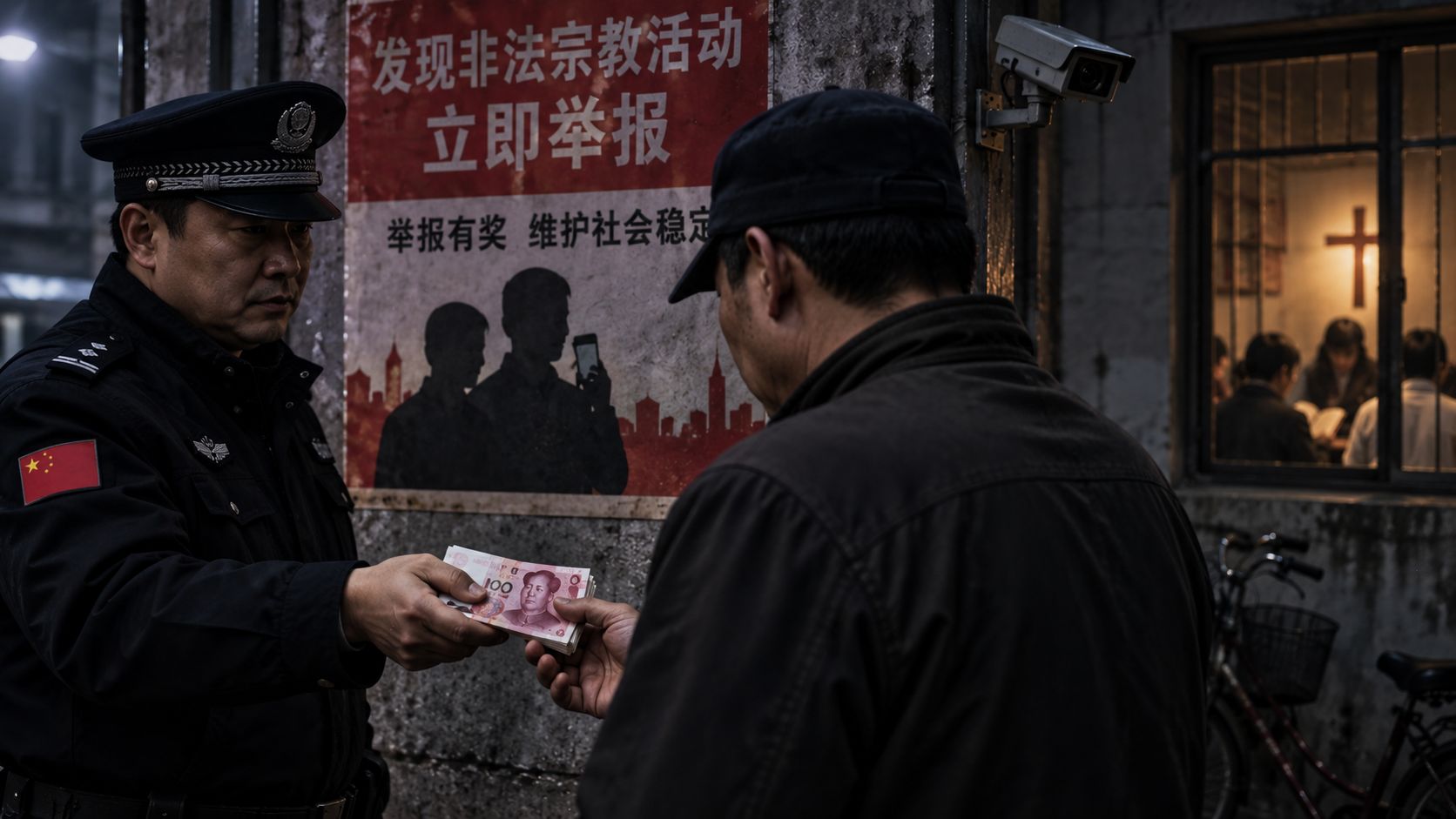
China’s government has found another way to control religious life: encourage ordinary citizens to report one another.
Across more than a dozen Chinese cities, local authorities introduced measures during the first half of 2026 encouraging—or financially rewarding—people who report religious activities the government considers “illegal.” The targets can include activities that would be completely ordinary exercises of religious freedom in a democratic society: worship in private homes, religious education without government approval, preaching online, distributing religious literature or organizing religious gatherings outside officially authorized venues.
In Chengdu, authorities have even offered cash rewards for verified reports. China officially claims to guarantee freedom of religion. Increasingly, however, that freedom appears to mean something very different: you may practice religion as long as the Communist Party approves who practices it, where they practice it, who teaches them and what they are allowed to say.
Cash for reporting religious activity
According to Human Rights Watch, more than a dozen Chinese cities introduced measures in the first half of 2026 encouraging people to report supposedly illegal religious activities. Some authorities are putting money behind the policy.
In Chengdu, Sichuan province, verified reports can reportedly earn informants between 200 and 800 yuan. The significance goes beyond the relatively modest amount of money.
A financial reward changes the relationship between citizens. A neighbor, colleague, landlord or business owner can potentially benefit from informing authorities about another person’s religious activity. That encourages suspicion precisely where private life should normally begin.
The categories of behavior subject to reporting can also be extraordinarily broad. In February, authorities in Honghe prefecture in Yunnan reportedly listed 35 categories of “illegal religious activity.”
Among them were collective religious ceremonies conducted in private homes or other unauthorized locations, religious preaching through livestreams or WeChat groups, distributing religious materials publicly and organizing religious education without official authorization. In other words, the issue is not simply terrorism, violent extremism or genuinely dangerous cult activity.
Ordinary independent religious practice can fall within the government’s definition of illegality.
Hotels and businesses become watchers
The surveillance network does not stop with neighbors. Authorities have increasingly enlisted businesses.
In Haidong, Qinghai province, hotels and travel agencies have reportedly been instructed to scrutinize events and report suspicious religious activity. An official notice issued in Fuzhou goes even further.
Hotels, restaurants, guesthouses and property-rental businesses have been instructed not to provide premises for unauthorized religious activities. Businesses are told to watch for indicators such as religious altars, large quantities of religious books, groups frequently entering rented premises or rooms being used for repeated religious gatherings.
Businesses are also expected to cooperate with authorities by providing information including reservation records, surveillance footage and rental agreements. The implications are profound.
A hotel is no longer merely providing accommodation. A landlord is no longer merely renting a property. They can become components of the state’s religious surveillance apparatus.
Five religions—under state control
China is not officially a country in which every religion is simply prohibited. The reality is more complicated.
The government recognizes five religions: Buddhism, Taoism, Islam, Protestantism and Catholicism. But recognition does not mean independence.
Religious organizations are expected to operate within structures approved by the state. Authorities exercise extensive influence over religious personnel, institutions, publications, finances and teaching.
Independent Protestant house churches have repeatedly faced raids and arrests. Catholic communities outside state-approved structures have faced pressure. Tibetan Buddhist institutions operate under intense political supervision. Uyghur Muslims have experienced some of the most extreme religious and cultural repression anywhere in the world.
The central question for the Chinese Communist Party is therefore often not whether someone believes in God. It is whether that belief exists independently of Party control.
Religion must become Chinese—and political
Much of the current policy can be understood through Xi Jinping’s campaign for the “Sinicization of religion.” The phrase might sound like a campaign encouraging religions to adapt culturally to Chinese society.
In practice, it goes much further. Religious communities are expected to conform to the political objectives and ideological priorities of the Chinese Communist Party.
Religious institutions have been pushed to demonstrate patriotism and loyalty to the state. Authorities regulate religious education, clergy and online religious activity.
The United States Commission on International Religious Freedom reported in 2026 that Chinese authorities seek extensive control over religion through a network of laws and policies and increasingly integrate Communist Party ideology into religious life.
Religion can exist. Independent religion is the problem.
Even online preaching is controlled
Digital technology has given governments unprecedented opportunities to monitor religious expression. China has taken advantage of them.
Regulations already restrict religious information distributed online. In 2025, authorities introduced additional rules restricting clergy from conducting religious activities through unauthorized websites and platforms.
The new reporting measures extend this logic. A religious leader preaching through a WeChat group may therefore attract government attention even though no physical congregation exists.
This makes independent religious organization increasingly difficult. A private home can be monitored. A hotel can report you. A landlord can report you. Your online activity can be monitored. And now another citizen may receive money for reporting you.
The result is not simply regulation. It is an environment designed to make independent religious organization inherently risky.
Administrative detention
The consequences are not merely theoretical. Changes to China’s Public Security Administration Punishment Law took effect on January 1, 2026.
The revised framework provides for administrative detention in cases involving what authorities classify as illegal religious activity under specified circumstances. Administrative detention is particularly concerning because punishment can occur without the safeguards associated with an ordinary criminal trial.
Meanwhile, religious leaders and believers continue to face criminal prosecution under other provisions of Chinese law. Human Rights Watch reports that police harass and detain members of religious groups considered illegal, including independent Protestant congregations refusing to operate through officially approved churches.
The Zion Church crackdown
The experience of Zion Church illustrates what independent Christianity can mean in modern China. Zion Church is a prominent Protestant congregation that has operated outside the state-controlled religious system.
Chinese authorities arrested nearly 30 people associated with the church across several cities in October 2025. Eighteen were subsequently formally arrested.
Its founding pastor, Ezra Jin Mingri, was eventually released in July 2026 following international pressure. Others remained detained.
Chinese lawyer Ruth Wang represented members of the church. According to Human Rights Watch, she fled to Taiwan in September after Chinese authorities threatened to shut down her law firm.
The message is difficult to miss. The state can target independent believers. And lawyers defending them can themselves come under pressure.
This is not secularism
There is an important distinction here, particularly for atheists and secularists. China is frequently described as an atheist state.
That can create a misleading association between atheism, secularism and China’s treatment of religion. A genuinely secular state does not tell people what they must believe.
It does not require Christianity to serve government ideology. It does not require Muslims to demonstrate political loyalty through their theology. And it certainly does not pay citizens to report neighbors for unauthorized prayer meetings.
Secularism means separating religious authority from state authority. China’s model frequently does the opposite: it places religious life underneath political authority.
That is not freedom from religion. It is state control of religion.
Atheists should defend religious freedom
Freethinkers should be among the strongest defenders of religious freedom. There is no contradiction.
An atheist may consider Christianity, Islam or any other supernatural belief completely false while simultaneously defending another person’s right to believe it. Freedom of conscience must work in both directions.
A Christian must have the right to become an atheist. An atheist must have the right to become a Christian. A Muslim must have the right to leave Islam. Someone without religion must have the right to remain without religion. And peaceful believers must have the right to worship without first asking a political party for permission.
The principle being defended is not religion. It is individual liberty.
The same principle protects everyone
Once the state receives the power to determine acceptable thought, atheists are no safer than believers. Today a government might suppress an unauthorized church.
Tomorrow another government might suppress atheists. The mechanism is identical.
Government officials decide which beliefs are acceptable, build institutions capable of monitoring private thought and association, and punish those who refuse to conform. That is precisely why freedom of conscience cannot depend on whether we personally agree with the belief being suppressed.
An atheist defending the rights of Chinese Christians is not defending Christianity. He is defending the principle that nobody should be persecuted for peacefully believing something the government dislikes.
Your neighbor as an informant
Perhaps the most disturbing feature of China’s latest measures is therefore not the financial reward itself. It is the social relationship the system encourages.
Religious repression traditionally brings to mind police officers breaking down doors. Modern authoritarian control can be subtler.
The government does not need a police officer watching every apartment if landlords, hotel employees, business owners and neighbors are encouraged to watch instead. Surveillance becomes distributed throughout society.
The question facing a believer then changes. It is no longer simply: “Will the government discover us?” It becomes: “Who around us might report us?”
That uncertainty can itself suppress behavior. People stop organizing. They stop speaking openly. They become suspicious of strangers. Eventually, they may become suspicious of friends.
The government does not need to prohibit every religious gathering if fear persuades citizens not to organize one in the first place.
Freedom means leaving people alone
China has legitimate authority to prosecute actual crimes committed under the guise of religion. Fraud is still fraud when committed by a religious leader.
Violence remains violence when justified by scripture. Coercion, abuse and terrorism should be prosecuted regardless of whether perpetrators invoke religion.
But peacefully praying inside a private home is not terrorism. Teaching someone about a religion is not violence. Distributing religious literature is not violence. Holding an unauthorized Bible study is not violence.
The difference matters. A government committed to freedom of conscience should intervene when people harm other people—not simply when citizens practice beliefs outside government-approved institutions.
China’s latest reporting measures move in the opposite direction. They turn ordinary citizens and businesses into potential monitors of religious life and even offer financial incentives for informing.
For atheists, Christians, Muslims, Buddhists and everyone else, the principle should be the same: Your conscience belongs to you. Not to your neighbor. And certainly not to the state.