More than a year after Moroccan authorities arrested atheist, feminist and LGBTQ rights activist Ibtissame “Betty” Lachgar, she remains behind bars.
Her crime was not violence. She did not attack anyone, organize a terrorist group or call for the persecution of Muslims.
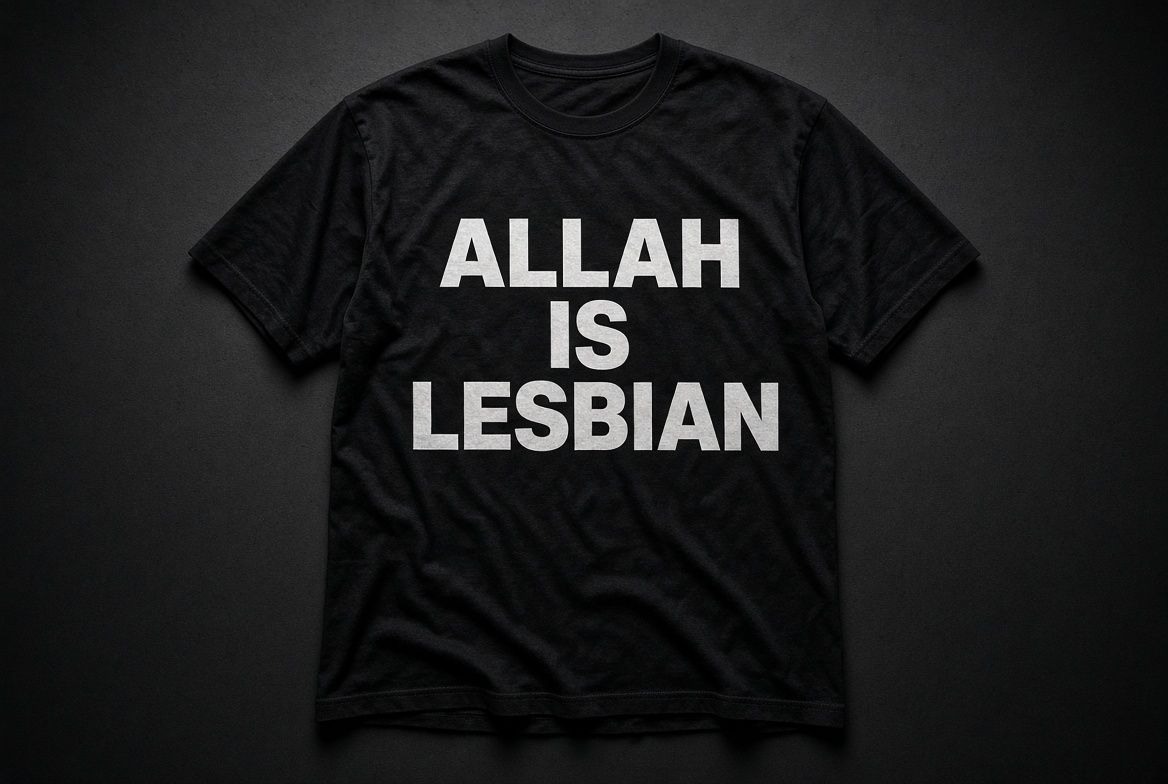
She posted a photograph of herself wearing a provocative T-shirt.
The shirt carried the slogan “Allah is lesbian.”
For that act of expression, a Moroccan court sentenced Lachgar to 30 months in prison and imposed a fine of 50,000 Moroccan dirhams.
Whatever one thinks about the slogan, imprisoning a person for it raises a much more fundamental question: should a government have the power to punish someone simply for offending a religion?
For freethinkers, the answer should be clear.
A photograph became a criminal case
Moroccan authorities arrested Lachgar on August 10, 2025, after the photograph circulated online.
The picture had not even been taken in Morocco. According to her defense, it was taken in London. Her lawyers argued that the slogan belonged to a tradition of feminist protest challenging patriarchal conceptions of God and religion.
Nevertheless, Moroccan prosecutors treated the publication as a criminal offense.
Article 267-5 of Morocco’s Penal Code criminalizes certain acts considered intentionally insulting to Islam or sacred symbols when committed publicly or through electronic means.
On September 3, 2025, the Rabat Court of First Instance convicted Lachgar and sentenced her to two and a half years in prison.
Her appeal failed the following month. Then, in June 2026, the Court of Cassation rejected her challenge, making the conviction final.
A photograph and a sentence on a shirt had effectively cost her years of freedom.
Who is Betty Lachgar?
Lachgar was controversial long before this case.
A psychologist by training, she is one of Morocco’s most outspoken advocates of individual liberty. She co-founded the Alternative Movement for Individual Freedoms, commonly known by its French acronym MALI.
For years, she has challenged some of Morocco’s most socially conservative laws and traditions.
She has campaigned for women’s rights, LGBTQ rights, abortion rights and the decriminalization of consensual sexual relationships outside marriage. She has also defended the rights of people who do not observe Ramadan.
In 2009, activists associated with her movement attempted to hold a daytime picnic during Ramadan to challenge restrictions on publicly eating while most Muslims were fasting.
She later became involved in a public “kiss-in” supporting teenagers who faced legal trouble after posting a photograph of themselves kissing.
These campaigns deliberately challenged social and religious taboos.
That is precisely why freedom of expression matters.
Speech does not need legal protection only when it is polite, popular or reassuring. Popular speech rarely needs protection in the first place. The real test comes when someone says something that a majority considers offensive.
“Allah is lesbian”
The slogan that led to Lachgar’s imprisonment was intentionally provocative.
It was supposed to be.
Her defense argued that it was a feminist political message rather than an attack on individual Muslims. Lachgar herself told the court that she had not intended to insult Islam.
But even if she had intended to ridicule religion, imprisonment would remain an extraordinary response.
Religions are systems of ideas and beliefs. Like political ideologies, philosophical theories and moral doctrines, they must remain open to criticism, satire and even ridicule.
People have rights.
Ideas do not.
A Muslim has the right to practice Islam without persecution. A Christian has the right to practice Christianity. An atheist has the right to reject both.
But protecting Muslims from discrimination is fundamentally different from protecting Islam from criticism.
Confusing those two principles transforms protection of religious freedom into protection of religion itself.
Freedom of religion includes freedom from religion
The case exposes a contradiction that exists far beyond Morocco.
Governments frequently speak about religious freedom while simultaneously restricting the freedom to reject, criticize or leave religion.
But freedom of religion cannot function in only one direction.
If someone has the right to say that Allah exists, someone else must have the right to say that Allah does not exist.
If a believer may publicly declare Islam to be the truth, a critic must be able to call Islam false.
And if religious people are permitted to express their views about homosexuality, feminism or atheism, atheists and LGBTQ activists must likewise be allowed to express their views about religion.
Otherwise, there is no equality of conscience.
There is merely a hierarchy in which religious beliefs receive privileges unavailable to competing ideas.
Morocco’s blasphemy problem
Morocco is often regarded internationally as relatively moderate compared with several other states in the region.
Yet significant restrictions on individual freedoms remain.
Speech considered offensive to Islam can result in criminal prosecution. Same-sex sexual relations remain criminalized. Other laws and social restrictions continue to affect personal behavior and freedom of conscience.
Lachgar has spent much of her public life challenging precisely these limitations.
Her prosecution therefore represents something larger than one controversial T-shirt.
It demonstrates what happens when the state becomes an arbiter of permissible criticism of religion.
Once governments receive that authority, an unavoidable question follows: how much criticism is too much?
A theological disagreement?
A cartoon?
A joke?
An atheist book?
A feminist slogan?
A social-media post?
The boundary becomes whatever prosecutors, politicians or judges decide it should be.
That is why blasphemy laws are inherently dangerous to free expression.
Her health makes the case more urgent
There is another disturbing dimension to Lachgar’s imprisonment. She has serious medical problems.
Lachgar previously suffered from a rare form of bone cancer and has a prosthesis in her left arm. According to her supporters and legal team, she requires specialized surgery involving the prosthesis.
The procedure had reportedly been planned for September 2025.
Instead, she was in prison.
Her lawyers repeatedly raised concerns about her health and sought her release. A request for provisional release was rejected during the original proceedings.
Her family and supporters now say her condition has deteriorated and that she urgently requires specialist treatment unavailable to her in prison.
Her sister, Siham Lachgar, has described the situation not primarily as a political debate but as a humanitarian emergency.
International pressure has consequently intensified.
Amnesty International considers Lachgar imprisoned solely for peacefully exercising her freedom of expression and has called for her immediate and unconditional release.
The UN special rapporteur on human rights defenders has also called for her release and urgent access to appropriate specialized medical care.
A possible way out
Morocco introduced legislation allowing alternative punishments for some people serving shorter prison sentences.
Lachgar’s lawyers argue that she should qualify.
One possible mechanism would allow a prisoner to pay a prescribed amount for each remaining day rather than continue serving the sentence behind bars.
Her defense hopes that such an alternative could allow her to leave prison and receive the medical treatment she needs.
But there is a deeper problem. Lachgar should not need to buy her way out of prison for expressing an opinion.
The central injustice is not simply the length or conditions of her imprisonment.
It is that peaceful expression resulted in imprisonment at all.
Offense is not violence
There is nothing contradictory about finding Lachgar’s slogan crude while defending her right to display it.
Many Muslims understandably consider the words “Allah is lesbian” deeply offensive.
That still does not make them victims of violence.
Modern pluralistic societies contain Christians, Muslims, Jews, Hindus, atheists, agnostics and countless other groups whose fundamental beliefs contradict one another.
There is no possible way to guarantee that everyone’s deepest convictions will remain unchallenged.
Nor should there be.
The alternative would require enormous censorship.
Atheist criticism could offend believers. Religious preaching could offend atheists. Christian claims could offend Muslims. Muslim claims could offend Christians. Satire could offend everyone.
Freedom therefore cannot mean freedom from being offended.
It means that people can hold and express radically different ideas without the government putting them in prison.
Blasphemy is a victimless “crime”
No supernatural being needs protection from a T-shirt.
If Allah exists and is omnipotent, a Moroccan atheist cannot harm him with a slogan. If Allah does not exist, there is nobody supernatural to offend.
Either way, the government has no legitimate victim to protect.
Real people, of course, can feel insulted. Their anger may be genuine. But hurt feelings cannot be sufficient grounds for imprisoning another human being.
The same principle applies to every religion. Christians should be free to preach Christianity. Muslims should be free to preach Islam.
Atheists should be free to argue that both are wrong. And satirists should be free to mock all three.
The state’s role should be to protect people from violence, threats and discrimination—not to protect ideologies from criticism.
More than one woman in prison
Betty Lachgar’s case ultimately concerns something much larger than Betty Lachgar.
It concerns whether freedom of conscience has any meaning when abandoning or criticizing the dominant religion can lead to prison.
A person does not truly possess freedom of religion if the government allows her to choose only among approved religious beliefs.
Freedom of conscience necessarily includes the right to have no religion at all.
It includes the right to change religion.
It includes the right to criticize religion.
And yes, it includes the right to offend religion.
More than a year of Betty Lachgar’s life has already been taken away because of words printed on a T-shirt.
She should be released.
Morocco should go further.
No atheist, believer, feminist, artist or dissident should ever again be imprisoned merely because a religious idea was offended.