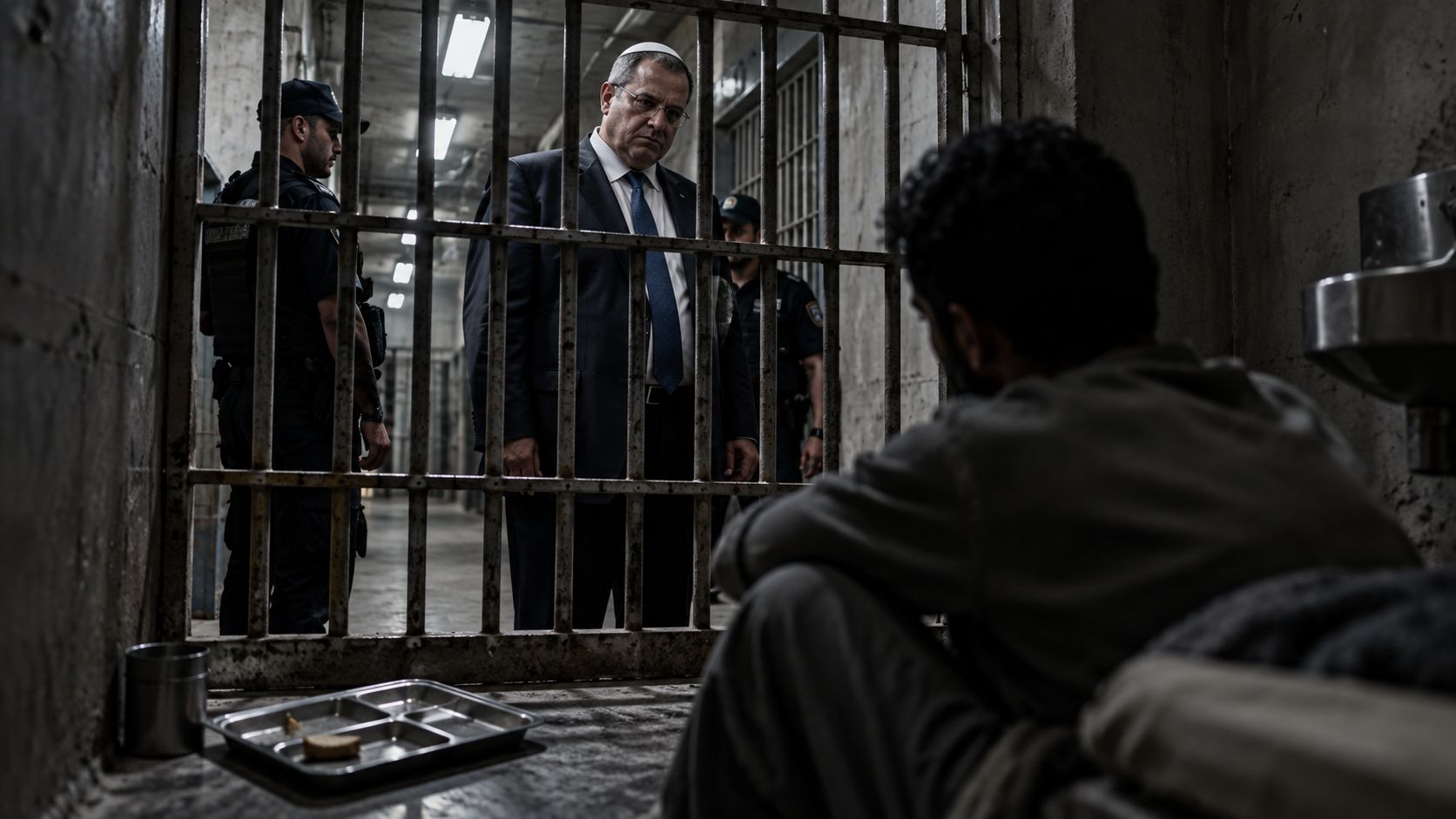
Israel’s treatment of Palestinian prisoners has moved far beyond a debate about whether convicted terrorists deserve comfortable prison conditions. Thousands of Palestinians are being held without charge or trial, while former detainees, Israeli human rights organizations, international organizations and lawyers have described a system marked by hunger, beatings, humiliation, medical neglect and, in some cases, alleged sexual violence.
At the political center of this system stands Israel’s far-right National Security Minister Itamar Ben-Gvir, who oversees the Israel Prison Service. Rather than distancing himself from harsh conditions, Ben-Gvir has repeatedly presented them as an achievement.
In August 2026, he visited Palestinian female prisoners and confronted them on camera. One woman complained that prisoners had gone three days without showers, lacked clean clothes and were not receiving medical treatment.
Ben-Gvir’s response was extraordinary.
“The good conditions in the prisons are over,” he told her. He added that he was directly responsible for the situation and was pleased with the conditions.
This is what makes the Israeli prison controversy particularly disturbing. Allegations of abuse are one thing. A government minister publicly taking pride in deprivation is another.
Thousands held without trial
Israel has legitimate security concerns. Hamas and other Palestinian armed groups have deliberately killed Israeli civilians, and Israel has the right to arrest and prosecute people responsible for terrorism and other violent crimes.
But that does not describe everyone behind bars.
Thousands of Palestinians are being detained without ordinary criminal trials. Administrative detention allows Israel to imprison people for renewable periods without filing conventional criminal charges against them, frequently on the basis of secret evidence that detainees cannot fully challenge.
By early 2026, UN experts cited figures indicating that more than 3,000 Palestinians were being held under administrative detention. Others from Gaza were detained as “unlawful combatants.”
Among those detained have been journalists, doctors and other civilians.
Palestinian photojournalist Muath Amarneh is one example. He was detained twice after October 7, 2023. During his first detention, he spent nine months imprisoned without charge. He was arrested again in August 2025 and held for another eight months.
The United Nations Working Group on Arbitrary Detention had already concluded that his first detention was arbitrary.
Yet he was imprisoned again.
A journalist loses 35 kilograms
Amarneh’s account offers a disturbing description of what happened as prison conditions deteriorated after October 7.
Across his periods in detention, he says he lost approximately 35 kilograms.
He described inadequate food, beatings, humiliation, inadequate hygiene and severe restrictions on medical treatment. He said guards took away his prescription glasses for six months.
According to his testimony, prisoners sometimes received so little medication that a single painkiller had to be divided among 11 detainees.
He also described guards insulting prisoners, calling them animals and telling them that they should have been killed.
The cruelty was sometimes apparently arbitrary. Amarneh recalled that after one prisoner asked when Eid would occur, a special unit entered the cell shortly afterward. He says the prisoners were beaten and the man who had asked the question was shot with rubber bullets.
Even sunlight could become part of the punishment. Amarneh said guards sometimes prohibited prisoners from standing in the sun, telling them that the sun belonged to the guards rather than the prisoners.
These claims cannot all be independently verified from outside the prison walls. But they do not exist in isolation.
Israeli human rights groups describe a system
One of the most important aspects of this story is that some of the strongest accusations are coming not from Hamas or the Palestinian Authority, but from Israeli organizations.
B’Tselem, one of Israel’s best-known human rights organizations, published an extensive follow-up investigation in 2026 based partly on testimony from recently released Palestinians. It described Israeli prisons as a network of facilities in which abuse had become systematic.
Former detainees reported severe beatings, starvation, denial of medical care, degrading treatment and sexual violence.
Other Israeli organizations have raised similar alarms.
Physicians for Human Rights Israel has documented deaths and medical neglect. The Association for Civil Rights in Israel has fought the government over food provided to Palestinian detainees. The Public Committee Against Torture in Israel, HaMoked and other Israeli organizations have also documented alleged torture and challenged detention practices.
This matters because it makes dismissing the entire issue as enemy propaganda increasingly difficult.
The UN raised an extraordinary alarm
The United Nations Committee Against Torture reached an unusually severe conclusion after reviewing Israel in 2025.
It said it was deeply troubled by reports indicating a de facto state policy of organized and widespread torture and ill-treatment that had intensified dramatically since October 7, 2023.
The allegations considered by the committee included severe beatings, attacks by dogs, electrocution, stress positions, sexual violence, threats, humiliation, deprivation of adequate food and water, denial of medical treatment, extreme temperatures and sleep deprivation.
The committee also expressed concern about deaths in custody and allegations of rape and other forms of sexual abuse.
These remain allegations in individual cases unless established through credible investigations or judicial proceedings. But their scale and repetition across different facilities, detainees and organizations make them impossible to dismiss responsibly as a handful of isolated accusations.
Hunger as punishment
Food has become one of the central controversies.
Ben-Gvir has openly promoted reducing conditions for Palestinian prisoners to what he calls the minimum. One of his early moves as minister was closing prison bakeries used by Palestinian detainees.
In September 2025, Israel’s own Supreme Court ruled that the state was failing to provide Palestinian prisoners with adequate food and ordered authorities to improve the situation.
Yet months later, Reuters interviewed released detainees and examined lawyers’ reports indicating that serious hunger persisted.
One journalist said he lost 22 kilograms during nine months in detention. He described surviving largely on thin pieces of bread with small quantities of hummus, tahini and occasional tuna.
The Israel Prison Service rejects accusations of systematic starvation or neglect. It says prisoners receive nutrition and medical treatment according to professional standards and that it complies with Israeli law and court decisions.
That denial must be included.
But so must the fact that Israel’s own highest court found the food situation inadequate enough to intervene.
Deaths behind bars
The consequences may go far beyond discomfort or hunger.
Dozens of Palestinians have died in Israeli custody since October 7, 2023. Human rights organizations have placed the number considerably higher as additional cases have been documented.
One particularly disturbing case involved 17-year-old Palestinian detainee Walid Ahmed.
An autopsy reviewed by Reuters described prolonged malnutrition and listed starvation, dehydration and infection among possible causes of his death. His lawyer said his body had lost substantial muscle and fat, leaving his immune system unable to fight infection effectively.
The UN Committee Against Torture has also expressed concern about the unusually high number of Palestinian deaths in Israeli custody and reports that some bodies showed signs consistent with torture, ill-treatment, inadequate medical care or extreme malnutrition.
Every death in state custody deserves independent investigation.
When deaths occur amid widespread allegations of starvation and abuse, investigation becomes even more urgent.
Allegations of sexual violence
Some testimonies go considerably further.
Released Palestinian detainees have alleged rape, forced nudity, attacks on genitals, sexual humiliation and penetration with objects.
These are among the most serious allegations that can be made against prison personnel, and individual accusations require investigation rather than automatic acceptance.
Yet the allegations have become sufficiently numerous that the UN Committee Against Torture formally expressed serious concern about reports of rape, attempted rape, sexualized torture, electrocution of genitals, forced nudity and other sexual abuse.
B’Tselem has separately collected testimonies describing sexual violence.
If even a portion of these allegations is established, those responsible should face criminal prosecution. Being a soldier, prison guard or government employee does not place anyone above laws prohibiting torture and sexual violence.
The underground prison
Another disturbing development has been the reopening of an underground detention complex known as Rakefet.
The facility had been closed decades ago. Under Ben-Gvir, it was brought back into use for Palestinian detainees.
Former prisoners and lawyers have described cells without natural daylight, severe isolation, inadequate food and extremely limited opportunities to leave the cells.
Ben-Gvir himself has publicly celebrated the underground facility, arguing that terrorists belong underground.
But again, the fundamental problem is that the category of people held in Israel’s detention system extends beyond convicted terrorists. Some prisoners have not been convicted of anything. Some have not even been formally charged.
Punishment before conviction destroys the distinction between imprisonment and arbitrary state violence.
The Red Cross problem
Independent monitoring has also become more difficult.
Since October 2023, Israel has prevented the International Committee of the Red Cross from carrying out its traditional visits to Palestinian detainees.
That removes one of the most important independent safeguards in wartime detention.
The UN Committee Against Torture has criticized the suspension and called attention to the lack of independent oversight. Human rights organizations have repeatedly demanded that international monitors be allowed back inside.
If Israel believes accusations of systematic abuse are false, independent access would provide an obvious way to demonstrate it.
Keeping independent monitors out does the opposite.
Ben-Gvir is not hiding his philosophy
Perhaps the most extraordinary element of the story is that Ben-Gvir does not present himself as a reluctant administrator struggling with overcrowded prisons during wartime.
He celebrates harshness.
He has repeatedly argued that Palestinian prisoners should receive only the bare minimum. When prisoners complain about inadequate hygiene or medical treatment, he portrays their suffering as evidence that his policies are working.
In August, an AI-generated video posted to his social media reportedly depicted well-fed Palestinian prisoners entering detention and emerging emaciated and crying. The accompanying message was effectively a declaration of success. The video was later deleted after outrage and comparisons with concentration-camp imagery.
This is not normal rhetoric for a minister responsible for people held in state custody.
A democratic state can imprison terrorists. It can impose strict security measures. It can prosecute murderers and sentence them to decades behind bars.
What it cannot legitimately do is transform cruelty itself into a political objective.
Prisoners have human rights
There is a basic principle that becomes easily forgotten during war: human rights do not depend on whether we like the person possessing them.
A convicted Hamas murderer has human rights.
An Israeli accused of murdering Palestinians has human rights.
A Palestinian journalist held without charge has human rights.
An Israeli hostage held by Hamas has human rights.
None of these propositions contradicts another.
Hamas’s torture, starvation or abuse of Israeli hostages cannot justify Israel torturing Palestinian prisoners. International humanitarian and human rights law does not work through reciprocal cruelty. One war crime does not provide legal or moral permission for another.
Prisons are precisely where a state’s commitment to human rights is tested most severely, because prisoners are almost entirely dependent on the people guarding them.
The state controls their food. Their water. Their medicine. Their sleep. Their contact with their families. Their ability to move. Sometimes even their access to sunlight.
That degree of power creates an equally extraordinary responsibility.
Cruelty as politics
The evidence emerging from Israeli detention facilities presents a disturbing picture.
There are allegations that still require independent investigation. There are individual accounts that cannot be independently verified. Israeli authorities deny systematic starvation and abuse and maintain that prisoners are treated according to law.
Those qualifications matter.
But they do not erase what has already been established.
Thousands of Palestinians have been detained without ordinary criminal trials. Israel’s Supreme Court found that prisoners were not receiving adequate food. Israeli human rights organizations have documented extensive allegations of abuse. The UN Committee Against Torture has expressed alarm over reports of organized and widespread torture. Independent Red Cross access has been blocked. Palestinians have died in custody.
And the minister responsible for the prison system openly boasts about making conditions harsher.
The most frightening part may therefore not be what Israel is accused of hiding.
It is what one of its most powerful ministers is willing to show publicly.
A government that treats human suffering as evidence of political success has crossed a dangerous line. Whether the prisoner is innocent, a political activist, a journalist, an administrative detainee or a convicted terrorist does not change the prohibition against torture.
A prison sentence may take away freedom.
It does not take away humanity.