

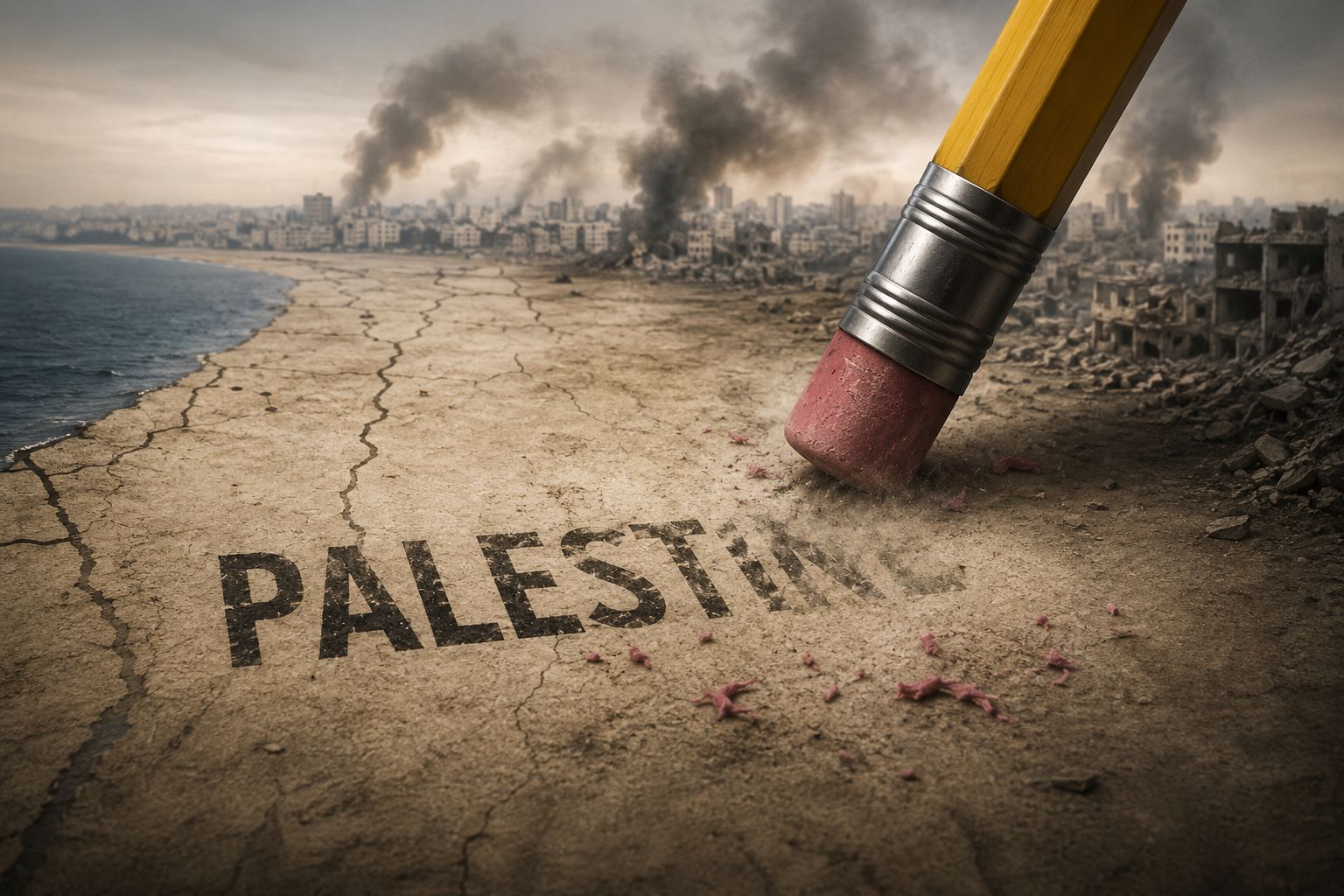
There is something unusual about diplomats abandoning diplomatic language.
More than 100 former senior British and French diplomats have signed a joint letter accusing the Israeli government of pursuing policies that are destroying the possibility of a viable Palestinian state. Their language is striking. They speak of the “erasure” of Palestine, accuse Israel of ethnic cleansing and argue that recognition of Palestinian statehood must now be followed by concrete political and economic pressure.
These are not student protesters shouting slogans outside an embassy. The signatories include former ambassadors and senior officials who spent their careers representing two of Europe’s most important diplomatic powers. France and the United Kingdom are also permanent members of the UN Security Council.
Their central argument is difficult to dismiss: recognizing Palestine means very little if the territory from which a Palestinian state is supposed to emerge continues to be fragmented, settled, occupied and transformed on the ground.
Britain and France recognized Palestine in 2025. Recognition was symbolically important, but symbols cannot stop settlement construction. They cannot protect Palestinian homes, restrain violent settlers or reconstruct Gaza. A Palestinian flag outside an embassy means little if the state represented by that flag becomes geographically impossible.
The diplomats are effectively asking their former governments to confront this contradiction.
Recognition without consequences
Recognizing Palestine was supposed to demonstrate support for Palestinian self-determination and the two-state solution. Yet recognition alone does not create sovereignty.
A functioning state needs territory. It needs political institutions, physical continuity and some meaningful ability to govern itself. Palestinians currently possess none of these things in anything approaching the conventional meaning of statehood.
Gaza has suffered catastrophic destruction. The West Bank remains under Israeli occupation and is fragmented by settlements, checkpoints and different administrative zones. East Jerusalem, which Palestinians claim as the capital of a future state, remains under Israeli control.
Meanwhile, Israeli settlement expansion continues.
The latest confrontation centers partly on the E1 settlement project east of Jerusalem. Western governments have warned that development there would further fragment the West Bank and undermine the territorial viability of a Palestinian state. Britain, France, Germany, Italy, the Netherlands, Canada and Norway recently demanded that Israel retract the plans, with additional governments and the European Commission subsequently joining the criticism.
This is not merely another argument over where several apartment buildings should be constructed.
Geography determines whether the two-state solution can exist outside diplomatic speeches.
A Palestinian state divided into disconnected pieces, surrounded and intersected by Israeli-controlled territory, would struggle to function as an independent country in any meaningful sense.
The diplomats use the words governments avoid
Perhaps the most remarkable feature of the letter is its language.
Former diplomats are usually cautious people. Their careers teach them to qualify statements, preserve relationships and avoid unnecessarily inflammatory terminology. Yet these former British and French officials accuse Israel of ethnic cleansing and describe the disappearance of Palestine as something occurring before the world’s eyes.
That does not make their characterization automatically correct. “Ethnic cleansing” is a grave allegation, and Israel strongly disputes international accusations that portray its policies as an attempt to eliminate Palestinian national existence.
But the fact that more than 100 former diplomats are willing to use such terminology illustrates how dramatically Israel’s international standing has deteriorated.
The argument is no longer confined to whether individual Israeli military operations were disproportionate or whether particular settlements violate international law. Increasingly, critics are asking whether the cumulative direction of Israeli policy is making Palestinian statehood deliberately impossible.
That is a much larger accusation.
E1 matters because maps matter
The E1 controversy demonstrates why settlement policy cannot be separated from the future of Palestine.
The proposed development lies between East Jerusalem and the large Israeli settlement of Ma’ale Adumim. Critics have long warned that extensive Israeli construction there would severely damage territorial continuity between Palestinian areas of the West Bank and further separate East Jerusalem from them.
Israeli supporters of settlement construction offer different arguments. Some reject the idea that Jews should be prohibited from living in parts of the West Bank. Others emphasize Israeli security or historical and religious claims to the territory. Elements of Israel’s current right-wing political establishment reject Palestinian statehood altogether.
But there is a fundamental incompatibility that diplomacy can no longer disguise indefinitely.
Israel cannot continuously expand permanent Israeli communities throughout territory intended for a future Palestinian state while simultaneously assuring the world that the two-state solution remains available.
Eventually, construction on the ground becomes more important than promises made at diplomatic meetings.
Netanyahu’s government has made the problem clearer
Benjamin Netanyahu has spent much of his political career navigating ambiguity around Palestinian statehood. Members of his current political coalition have been considerably less ambiguous.
Far-right figures in Israeli politics openly oppose the establishment of a Palestinian state. Finance Minister Bezalel Smotrich has been closely associated with settlement expansion, while National Security Minister Itamar Ben-Gvir has repeatedly provoked international condemnation over his positions toward Palestinians.
France has already barred Ben-Gvir from entering the country and has defended sanctions against him amid escalating settler violence in the West Bank. France, Britain, Canada and Norway have also coordinated sanctions against Israeli networks linked to West Bank violence.
These are significant measures, but they remain targeted.
The former diplomats are asking a more difficult question: when does responsibility extend beyond extremist settlers and individual ministers to the policies of the Israeli state itself?
If a government enables settlement expansion, protects settlements militarily and administers an occupation under which those settlements continue growing, sanctioning a few violent settlers addresses only one part of the system.
Trade is where principles become expensive
The former diplomats are not merely demanding another statement of concern. They propose measures that would impose material consequences, including restrictions on trade connected to settlements and action involving arms and broader economic relationships.
Britain is already considering a ban on trade involving Israeli settlements in the occupied West Bank following the E1 plans. Such measures would represent an important shift because they move the debate from condemnation toward economic consequences.
Governments frequently say that settlements violate international law while maintaining extensive economic and diplomatic relationships with Israel.
That creates an obvious credibility problem.
If a government believes an activity is illegal and actively undermines peace, why should businesses under its jurisdiction economically support that activity?
A settlement trade ban would not amount to severing all economic relations with Israel. It would instead establish a distinction between Israel within its internationally recognized boundaries and Israeli activity in occupied territory.
Whether such measures would change Israeli policy is another question. Israel has repeatedly resisted international pressure over settlements.
But pressure that costs nothing is easily ignored.
Gaza cannot be separated from this debate
The letter also arrives after years of devastation in Gaza.
The Hamas-led atrocities of October 7, 2023, including the killing of civilians and taking of hostages, were indefensible. Nothing about Palestinian suffering retrospectively justifies deliberately murdering Israeli civilians.
But condemning October 7 does not provide Israel with unlimited moral or legal permission for everything that followed.
The destruction of Gaza, enormous civilian death toll, displacement of much of its population and repeated controversies over humanitarian access transformed international attitudes toward Israel. The question of Palestinian statehood consequently became more urgent rather than less.
A population cannot remain indefinitely trapped between Hamas, Israeli military power, occupation, displacement and diplomatic promises that never materialize.
Israeli civilians deserve security.
Palestinian civilians deserve freedom and security too.
Neither principle cancels the other.
Accountability has become another dividing line
International frustration with Israel is also being driven by questions about accountability.
Britain, Australia and Canada have just criticized Israel’s decision not to open a criminal investigation into the 2024 Israeli strike that killed seven World Central Kitchen aid workers, including three British nationals. The governments described the lack of criminal accountability in unusually strong terms.
At the same time, Israel has announced criminal investigations into other notorious incidents, including the killing of five-year-old Hind Rajab and members of her family and the killing of 15 Palestinian paramedics in Rafah.
Investigations matter, but they also raise the obvious question of whether accountability will actually follow.
Western governments have spent years insisting that Israel is a democratic ally governed by the rule of law. That claim creates obligations. A democracy cannot demand that allies trust its institutions while treating serious allegations involving civilian deaths as matters that can routinely end with internal reviews and disciplinary measures.
Democracy is not merely elections.
It also requires accountability for state power.
Criticism of Israel is not antisemitism
Any discussion of sanctions against Israel inevitably produces accusations of antisemitism.
Antisemitism is real, ancient and dangerous. The October 7 attacks were followed by disturbing increases in antisemitic incidents in several countries. Jewish people should never be held collectively responsible for decisions made by the Israeli government.
But that principle works in both directions.
Jewish people are not the Israeli government, and the Israeli government does not represent every Jewish person on Earth.
Therefore, imposing political or economic consequences on an Israeli government because of its policies is not inherently antisemitic. Governments are criticized, sanctioned and pressured constantly. Israel cannot be uniquely exempt from that process because it is a Jewish state.
Indeed, treating all Jews as politically responsible for Israel would itself reproduce the collective logic that opposition to antisemitism should reject.
The relevant questions are about policies, actions and international law—not ethnicity or religion.
Palestinians need political reform too
The former diplomats do not place responsibility exclusively on Israel. Their letter also calls for political reform on the Palestinian side, including democratic elections and greater political unity between Gaza and the West Bank.
That point is essential.
Supporting Palestinian self-determination does not require pretending that Palestinian political institutions function well.
Hamas is authoritarian and responsible for terrorism and grave crimes against civilians. The Palestinian Authority has suffered from corruption, democratic stagnation and declining legitimacy. Palestinians deserve better political leadership just as Israelis deserve leadership capable of pursuing security without permanent domination over another population.
A viable Palestinian state cannot simply be created geographically.
It must also become politically viable.
That requires institutions, elections, accountability, economic development and leadership that does not treat civilians as expendable pieces in an endless national struggle.
Two states are becoming harder to imagine
For decades, politicians have repeated the phrase “two-state solution” almost automatically.
Israel alongside Palestine. Security for Israelis. Self-determination for Palestinians. Jerusalem somehow negotiated. Borders eventually agreed. Refugees addressed through compromise.
The formula survives partly because the alternatives are so difficult.
A single democratic state between the Jordan River and Mediterranean Sea would require Israelis and Palestinians to share political sovereignty despite generations of conflict and profound mutual distrust. Permanent Israeli control over millions of Palestinians without equal political rights would institutionalize an indefensible inequality. Expelling either population would be a catastrophe and a crime.
Two states therefore remain attractive partly because every alternative contains enormous problems.
Yet repeating the formula cannot preserve it.
Every settlement, territorial fragmentation and act of annexation can make the eventual border harder to draw. If governments genuinely believe two states are necessary, there eventually comes a point when they must defend the territorial possibility of two states rather than merely defending the phrase.
That is precisely what the former diplomats are arguing.
Britain and France have more leverage than they pretend
Neither Britain nor France can dictate Israeli policy.
The United States remains far more important to Israel militarily and diplomatically. European pressure alone is unlikely to force Netanyahu’s government to reverse its entire approach.
But London and Paris are not powerless.
Both are nuclear powers, permanent members of the UN Security Council and major diplomatic actors; both maintain economic relationships with Israel; both recognized Palestine. Both can impose targeted sanctions, restrict settlement trade, reconsider arms-related cooperation and coordinate measures with other European and democratic governments.
More importantly, they can help change what Israel considers politically normal.
International isolation rarely arrives in a single dramatic moment. It develops when individual governments gradually decide that policies previously tolerated will now carry consequences.
France and Britain have already moved further in that direction than they had several years ago.
The former diplomats want them to move further still.
Recognition must mean something
Recognizing Palestine while watching the physical possibility of Palestine disappear would be an extraordinary diplomatic failure.
It would mean recognizing a state in theory while allowing the conditions necessary for that state to be dismantled in practice.
The former British and French diplomats are therefore asking a question larger than whether London and Paris should sanction another settler or issue another condemnation.
They are asking whether Western governments actually mean what they say.
If Britain and France believe settlements are illegal, they should act accordingly; if they believe Palestinians possess a right to self-determination, they should defend the territorial conditions necessary for exercising it. If they believe Israeli and Palestinian civilians possess equal human value, their policies should reflect that principle even when doing so becomes politically uncomfortable.
Israel has legitimate security concerns. Palestinians have legitimate national rights. Hamas committed atrocities. Israeli civilians cannot be collectively blamed for their government, and Palestinians cannot be collectively blamed for Hamas.
None of those facts requires accepting permanent occupation or the progressive destruction of Palestinian statehood.
More than 100 people who once practiced diplomacy professionally are now warning their governments that diplomatic language is no longer enough.
Perhaps they are right.
If Palestine is recognized only after there is no viable Palestine left to recognize, recognition will have become little more than an epitaph.






