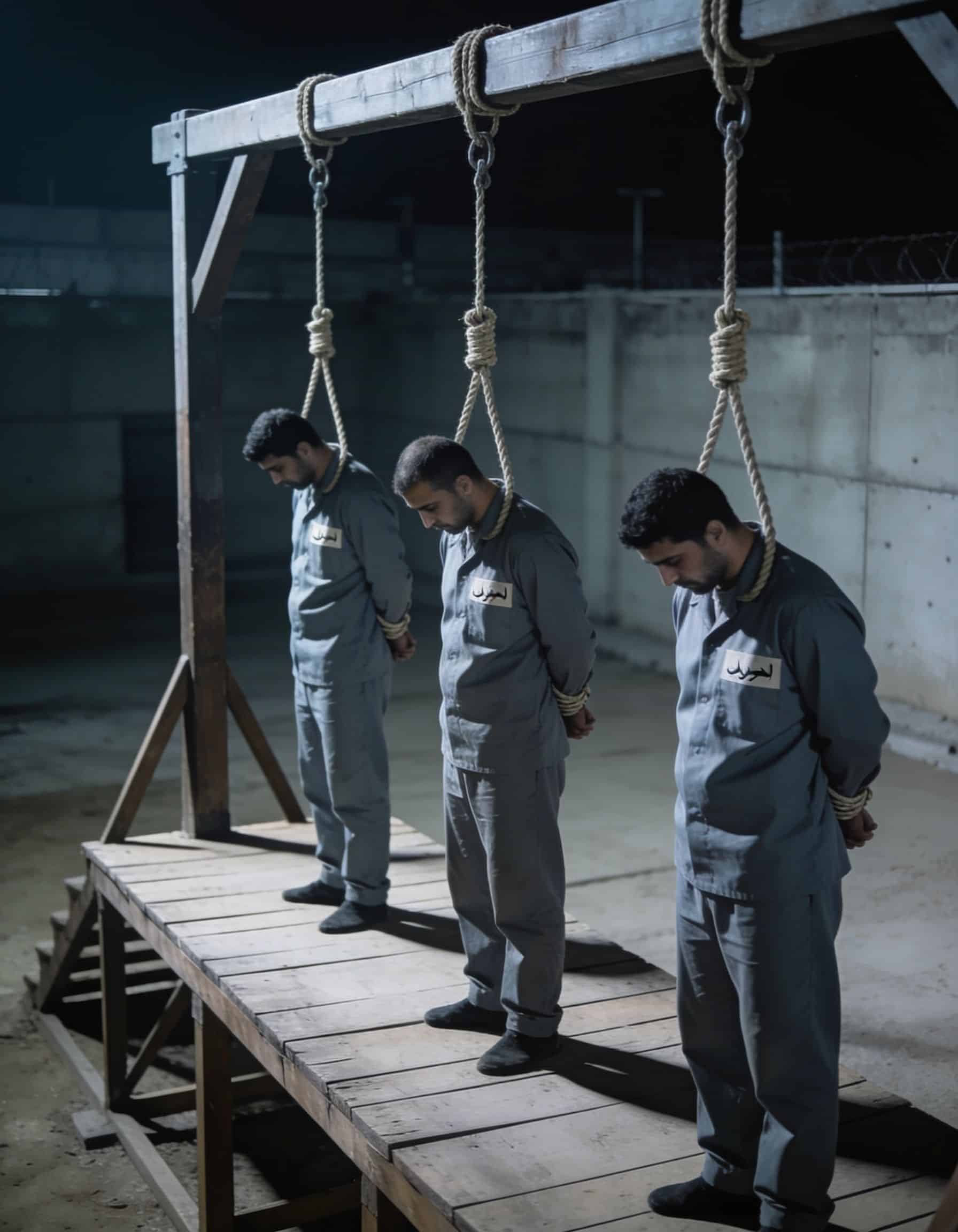
Iran does not merely execute people convicted of murder or other violent crimes. It executes political prisoners. It executes protesters. And it imposes death sentences after trials that human rights organizations describe as grossly unfair. And increasingly, the gallows appear to function as another instrument for keeping a frightened population under control.
The numbers emerging from Iran in 2026 are alarming. One human rights organization, the Abdorrahman Boroumand Center, counted at least 916 executions between the beginning of the year and August 12. Iran Human Rights, which uses a different methodology and has verified a substantially lower number, documented at least 444 executions through the end of July.
The discrepancy itself illustrates a fundamental problem: nobody outside the Iranian state knows the complete number. Executions are not always publicly announced, independent monitoring is difficult, and human rights organizations apply different standards before adding cases to their databases. What we do know is bad enough.
The United Nations says Iran has sharply increased executions and death sentences connected to national security and the protests that shook the country earlier this year. UN human rights chief Volker Türk said in August that at least 56 people had been executed on national security-related charges since March 19. Twenty-seven of them were connected to the protests. More than 100 others faced similar charges that could result in death sentences. Iran’s execution machine is not slowing down. It is accelerating.
Death as a political instrument
Capital punishment in Iran has always extended far beyond political prisoners. People are executed for murder and drug offenses, among other crimes. Iran Human Rights documented 71 executions in July alone: 36 for murder, 26 for drug-related offenses, eight for security-related charges and one for rape.
But the political cases deserve particular attention because the death penalty can become something even more sinister than an exceptionally cruel criminal punishment. It can become a method of government.
When protesters know that participation in demonstrations could eventually lead them to the gallows, an execution does not affect only the person being hanged. It sends a message to everyone considering resistance: protest, and this could happen to you. That is why the increasing use of capital punishment against protesters cannot be separated from Iran’s broader system of political repression.
The Center for Human Rights in Iran reported in April that at least 22 political prisoners had been executed within roughly six weeks. Ten had been detained during the January 2026 protests. The organization described secretive proceedings, forced confessions, torture allegations and severe restrictions on access to independent lawyers.
Some families reportedly received little or no warning before executions. This is not simply punishment after a conventional criminal process. Human rights organizations describe a system in which the criminal process itself can become part of political repression.
Executing protesters
Among the most disturbing developments is the execution of people arrested during demonstrations. The UN says at least 27 people connected to the protests had been executed on national security-related charges since March 19 by early August. Human Rights Watch has also documented executions following proceedings it describes as extremely summary and involving serious violations of fair-trial rights.
The charges themselves deserve attention. Iranian authorities frequently prosecute dissidents and protesters under broadly framed national security offenses. One particularly notorious concept is moharebeh—often translated as “waging war against God.”
The theological language is remarkable. A modern state is killing human beings after convicting them of offenses framed partly in terms of rebellion against God.
For a secular human rights organization, there could hardly be a clearer example of why religion and state power make such a dangerous combination. God cannot appear in court; God cannot testify. God cannot explain who supposedly declared war against him. Human beings do all of that on his behalf, and then other human beings build the gallows.
Twenty years old and dead
Statistics make atrocities easier to comprehend intellectually and harder to comprehend emotionally. Nine hundred executions become a number. One dead person remains a person.
Iran International reported that 19-year-old Arvin Kheirkhah was executed at Shahroud prison on August 1 after being convicted over his involvement in the January protests. The charges reportedly included moharebeh.
His family gathered outside the prison in an attempt to stop the execution. They failed.
Whatever political ideology a government follows, there is something profoundly disturbing about a state taking a young person into custody, prosecuting him through a system whose fairness has been repeatedly challenged, and deliberately ending his life.
An execution is not an accidental death during a riot. It is not a police officer making a split-second decision. The prisoner is already under the state’s control.
Officials have time to reconsider. Judges have time to reconsider. Prosecutors have time to reconsider. Political leaders have time to intervene. Then, after all those opportunities to choose life, the state chooses death.
Trials that cannot inspire confidence
Capital punishment becomes even more indefensible when the judicial system administering it fails basic standards of fairness.
Human rights organizations have repeatedly documented allegations of torture, coerced confessions, restricted access to lawyers, closed proceedings and extraordinarily rapid prosecutions in political cases.
The Center for Human Rights in Iran says some independent lawyers have been prevented from participating in proceedings involving protesters facing capital charges. It has also documented cases in which defendants were allegedly tortured or subjected to other mistreatment before being sentenced to death.
Human Rights Watch similarly reports that Iranian courts have relied on confessions extracted under torture and convicted defendants in proceedings lacking fundamental due-process protections. These allegations matter enormously.
A prison sentence imposed after an unfair trial is an injustice that may, at least theoretically, be reversed. An execution cannot be reversed.
There is no successful appeal after death. There is no compensation capable of restoring an executed prisoner to his family. If a judicial system makes a mistake—or deliberately manufactures guilt—the executioner makes that mistake permanent.
The numbers are disputed. The crisis is not
Execution statistics from authoritarian states require caution.
The Abdorrahman Boroumand Center said at least 916 people had been executed in Iran since the beginning of 2026 as of August 12. Iran Human Rights had independently verified 444 executions through July and subsequently continued documenting additional cases.
These figures should not be presented as interchangeable. Different monitoring organizations use different methodologies, information networks and verification standards.
But disagreement over the exact total should not obscure what virtually every credible human rights assessment agrees upon: Iran uses capital punishment on an extraordinary scale.
Iran Human Rights recorded more than 2,000 executions in 2025, according to Human Rights Watch’s 2026 World Report. HRW described it as the highest known number in Iran since the late 1980s.
Iran is surpassed globally only by China in the estimated number of executions, according to Human Rights Watch. China’s true total remains a state secret. Even the lower estimates for Iran are therefore horrifying.
The question is not whether Iran has an execution problem. The question is how much worse the true scale is than outsiders can document.
Drugs can get you executed too
Political executions understandably attract international attention, but focusing exclusively on dissidents can obscure another enormous part of Iran’s death-penalty system.
Drug offenses account for a substantial share of executions. Of the 71 executions Iran Human Rights documented in July, 26 were for drug-related offenses. In 2025, more than half of the more than 2,000 executions recorded by the Abdorrahman Boroumand Center were for drug-related offenses, according to Human Rights Watch.
International human rights standards restrict capital punishment, in countries that have not abolished it, to the “most serious crimes,” a category the UN interprets as crimes involving intentional killing. Executing people for drug offenses therefore violates those standards.
A person can commit a serious drug offense and deserve punishment without deserving death. That distinction should not be difficult. The state does not need to approve of someone’s actions to recognize that killing him is unnecessary.
Women, minorities and vulnerable defendants
The execution system also operates within Iran’s wider patterns of discrimination and repression.
Iran Human Rights documented 12 women among the 444 people it recorded as executed during the first seven months of 2026. It also counted 80 people belonging to ethnic minorities and 17 foreign nationals.
Meanwhile, human rights organizations have repeatedly raised concerns about death sentences imposed on people for crimes committed when they were children.
The Center for Human Rights in Iran reported earlier this year that three 17-year-olds were among protesters sentenced to death following the January demonstrations. Whether those particular sentences will ultimately be carried out remains uncertain. Their existence should be shocking enough.
A government should protect children from execution. It should not prepare legal mechanisms for killing them.
War provides another excuse
Iran’s repression is occurring amid war and severe international tensions. That context makes the situation more dangerous rather than less important.
Governments frequently expand repression when they can invoke national security. Foreign enemies become convenient justifications for domestic surveillance, arrests and restrictions on dissent. Iran is no exception.
Human Rights Watch has warned that Iranian civilians now face a “double peril” from external military attacks and domestic repression. Authorities have executed people accused of espionage or collaboration with hostile states while intensifying pressure on political opponents.
This creates a dangerous false choice in international debate. One can oppose attacks on Iranian civilians while condemning the Islamic Republic; one can oppose foreign military escalation while demanding freedom for Iranian protesters. One can criticize American or Israeli policy without pretending that Tehran’s rulers therefore become defenders of human rights.
Iranian civilians do not belong to their government. Opposing their government’s repression is not an attack on Iran’s population. It is a defense of it.
The world has condemned it
On August 12, the European Union and 26 countries jointly condemned Iran’s executions of protesters and its broader use of capital punishment to suppress dissent.
Their statement called on Iran to stop using the death penalty and release people who have been arbitrarily detained. The condemnation matters, but statements do not stop executions.
Iran has endured decades of international criticism over its human rights record. Its rulers know that another European government condemning an execution will not automatically threaten their hold on power.
That leaves democratic governments with a difficult question: what comes after condemnation?
Human rights organizations have proposed diplomatic pressure, targeted sanctions against officials involved in abuses, preservation of evidence for future prosecutions and stronger international support for Iranian civil society. None offers an easy solution, but silence is worse.
Prisoners themselves are resisting
Some of the bravest opposition to Iran’s death penalty comes from people who live closest to the gallows.
Prisoners across Iran have participated in the “No to Execution Tuesdays” campaign, staging weekly hunger strikes against capital punishment.
By June, the Center for Human Rights in Iran reported that the protest had continued for more than 120 consecutive weeks and spread to dozens of prisons.
Think about what that means. People already imprisoned by an authoritarian government are deliberately making themselves more vulnerable to protest that government’s killing of prisoners. They know retaliation is possible, but they protest anyway.
Their campaign also demonstrates something easily forgotten when outsiders discuss Iran purely in geopolitical terms: Iranian society is not synonymous with the Islamic Republic. Iran is not its government. Iranians are not their rulers. The people resisting executions are Iranian too.
Human rights cannot depend on geopolitics
Iran presents an uncomfortable test of political consistency.
Some people become intensely interested in Iranian human rights abuses when Iran is an enemy of their country, then suddenly lose interest when criticism might support policies they oppose. Others rightly condemn Iran’s repression but seem considerably less interested in human rights violations committed by governments allied with their own side.
Both approaches reduce human beings to geopolitical instruments. Human rights should not work that way.
Torture is wrong when an enemy does it. It is also wrong when an ally does it. Killing civilians is wrong when Iran does it, when Israel does it, when Russia does it and when the United States does it.
And executing prisoners after grossly unfair political trials does not become acceptable because the government responsible happens to oppose another government we dislike. There should be no geopolitical exemption from basic human dignity.
Abolish the death penalty
The immediate demand should be simple: Iran should halt executions. Not merely executions of protesters. Not merely executions following politically motivated prosecutions. All executions.
The strongest argument against Iran’s death penalty is not that the Islamic Republic applies it badly. It is that governments should not possess the power to deliberately kill prisoners who are already securely under their control.
Iran demonstrates why. Give an authoritarian government the machinery of capital punishment and it can eventually point that machinery toward its political enemies. And give religious courts the power to execute, and theological concepts can become capital offenses. Give an unfair judicial system an irreversible punishment, and every wrongful conviction becomes potentially fatal.
Iran’s government presents executions as law. But legality does not automatically create justice. History contains countless atrocities that were perfectly legal under the governments that committed them.
The gallows are still waiting
Behind every execution statistic is a process designed by human beings.
Someone arrests the prisoner, someone interrogates the prisoner, someone prosecutes the case, someone pronounces the sentence, someone rejects the appeal. Someone prepares the execution. Eventually, someone kills a human being who is already helpless in state custody.
Iran’s accelerating use of the death penalty therefore cannot be dismissed as an unfortunate side effect of political instability. In political cases, human rights monitors increasingly describe it as part of the machinery of repression itself.
At least 56 people had been executed on national security-related charges since March 19 by early August, according to the UN. Twenty-seven were connected to protests. More than 100 others faced charges that could lead to death.
Those numbers will change. Without pressure, they are likely to rise, while the people represented by them will not get another life.
Iran does not need more gallows. It needs fewer prisoners of conscience, fair trials, freedom of expression and ultimately the complete abolition of capital punishment.